The Box Beat Us, Not the Drones. Inside the Exercise the WSJ Called a Loss
Atlas News spoke directly with a U.S. Army soldier who served with the 3rd Armored Brigade Combat Team, 1st Cavalry Division, during the Combined Resolve training exercise at Hohenfels, Germany.
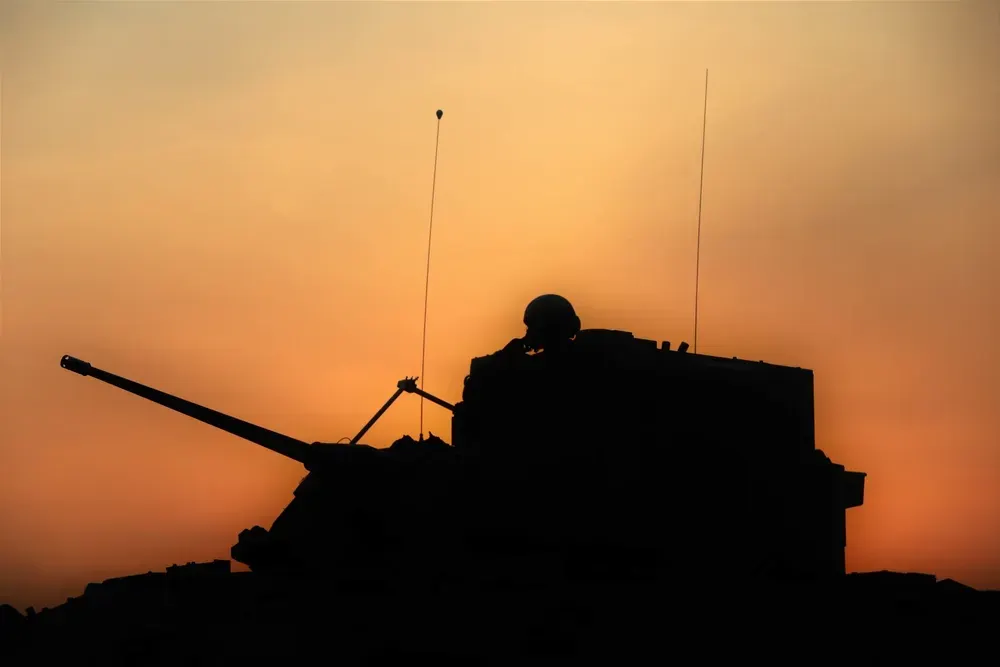
This article is a first-hand response to the article reported on this week by The Wall Street Journal under the headline "U.S. and Ukrainian Forces Went Head-to-Head in an Exercise. Ukraine's Drones Won."
The Army officer worked directly with the brigade's unmanned aerial systems throughout the rotation. What follows is his account, published with his permission and lightly edited for length and clarity. Atlas News is withholding his name to protect operational security.
The views below are his own and do not represent an official position of the U.S. Army or the Department of War.
Media reports claiming U.S. armored units were easily defeated by Ukrainian drone operators during the exercise Combined Resolve are missing a huge portion of the operational context. Combined Resolve is a recurring U.S. Army Europe exercise held at the Joint Multinational Readiness Center, or JMRC, in Hohenfels, Germany, where American brigades rotate through realistic combat scenarios against a dedicated opposing force before deploying. This particular rotation paired the 3rd Armored Brigade Combat Team, 1st Cavalry Division, against Ukrainian drone operators from the 412th Regiment of Unmanned Systems Forces, known by their call sign "Nemesis," who were brought in specifically because of their combat experience against Russia.
Evaluating exercise kill rates in a vacuum ignores the artificial constraints imposed by JMRC. These constraints include compressed maneuver space, peacetime spectrum restrictions, and asymmetric airspace rules. Far from revealing a systemic vulnerability, the exercise highlighted the lethality of organic U.S. drone assets and demonstrated U.S.-Ukrainian coalition integration across the entire second half of the training exercise.
Defeat Due to Constraints, Not Force-on-Force
Ukraine's ability to disrupt logistics nodes and strike deep in enemy territory is real, but this specific scenario fails to paint the entire picture. Combat training centers are designed to stress test formations under degraded conditions, not to display a Joint Force's full, unhindered kill chain capability. At Combined Resolve, 3rd ABCT was restricted to a tight operational "box" that offered little opportunity for real armored maneuver.
The JMRC training area is roughly 14 by 27 kilometers, known to everyone who rotates through it as "the Box." Cramming an armor-heavy brigade combat team into that space forces tracked vehicles down predictable, canalized movement corridors. In real combat, an armored brigade could use hundreds of square kilometers to disperse, leverage terrain masking, and call in long-range fires to suppress, disrupt, or neutralize drone team observation posts, or OPs, before they mass sensors on a target. Inside the Hohenfels box, the 412th Regiment, serving as OPFOR (military shorthand for "opposing force," the role played by a dedicated unit that simulates the enemy during training), didn't need wide-reaching reconnaissance. They just had to watch known chokepoints in the terrain.
Compounding this was the exercise's administrative design. Units were continuously respawned to maximize training repetitions for the troops, creating an artificial target-rich environment. Troops don't get training sitting on the sidelines, so they get put back in the game when training objectives call for it. Therefore, it is very possible to "kill" the same piece of armor two to three times per day, depending on the scenario. A kill count generated by a range designed to recycle "destroyed" vehicles back into the fight is not the same thing as a kill count from an actual battlefield, and treating the two as equivalent overstates what the exercise actually showed.
Asymmetric Guardrails and Spectrum Realities
The WSJ report has also overlooked the legal and safety guardrails that hamstrung U.S. combat power.
Airspace Restrictions: Range safety protocols dictated strict flight boundaries. OPFOR drones were permitted to operate within and transit specific restricted airspace zones that U.S. operators were prohibited from entering. This allowed OPFOR to hide launch points and approach vectors behind safety buffers U.S. forces couldn't legally cross or target.
Electronic Warfare Constraints: U.S. forces were also bound by European telecommunications laws restricting high-powered, broad-spectrum jamming to protect critical Command and Control, or C2, nodes, the communications infrastructure that keeps a unit's leadership connected to its troops in the field. Barred from the full electronic warfare, or EW, capabilities that would have let them jam or sever drone control links, U.S. forces remained exposed to small unmanned aircraft systems relying on GPS data. Fiber-optic drones, which fly on a physical control line and are immune to jamming, were not present in the training area.
The Lethality of U.S. sUAS
The narrative fixates on armor vulnerabilities while ignoring what U.S. drone teams accomplished during the training. Small unmanned aircraft systems, or sUAS, are the compact, often quadcopter-style drones that individual units now use for their own reconnaissance and strikes, distinct from the larger, higher-altitude platforms most people picture when they hear "military drone." Even with airspace limitations, 3rd ABCT's sUAS operators executed effective strike and reconnaissance missions several times over. U.S. crews identified and destroyed OPFOR heavy armor, command and logistics nodes, and dismounted elements. The ability to deploy organic sUAS to sense, strike, and destroy enemy assets, without assistance from foreign militaries, demonstrates just how quickly the U.S. is adapting to the evolving battlefield. American troops also adapted their maneuver tactics, refining concealment and dispersion where the terrain allowed, to shrink their visual footprints.
The Real Takeaway: Coalition Interoperability
The most important operational development occurred on Day 5, when the Ukrainian 412th Regiment flipped from OPFOR to the "Blue" coalition force for the remainder of the rotation. Over the final hours of training, U.S. and Ukrainian operators integrated their drone networks, shared real-time intelligence, surveillance, and reconnaissance, and coordinated joint fires. The Ukrainians brought real battlefield adaptations directly into the airspace, while U.S. leaders integrated those capabilities into large-scale armored maneuver.
Conclusion
Framing Combined Resolve as a failure of U.S. armor fundamentally misunderstands training design. The 3rd ABCT was forced to fight in a tight box, stripped of Joint Force fires, bound by peacetime spectrum laws, and restricted by administrative safety rules. Despite those handicaps, U.S. forces produced heavy casualties with organic drones, adapted within mere hours, and spent the second half of the exercise executing operations alongside battle-hardened partners. The key takeaway isn't the obsolescence of heavy armor; it's the power of U.S.-allied integration.
Why We're Running This
Atlas News interviewed a soldier who served with the 3rd Armored Brigade Combat Team during Combined Resolve. We are publishing his account because a kill count stripped of the rules that shaped it makes for a clean headline and an incomplete lesson.
The U.S. defense industrial base is in the middle of a genuine reckoning with cheap, attritable drone warfare, and stories about who "won" a training rotation will keep shaping that debate whether or not they capture the full picture. We'll keep publishing firsthand accounts like this one whenever service members are willing to put their experience on the record, because the people who were actually in the box see things a wire story doesn't have room for.
Author

Stanford Nix is COO of Atlas, leading operations & government relations. When not running Atlas he writes on economics, grand strategy, and U.S. politics. Separately, he invests across the U.S. defense industrial base and holds an MBA in finance.
Sign up for Atlas newsletters.
Stay up to date with curated collection of our top stories.