Albertans voted by a wide margin to remain in Canada in Monday’s 10-question provincial referendum, rejecting a proposal to start the legal process toward a future vote on independence, according to unofficial results from Elections Alberta.
As of 7:14 a.m. CT Tuesday, Elections Alberta’s results site showed 1,355,095 votes for “Alberta should remain a province in Canada” and 430,068 for starting the process toward a binding separation referendum, with 4,321 of 5,586 voting areas and locations reporting. That count includes election-day votes as well as advance, mobile and special-ballot votes. The Associated Press, citing the same unofficial count with more than 1.5 million votes tallied, put the split at 76% to remain and close to 24% for the separation process.
The results are not final. Elections Alberta said in an Oct. 19 release that counts are “subject to robust verification processes” and that official results will be published Oct. 29.
A vote watched in Washington
The AP described the result as a boost to Prime Minister Mark Carney’s push for national unity “amid U.S. President Donald Trump’s trade war and annexation threats.” The wire service reported that Trump’s tariffs and his threats to make Canada the 51st U.S. state helped Carney rally support in Alberta, where Liberal prime ministers have historically been unpopular.
Separatists had courted Washington. Reuters reported on Feb. 12 that Alberta separatists met with State Department officials as their petition drive ramped up.
Energy links the province to the United States. Alberta produces more than 4 million barrels of oil a day and ships the bulk of it to U.S. refineries, Bloomberg News reported, making energy Canada’s largest category of exports.
On Oct. 1, Carney designated Pacific Link, a proposed 1 million-barrel-a-day pipeline from Alberta to the British Columbia coast, as the first project of national interest under the Building Canada Act, BNN Bloomberg reported. “Today, 90 per cent of Alberta’s oil goes to the U.S.,” Carney said then. “Pacific Link will materially reduce that dependence.”
What voters were asked
The ballot’s 10th question read: “Should Alberta remain a province of Canada, or should the Government of Alberta commence the legal process required under the Canadian Constitution to hold a binding provincial referendum on whether or not Alberta should separate from Canada?”
It was not a direct vote on independence. The AP reported that approval would only have set Alberta on a path toward a second vote. Nine other questions shared the ballot.
Any eventual secession vote would also run into federal law. Under Section 1 of Canada’s Clarity Act, S.C. 2000, c. 26, the House of Commons must decide whether a provincial secession question is clear. Section 2 requires it to decide whether a clear majority has expressed a will to secede, and bars Ottawa from negotiating unless it finds one.
Premier Danielle Smith called the referendum in May after the petition drive, Bloomberg reported. She pledged that a simple majority would decide the question and that there would be no follow-up referendum during her United Conservative Party government’s mandate, the National Post reported, and she said she voted to remain, according to Global News.
How it got on the ballot
The vote grew out of a citizen petition under Alberta’s Citizen Initiative Act. The petition, filed by proponent Mitch Sylvestre, was issued by Elections Alberta on Jan. 2. It asked a different question: “Do you agree that the Province of Alberta should cease to be a part of Canada to become an independent state?”
Canvassers had from Jan. 3 to May 2 to gather 177,732 signatures, a threshold Elections Alberta set at 10% of the votes cast in the 2023 provincial election.
Elections Alberta later said 279,337 signatures were counted as valid and that random statistical sampling found 222,597 verified signatures, CBC News reported. Further steps were put on hold pending an appeal after a lower court quashed the petition’s approval, Elections Alberta said.
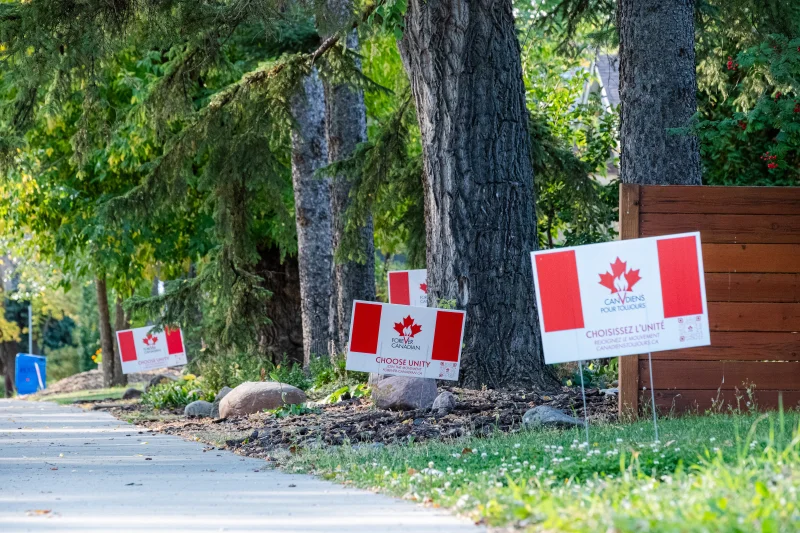
A rival petition led by former deputy premier Thomas Lukaszuk’s Forever Canadian movement collected more than 400,000 signatures in favor of staying in Canada, Global News reported.
Both sides react
“Albertans made a clear choice,” Carney said, according to the AP. “They chose unity, to build together, and to take care of each other. Above all, Albertans chose Canada.”
Smith wrote on social media: “I’m very pleased to see the initial results from Elections Alberta show widespread support for remaining in Canada. Albertans have voted for a stronger Alberta in a united Canada.”
Lukaszuk told Global News the result was “a message to the United States saying, ‘back off, you can’t break up Canada.’”
Separatist leaders said their cause would continue. “We don’t have the final results. I think the numbers are going to fluctuate, but it is fair to say that at least a quarter of Albertans feel that Alberta needs to be treated better,” Keith Wilson, a leader of the separatist movement, told the AP.
Jeffrey Rath, a co-founder of the Alberta Prosperity Project, told Global News, “Our movement isn’t going anywhere.”
What comes next
Elections Alberta said in its Oct. 19 release that 837,791 votes were cast during five days of in-person advance voting and 519,082 by special ballot, and it put advance and special ballot turnout at 43.1%. The release did not specify the denominator for that figure or give an overall turnout figure.
Smith is scheduled to address the province Tuesday at 6:45 p.m. Mountain time, or 7:45 p.m. CT, the National Post and Global News reported.
Author

We cover the world’s chaos so you don’t have to scroll twelve feeds to understand it.
Sign up for Atlas newsletters.
Stay up to date with curated collection of our top stories.