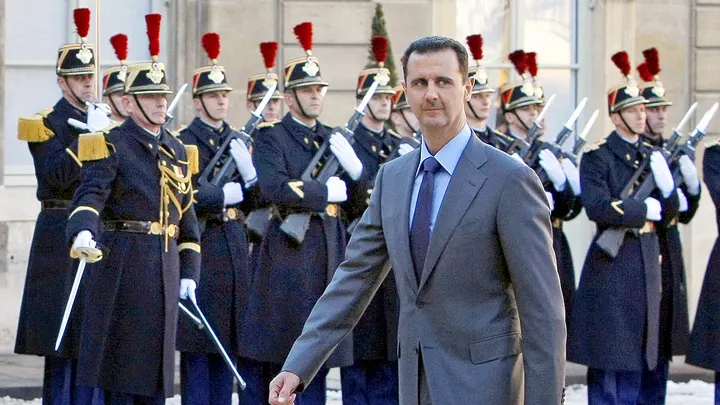
A Damascus court sentenced ousted President Bashar Assad to death Tuesday after convicting him in absentia of war crimes and crimes against humanity, the first ruling against the former ruler or his inner circle since his family's five-decade grip on Syria ended 20 months ago.
Judge Fakhr al-Din al-Aryan, presiding over the Fourth Criminal Court in a session aired live on state television, found Assad guilty of "premeditated murder, the intentional killing of more than one person, the intentional killing of children under 15 years... torture, torture leading to death, and deprivation of liberty on multiple occasions — classified as crimes against humanity and war crimes."
"He is therefore sentenced to death," the judge said. Witness testimony, al-Aryan added, established Assad's role as "the highest decision-maker" who "used state agencies to commit war crimes and crimes against humanity."
The court handed the same sentence in absentia to Assad's younger brother Maher, former commander of the army's 4th Armored Division, which opposition activists have accused of killings, torture, extortion, drug trafficking, and running its own detention centers. Six other former military and security officials who fled Syria were also sentenced to death in absentia, including former Defense Minister Fahd al-Freij and Louay al-Ali, who headed military intelligence in Daraa province in 2011.
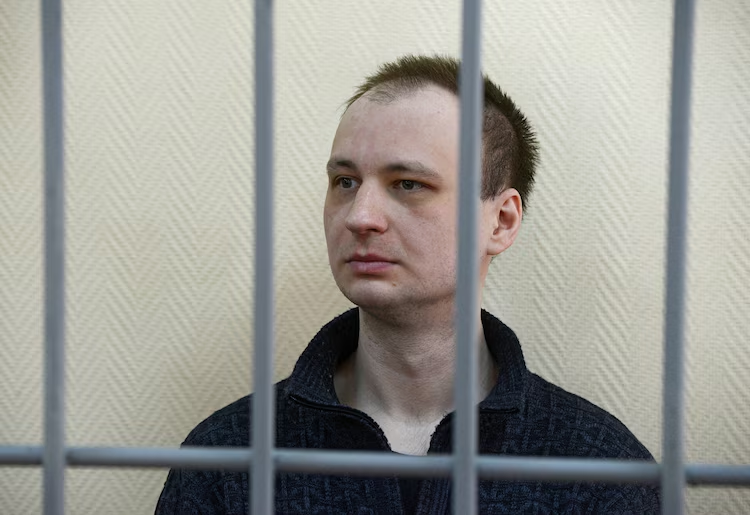
The verdicts are largely symbolic for now. Assad and Maher fled to Moscow as rebel forces closed in on Damascus in December 2024 and were granted asylum. But one defendant stood in the courtroom: Atef Najib, Assad's maternal cousin and the former head of political security in Daraa, wore a prisoner's uniform inside a cage as the judge read his death sentence. Al-Aryan said Najib denied the charges and showed "no remorse."
The Man Who Lit the Fuse
Najib, a former army brigadier general arrested in January 2025 and among the highest-ranking officials to face trial, occupies a particular place in the war's history. Under his tenure in Daraa in 2011, more than a dozen teenagers were arrested and tortured for scrawling anti-government graffiti on a school wall — the case that catalyzed mass protests against Assad's security state. The demonstrations were met with live fire, including the deadly dispersal of a sit-in at the city's Al-Omari mosque, and spiraled into a civil war that killed roughly half a million people, displaced millions, and disappeared tens of thousands into the prison system. The US Treasury sanctioned Najib in April 2011 for his role in the crackdown.
Some of his victims watched the sentencing. "Today we reached a point where the blood was not wasted," said Mouawiya Sayasneh, who was among the teenagers arrested in 2011. Nayef Abazeid, detained at 13, said his "biggest happiness will be when Bashar Assad is executed."
Outside the heavily guarded Palace of Justice, dozens gathered, many from Daraa, holding photographs of the dead, the disappeared, and the imprisoned. "Thank God and thanks to the judiciary, today we have obtained a judgement that has warmed our hearts," said Ramzi Abu Naboud, carrying a picture of his brother, killed in the 2011 mosque crackdown. "Today is the day of justice for all the wounded, martyrs, detainees and Syrians who were forced to leave their country," said Adnan al-Masalmeh, an attorney for victims' families.
Justice Minister Mazhar al-Wais said the rulings will be referred to Syria's court of cassation for a final decision, and defendants have 30 days to appeal. The court heard witnesses and reviewed documents, images, and at times classified material across sessions held since late April — public proceedings that contrast with the secret trials of the Assad era.
Praise for the Milestone, Alarm Over the Process
Syria's national commission for transitional justice called the ruling against Najib "an important milestone in the process of accountability." Rights organizations were more guarded. Human Rights Watch, which attended several hearings, called the proceedings "a test of Syrian authorities' efforts to pursue credible justice for Assad-era abuses" and restated its opposition to capital punishment. "It's cruel and irreversible, especially when a fair trial isn't guaranteed," said Hiba Zayadin, the group's Syria researcher, adding that Najib's appeal "needs to meet fair trial standards."
The Washington-based Syria Justice and Accountability Center, whose monitors attended the trial, called the conviction a "historical step" while documenting rushed proceedings, witness testimony that did not connect Najib to the crimes charged, and a defense lawyer who "lacked the capacity and willingness to meaningfully engage with the case."
A spokesman for UN Secretary-General Antonio Guterres said addressing demands for justice "can contribute to restoring confidence in institutions... and sustainable peace," while noting the General Assembly's opposition to the death penalty and urging a "victim-centred transitional justice process."
Nanar Hawach, Syria analyst at the International Crisis Group, argued real transitional justice must be "wider" — covering every armed faction of the war, not one — and "deeper." Families "need the truth about the missing," he said, and convicted men "can still provide it, where the graves are and who gave the orders, which makes them worth more to justice alive than executed."
The Extradition Question Runs Through Moscow
The sentence gives Damascus a fresh legal instrument in its long-shot campaign to retrieve Assad. A 2022 extradition treaty between Russia and Syria, signed during Assad's own rule, commits each country to hand over the other's criminals, and President Ahmed al-Sharaa personally raised extradition with Vladimir Putin during a visit to Russia last year. Moscow declined, and most analysts see virtually no chance it reverses course: abandoning a sheltered ex-ally would undercut the protection Putin implicitly offers other embattled partners.
What is striking is how little the issue has disrupted the two countries' rapprochement. On Sunday — two days before the verdict — Russia and Syria signed a memorandum settling the future of Moscow's Mediterranean footholds, with Russia turning over the civilian portions of its Tartus naval base and Khmeimim air base to Syrian control and the facilities converting to joint training centers, effective in three months. Russia retains considerable leverage over the rebuilding country, including a roughly $1.2 billion inherited debt, wheat and energy exports, spare parts and maintenance for Syria's Soviet-legacy arsenal, and its UN Security Council veto.
Officials in Damascus have had more success closer to home. Lebanon recently detained an Assad-era general and is weighing his handover, and the government has pressed countries where wanted former officials are hiding or held to return them. For the man at the top of the indictment, though, the verdict changes his legal status without changing his address — and Syrians who filled the courthouse square Tuesday made clear which of the two they are still waiting on.
Author

We cover the world’s chaos so you don’t have to scroll twelve feeds to understand it.
Sign up for Atlas newsletters.
Stay up to date with curated collection of our top stories.