D.R.C. Sentenced Former President To Death For Organizing An Insurrection. Two Weeks Later He Launched One.
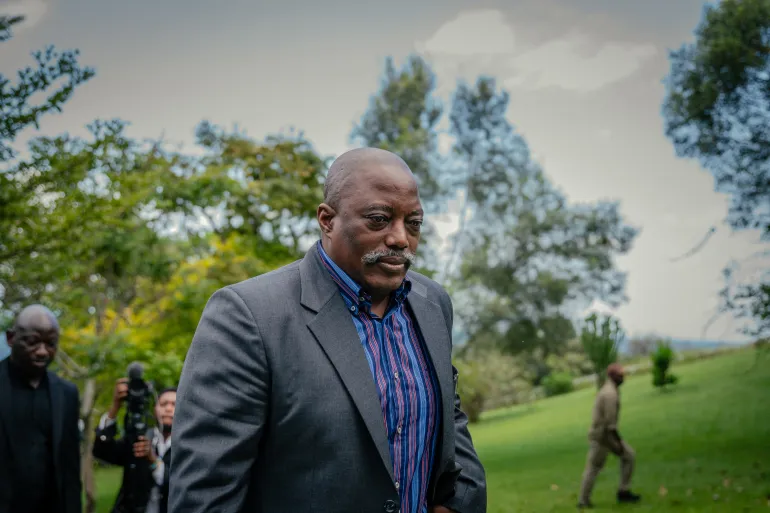
Joseph Kabila, a former president of the Democratic Republic of the Congo, on Monday, Oct. 12, became president of a new political-military coalition that includes the M23 rebels. He took the post in Goma, the eastern city the rebels seized in January 2025 and have held since.
On Sept. 30, 2025, the High Military Court in Kinshasa sentenced him to death in absentia for war crimes, including murder, rape and torture, as well as treason and organizing an insurrectional movement, according to the verdict as reported by Congolese media. It also gave him 15 years for conspiracy. Kabila has denied wrongdoing and called the judiciary politicized.
A sanctioned leader and two peace tracks
The Treasury Department’s Office of Foreign Assets Control designated Kabila on April 30, 2026. Treasury said he had “materially assisted, sponsored, or provided financial, material, or technological support for, or goods or services in support of” M23 and the Congo River Alliance, its political-military coalition.
Announcing the sanctions, State Department spokesperson Tommy Pigott said the action “sends a clear message: we will hold accountable anyone who obstructs peace efforts in the DRC.” He tied it to the “Washington Accords for Peace and Prosperity and Doha Framework.”
Congo and Rwanda signed a U.S.-brokered peace agreement in Washington on June 27, 2025. Kinshasa and the rebels signed the Doha Framework for a Comprehensive Peace Agreement in Qatar on Nov. 15, 2025. Their most recent announced round was held Aug. 17-21 in Switzerland, with Qatar and the United States taking part, according to a joint statement published by Qatar’s Foreign Ministry.
No date for the next round has been announced. Al Jazeera reported on Oct. 13 that the two sides were expected to meet in Qatar in November, and on Oct. 14 that they “were meant to meet this month.”
On Oct. 9, three days before the launch, Kabila issued an address warning that the country was “in peril.” He said the government mistakenly believed its critical-minerals deal with the United States guaranteed American political support. “The rights and obligations of the parties under such agreements are guaranteed by the principle of the continuity of the state, not by the permanence of the regime in power,” he said, as quoted by the Rwandan outlet KT Press.
What was announced in Goma
The coalition calls itself the Front pour la Refondation de la Nation, or Front for the Refoundation of the Nation (FRN). Claude Ibalanky, an adviser to the coalition, announced its leadership late Monday at a news conference at Kabila’s Goma residence.
Ibalanky said the front aims to “unite and coordinate all resistance forces in order to put an end to tyranny - by any means necessary, including the use of force.”
Corneille Nangaa, the former Congo River Alliance coordinator, and Bertrand Bisimwa, the M23’s political leader, were named vice presidents. Sultani Makenga, the M23’s military commander, becomes chief of the general staff with the rank of vice president. Freddy Kaniki was named secretary-general, with Benjamin Mbonimpa as his deputy.
What it does to Doha
The founding declaration names the FRN as successor to the Congo River Alliance and declares the alliance dissolved. It does not expressly settle the status of M23, law professor Roger-Claude Liwanga told the Congolese outlet Congo Quotidien. That matters because the Doha Framework names “AFC/M23” as the non-governmental party, he noted. He urged Qatar to seek written clarification.
Bram Verelst of the Institute for Security Studies told Al Jazeera that Rwanda would likely stay with the U.S.-led track, and that the real threat lies with the Doha process. “We are likely to see a hardening of Kinshasa’s position toward the rebel movement and Kabila,” he said.
Kinshasa answers
After the Oct. 9 address, government spokesman Patrick Muyaya wrote on X that Kabila was “a man of the past” with “nothing to offer but chaos.”
On Oct. 13, Economy Minister Daniel Mukoko Samba accused Kabila of betraying Congo, invoking an oath associated with his father, Laurent-Désiré Kabila, “never to betray the Congo.”
On Oct. 14, Vital Kamerhe, who resigned as speaker of the National Assembly in September 2025, said, “One cannot propose peace to our people while resorting to arms,” according to the Ugandan site ChimpReports.
On Oct. 12, the High Council for Audiovisual and Communication (CSAC) imposed a 60-day nationwide media ban on journalist Paulette Kimuntu Ndombe. The regulator cited her remark in a viral video that Kabila is not a rebel but is concerned for a Congo in danger. It said her comments amounted to an apology for war in the east.
Cracks in Kabila’s party
Kabila, 55, took power in 2001 after his father’s assassination and handed over to Félix Tshisekedi in January 2019 after a disputed election. The two later fell out, and Kabila went into self-imposed exile in 2023.
Since the launch, members of his People’s Party for Reconstruction and Democracy (PPRD) have quit or distanced themselves. Patrick Nkanga Bekonda, rapporteur of its political bureau, resigned after 20 years. Allegra Fosh Ngalula, a vice president of the party’s youth league, left with immediate effect.
Rwanda and the rebels
U.S. officials and United Nations experts have said Rwanda backs M23. Treasury’s April release called it “a Rwanda-backed armed group.” Kigali has consistently denied supporting the rebels.
In a report this summer, the U.N. Group of Experts said AFC/M23 was planning a leadership and structural reshuffle, including a new name, with Kabila expected to take a prominent role. The front launched in Goma on Monday is that reshuffle.
Author

We cover the world’s chaos so you don’t have to scroll twelve feeds to understand it.
Sign up for Atlas newsletters.
Stay up to date with curated collection of our top stories.