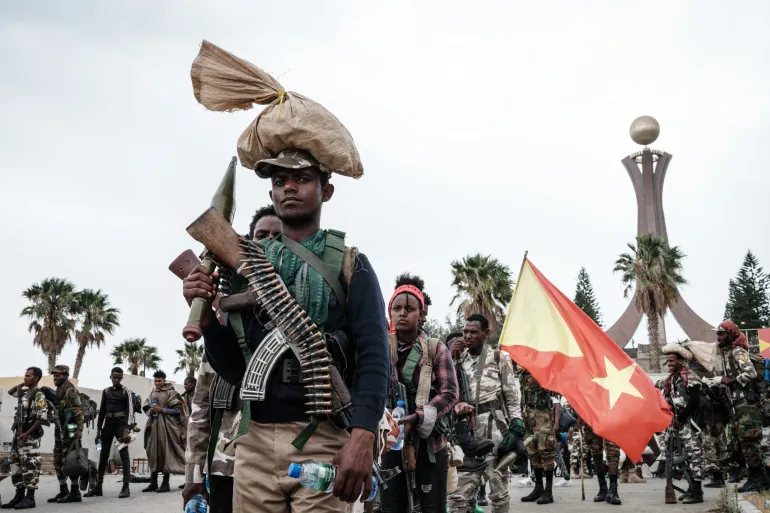
Ethiopia's army chief has accused Sudan and Egypt of backing the rebel coalition fighting federal troops and described Eritrea as allied with the rebels, as Tigrayan forces pushed deeper into Afar, a region that straddles Ethiopia's main trade routes to Djibouti.
Field Marshal Birhanu Jula, chief of general staff of the Ethiopian National Defense Force, spoke in an interview broadcast Friday by army media and widely reported over the weekend.
"We are fighting forces that are organized and allied to serve the interests of external forces," he said. "Neither Shaebia (Eritrea) nor the TPLF can achieve anything alone, even if they are allied, unless they are backed, supported and supplied by Sudan, Egypt and other external powers."
Asmara has repeatedly denied supporting the rebels. Sudan's army rejected the charge late Sunday, and Egypt has made no official comment.
A humanitarian source said the Afar town of Erebti fell to Tigray People's Liberation Front fighters on Sunday after heavy artillery fire, and that the rebels were advancing on Afdera, about 100 kilometers (60 miles) to the east.
The fighting, which erupted Wednesday, has raised fears of a return to the 2020-2022 war. That conflict killed about 600,000 people, according to African Union envoy Olusegun Obasanjo, an estimate a Ghent University researcher said might be roughly correct. It ended with an African Union-brokered cessation of hostilities signed in Pretoria on Nov. 2, 2022.
Rebels aim at Ethiopia's main trade corridor
Erebti and Afdera lie in Kilbati Rasu, Afar's northern administrative Zone 2. Mohamed Hussein, head of the ruling party in Afar, told Al Jazeera on Sunday that Tigrayan forces had entered Zones 2 and 4 and seized three towns, which he did not name. Tigrayan forces took the airports at Mekelle, Axum and Shire on Sept. 23, and Ethiopian Airlines suspended flights to all three, according to the U.N. human rights office.
The humanitarian source estimated that at least 150,000 people have been displaced in Afar. None of the battlefield claims could be independently verified.
The TPLF's offensive in Afar aims to cut Ethiopia's supplies from Djibouti, including fuel. More than 95% of Ethiopia's import-export trade by volume uses the Addis Ababa-Djibouti corridor, according to the World Bank.
The main northern road runs through Afar via Mille and Semera to the Galafi border crossing, while a separate road and railway run farther south via Dire Dawa. Afdera lies well north of both, and the corridor remains open.
Jalale Getachew Birru, senior East Africa analyst at the conflict monitor ACLED, said the rebel push into Afar could threaten the Semera-Djibouti route. "Control of this route could give the TPLF significant leverage over the federal government by threatening Ethiopia's main trade corridor to the port of Djibouti," Jalale said.
The rebels also appear to be repeating their last-war strategy of pushing south through Amhara toward Addis Ababa. In late 2021, Tigrayan forces were halted in the mountains around Debre Sina, about 200 kilometers (124 miles) from the capital, and failed that November to capture Mille.
The TPLF calls its campaign a "defensive war." Its vice president, Amanuel Assefa, said Thursday: "We are in the situation of full-blown war now."
Sudan rejects the charge and points to the RSF
In a statement read by army spokesperson Asim Awad Abdelwahab, the Sudanese military said: "The Sudanese Armed Forces categorically reject these allegations and consider them baseless."
The army said its paramilitary foe, the Rapid Support Forces, continues to receive support from Ethiopian territory, including training, supplies and the use of that territory for operations involving strategic and suicide drones.
Khartoum has repeatedly accused Ethiopia of allowing drone attacks to be launched from its soil in coordination with the United Arab Emirates, which both governments deny. In May, Ethiopia accused the Sudanese army of backing TPLF-linked "mercenaries," a charge Khartoum rejected.
Egypt stays officially silent
An unnamed Egyptian source told the Saudi-owned newspaper Asharq Al-Awsat that the allegations did not merit a response and that Cairo maintains a strict policy of non-interference in other countries' affairs.
The accusation follows a fresh exchange over the Grand Ethiopian Renaissance Dam on the Blue Nile. Egyptian Water Resources Minister Hani Sewilam said last week that building a dam on a shared river was "not like laying a carpet in their homes." Ethiopia's Water and Energy Ministry replied that his remarks reflected a "crude colonial mentality."
Egypt, which relies on the Nile for more than 90% of its freshwater, wants a legally binding agreement on the dam's operation.
A broadcaster hit and the phones cut
A drone struck the Mekelle headquarters of Tigrai TV, the main outlet of the Tigrayan authorities, at about 9 a.m. Sunday, blowing out windows and knocking the station off air. No casualties were immediately reported. Addis Ababa had suspended the broadcaster "indefinitely" six days earlier, on Sept. 21.
Phone and internet services in Tigray have been severely disrupted since Friday. Four sources told Reuters the TPLF ordered Ethio Telecom and Safaricom to cut access. A source close to the group denied that and blamed the government.
Many in Tigray fear a repeat of the wartime blockade, when electricity, banking and almost all aid were cut off.
"All parties must urgently de-escalate tensions and avoid a return to full-scale war," U.N. High Commissioner for Human Rights Volker Türk said in a Sept. 25 statement.
Author

We cover the world’s chaos so you don’t have to scroll twelve feeds to understand it.
Sign up for Atlas newsletters.
Stay up to date with curated collection of our top stories.