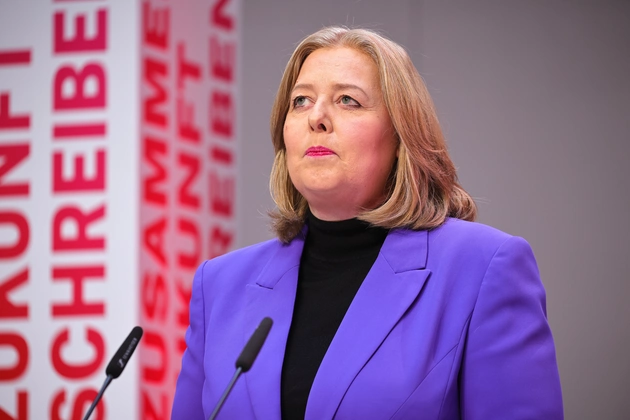
Bärbel Bas, Germany’s federal labor minister and co-leader of the Social Democratic Party (SPD), resigned both posts on Monday, Oct. 12. Her exit adds new strain to Chancellor Friedrich Merz’s governing coalition while the far-right Alternative for Germany (AfD) leads national polls.
Bas announced the decision shortly before 8 a.m. Berlin time Monday, in a statement to party members posted on Instagram.
Two reasons, one pointed line
Bas gave two reasons. The first was personal. “Following the death of my stepdaughter, I realized that I need time to come to terms with my grief,” she wrote. Her stepdaughter died in late September, according to German media reports.
The second was political. She cited “the public attacks against me, unfortunately also from the ranks of the coalition partner,” which she said had intensified during a personally difficult time. The SPD governs with Merz’s conservative Christian Democratic Union (CDU) and its Bavarian sister party, the Christian Social Union (CSU).
“As I currently do not have the strength to carry out my government and party duties in full, I have decided to give up both offices,” she wrote. She said she had informed her co-leader, Vice Chancellor and Finance Minister Lars Klingbeil, and had asked Merz to dismiss her from the cabinet.
She will keep her seat in the Bundestag, where she represents a constituency in Duisburg.
Pension fight behind the pressure
The criticism Bas referred to had built for weeks over overdue legislation. A government commission presented proposals to overhaul Germany’s statutory pension system before the July summer recess. The coalition partners wanted them turned quickly into law, but no finalized draft bills have been presented.
In September, Christian von Stetten, who heads the CDU/CSU parliamentary group’s caucus for small and midsize businesses, said of Bas: “The minister is no longer tenable. For months, she has been blocking the reforms our country so urgently needs.”
In early October, CDU Economy Minister Katherina Reiche demanded that the pension reform pass by the end of the year and said Bas had to submit the bill promptly.
On Monday, Gordon Schnieder, the CDU premier of Rhineland-Palatinate, pushed back on criticism of how Bas had been treated. He told the broadcaster Welt TV that when agreements are not kept and draft bills are not presented, it must be possible to ask why.
Klingbeil called the attacks on Bas “disgraceful.” Speaking to reporters in Berlin after an SPD leadership meeting, he said, “This poisons the political discourse.” He urged centrist politicians to be careful “that we don’t destroy the good people in politics by attacking one another.”
Merz pushes for speed
Merz thanked Bas for her work and for what he called her service to the country. He also rejected her accusations, saying he had never discussed personal matters with her and had explicitly advised her to take the time she needed to grieve.
He said Monday that “the personnel changes will not call into question the basis of the coalition agreement.” He added: “We need a stable federal government right now in order to remain capable of acting on the international stage.”
He quickly turned to her successor. Merz said Alexander Schweitzer would take over open legislative projects, “which I hope will now be quickly approved by the cabinet and introduced into the parliamentary process.”
Schweitzer, 53, was premier of Rhineland-Palatinate from 2024 to 2026. He lost the March 22 state election to Schnieder’s CDU, 31.0% to 25.9%, and Schnieder took office as premier on May 18, ending 35 years of SPD-led government in the state. Schweitzer is one of the SPD’s deputy national chairs and previously served as the state’s minister of labor and social affairs. Der Spiegel reported his appointment Monday morning, citing party sources. Klingbeil later confirmed it, and Merz proposed him to the president.
He may not deliver the speed Merz wants. Schweitzer has repeatedly opposed ending penalty-free retirement after 45 years of contributions, a change Bas had proposed phasing in. “The SPD must never be an anti-reform party,” he told the Frankfurter Allgemeine Sonntagszeitung. “But the way the chancellor and others are currently justifying the pension reform, that won’t work.”
What happens next
President Frank-Walter Steinmeier’s office said he would hand Schweitzer his certificate of appointment at 5 p.m. Berlin time Tuesday, Oct. 13, or 10 a.m. CT. Schweitzer must still be sworn in before the Bundestag to take up the post formally.
The SPD leadership will be rebuilt more broadly. Klingbeil announced that the party would elect its entire national leadership at a congress in December or January, well ahead of the regular schedule in mid-2027. He said the SPD would keep its dual leadership.
Klingbeil has not said whether he will run again. “This isn’t about me clinging to office,” he told ZDF, adding that there was “as of today, no decision.” State premiers Manuela Schwesig of Mecklenburg-Western Pomerania and Anke Rehlinger of Saarland have been named in German press reports as possible successors to Bas. No candidate has declared.
Coalition under polling pressure
Both governing camps are losing ground. An INSA poll for Bild am Sonntag, published Oct. 11 and conducted Oct. 5–9 among 1,207 eligible voters, put the AfD at 30%, the CDU/CSU at 19% and the SPD at 13%. The AfD hit a record 30.5% earlier this month, in an INSA poll for Bild published Oct. 5. A Forsa poll for RTL and ntv, conducted Sept. 29–Oct. 5, had the AfD at 26%, the CDU/CSU at 19% and the SPD at 14%.
Until the congress elects new leadership, Klingbeil leads the SPD alone.
Author

We cover the world’s chaos so you don’t have to scroll twelve feeds to understand it.
Sign up for Atlas newsletters.
Stay up to date with curated collection of our top stories.