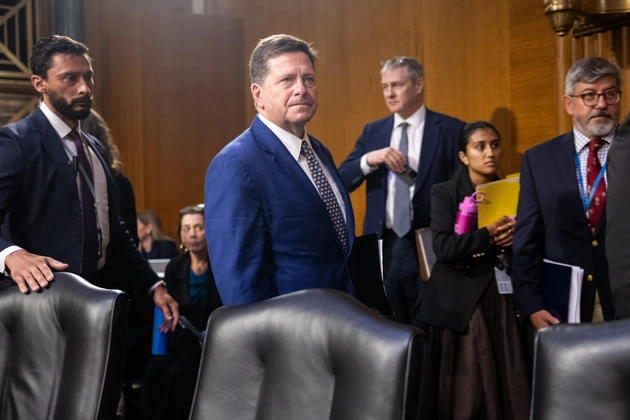
The Senate confirmed Jay Clayton as director of national intelligence Tuesday in a 51-47 party-line vote, installing a permanent leader atop the nation's 18 intelligence agencies and ending the turbulent acting tenure of Bill Pulte, a housing official with no intelligence experience.
Clayton, the US attorney for the Southern District of New York and former chairman of the Securities and Exchange Commission during the first Trump administration, replaces Tulsi Gabbard, who resigned in June to support her husband following his diagnosis with a rare form of bone cancer. Prior to his government service, Clayton was a partner at the law firm Sullivan & Cromwell.
"Jay Clayton is a highly qualified nominee with a deep experience combating a wide range of national security threats," said Senate Intelligence Committee Chairman Tom Cotton, an Arkansas Republican. Senate Majority Leader John Thune argued Clayton's record as Manhattan's top prosecutor and SEC chairman "inspires confidence in the type of DNI that he will be," noting he supervised terrorism prosecutions and the drafting of the drug-trafficking indictment against deposed Venezuelan leader Nicolas Maduro.
President Donald Trump praised Clayton after the vote, writing on social media: "Jay is outstanding in every way, and will do a spectacular job as Director!"
A Nomination Process Full of Curveballs
The confirmation caps a messy process that began after Trump appointed Pulte, the Federal Housing Finance Agency director, as acting DNI on June 2 — a move that angered lawmakers in both parties. Senate Democratic Leader Chuck Schumer described Pulte as "unqualified" with "no experience in intelligence," and Democrats feared he might use classified intelligence to target the president's enemies, as they alleged he had done with confidential mortgage information at his housing post.
In protest, Democrats blocked reauthorization of Section 702 of the Foreign Intelligence Surveillance Act, the warrantless surveillance authority that allows the government to collect intelligence on foreign targets overseas. The program lapsed in mid-June for the first time ever.
Trump nominated Clayton on June 11, writing that few people in the legal community were as respected. Senators Mark Warner and Cotton quickly struck a deal to fast-track the confirmation, which would have prevented Pulte from serving a single day. But Trump abruptly canceled Clayton's scheduled hearing hours before it was set to begin, instructing him not to appear as the president pressed the Senate to pass the SAVE America Act, a voting restrictions bill requiring ID to cast a ballot and proof of citizenship to register. The delay ensured Pulte took over when Gabbard departed.
The Hearing That Cost Him Democratic Votes
Many Democrats initially welcomed Clayton's nomination and signaled support. That changed after his rescheduled confirmation hearing on July 15, when he repeatedly refused to say outright that Joe Biden won the 2020 election. Pressed by Democratic senators, Clayton said Biden had been "certified" as president and that he was "not an election denier." The closest he came was saying Biden "followed our process, had the most electoral votes, was declared the winner."
The answers became a flash point for Democrats concerned about Trump's use of the intelligence community to advance his claims that the 2020 election was rigged. Two days after the hearing, Trump delivered a prime-time address accusing the intelligence community of covering up a Chinese meddling operation in the 2020 vote and directed his spy chiefs to investigate — a probe Clayton may now have to lead.
Democrats also raised concerns over subpoenas Clayton's office issued to several New York Times journalists after their reporting on security concerns involving Trump's Qatari-gifted Air Force One. Clayton told the committee his office followed Justice Department procedures, but the department withdrew the subpoenas on July 23 under pressure from a federal judge.
"He has repeated baseless conspiracy theories about American elections, refused to acknowledge who won the 2020 election and participated in an abusive investigation of American journalists while providing false testimony to Congress about that investigation," said Senator Ron Wyden, an Oregon Democrat.
Warner, the Intelligence Committee's top Democrat who had worked with Clayton during his SEC tenure, said he was "bitterly disappointed" by the hearing. In a statement Tuesday, he said Clayton "now has an opportunity — and the responsibility — to demonstrate that intelligence will never be shaped to fit a political narrative." He added: "Now that he has been confirmed, I sincerely hope he proves those concerns unfounded, because the Intelligence Community deserves steadier leadership than it has received in recent months."
A Downsized Office and Low Morale
Clayton inherits an organization dramatically smaller than the one Trump's second term began with. Hours before the confirmation vote, Pulte announced on X that he was "Executing a 5th and Near Final Round of TERMINATIONS, an approximately 30% Staff Reduction from Weeks Ago." The ODNI has shrunk from around 2,000 people at the start of Trump's second term to fewer than 1,300, though the workforce's precise size is classified.
"The Intelligence Community must protect the American people, NOT the political whims of the bloated and corrupt elite class," Pulte wrote.
Pulte also used his tenure to declassify thousands of documents about alleged foreign interference in the 2020 election, including material released hours before Tuesday's vote describing China's capacity to interfere in the American political process. The substance was largely recycled and already known.
Former senior intelligence officials have said morale at the office is low, citing politicized leadership and the firing of veteran analysts that they fear has discouraged independent analysis that clashes with White House narratives. Clayton, who did not mention Pulte at his hearing, emphasized his own management experience. "I saw firsthand how a strong national security apparatus depends on decisive judgment, discipline, integrity, and effective communication and cooperation across different branches of the government," he said.
What Comes Next for FISA
Republicans hope Clayton's installation will unlock Democratic support to revive Section 702, which has now lapsed for more than six weeks. "I hope this will encourage my colleagues to stop blocking reauthorization of the Foreign Intelligence Surveillance Act," Thune said.
Warner indicated some Democrats would drop their blockade now that Pulte is out, though he said a majority are still expected to oppose reauthorization over underlying policy concerns. Despite the lapse, communication providers have continued cooperating with the government under a separate FISA court certification that does not expire until March.
Timing remains a hurdle. The House is already on a five-week recess and is not scheduled to return until August 31, while the Senate is expected back September 14 — making it all but certain the surveillance program stays dark until at least September.
Clayton takes office at a delicate moment, with the White House under pressure to resolve the Iran war before the November midterms and the intelligence community navigating the president's renewed focus on the 2020 election. He was recommended for the role by CIA Director John Ratcliffe, one of Trump's most trusted national security aides.
Author

We cover the world’s chaos so you don’t have to scroll twelve feeds to understand it.
Sign up for Atlas newsletters.
Stay up to date with curated collection of our top stories.