North Korea Fires Second Ballistic Missile In Six Days As Joint U.S. & South Korea Mil. Drills Draw Near
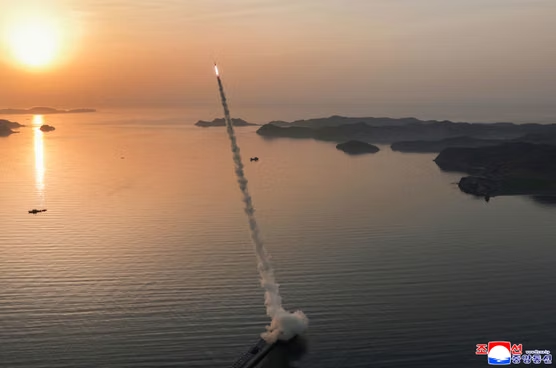
North Korea launched a ballistic missile toward the sea off its east coast early Wednesday, its second test in less than a week and a likely signal of protest days before South Korea and the United States open their largest annual joint military exercise.
South Korea's Joint Chiefs of Staff said the missile was fired from the Wonsan area on the North's eastern coast around 6 a.m. and flew more than 700 kilometers, or about 435 miles, over the body of water known as the East Sea or Sea of Japan. Japan's Defense Ministry also detected the launch and said the weapon fell outside the country's exclusive economic zone, in waters between the Korean Peninsula and Japan.
Seoul and Washington were analyzing the missile's specifications, the Joint Chiefs said. Notably, the military did not classify the weapon as a short-range ballistic missile, as it typically does. Hong Min, a senior researcher at the Korea Institute for National Unification, said the range, trajectory, and launch site suggested it may have been a type of hypersonic missile, though a submarine-launched weapon was also possible. Pyongyang issued no immediate statement.
The launch was North Korea's 11th suspected ballistic missile test of 2026, by South Korean count, and came six days after a short-range ballistic missile was fired from the same area on August 6 — the North's first such activity since late June. Pyongyang never confirmed that earlier launch in state media, a departure from its usual practice, and Hong said the test may have failed to achieve its objective.
Timed to the Drills
The back-to-back launches precede Ulchi Freedom Shield, the 11-day US-South Korean exercise set to run August 17 to 27. The drills, a fixture of the summer calendar, are designed to sharpen the allies' defense against the nuclear-armed North, which denounces them as invasion rehearsals and has staged missile launches before and after them in past years.
"North Korea has never simply let a South Korea-US joint military exercise pass without a response," said Lim Eul-chul, a North Korea expert at Kyungnam University. "This is a message that Pyongyang is closely watching the upcoming drills and could stage a provocation if it deems one necessary."
Hong offered a similar reading with a caveat: the launch was likely part of North Korea's existing weapons development schedule, but the timing was no accident. "Even if it was a test of a weapon under development, choosing when to conduct it requires a political decision," he said.
This year's exercise will involve 18,000 South Korean troops alongside personnel from the 28,500-strong American contingent stationed in the country, and it incorporates responses to newer forms of attack, including drones, GPS jamming, and cyber assaults. Planners are also accounting for a change in the adversary itself: North Korean soldiers returning from deployment alongside Russian forces in Europe. Those troops have "taken those lessons they learned there and brought them back to North Korea," Colonel Ryan Donald, spokesman for the US-South Korean Combined Forces Command, told reporters Monday. "Our training accounts for that threat."
After last year's exercise began, North Korean leader Kim Jong Un said the drills showed the allies' "will to ignite a war" and vowed "proactive and overwhelming" countermeasures. The US and South Korea maintain the training is defensive.
Seoul and Tokyo Respond
South Korea's presidential Office of National Security convened an emergency meeting Wednesday, calling the recent launches "acts of provocation" that violate UN Security Council resolutions and demanding Pyongyang halt them immediately. The military said it remains ready to respond "overwhelmingly" to any provocation under its combined defense posture with the United States. US Indo-Pacific Command said its initial assessment was that the launch posed no immediate threat to American personnel, territory, or allies.
Japanese Defense Minister Shinjiro Koizumi said Tokyo "lodged a strong protest" with North Korea through diplomatic channels at the Japanese Embassy in Beijing. "It's a serious problem that affects the safety of the Japanese people," he told reporters, calling the launch a "threat to peace and security in our region."
The test lands amid an escalating war of words between Pyongyang and Tokyo. On Tuesday, North Korean state media condemned Japan's latest defense white paper as a document aimed at reviving militarism, and last week Kim Yo Jong, the leader's sister, threatened "additional military options" over Japan's expanding strike capabilities following its first Tomahawk cruise missile test. The August 6 launch came shortly after that statement. Japan, which has been raising military spending and deploying missile launchers to its outer islands, is also hardening its home front: Tokyo's governor announced plans last week to convert a 13,000-square-meter underground parking garage near Tokyo Station into a missile shelter. As of April 2025, Japan counted 61,142 shelters nationwide, but fewer than 7% were underground.
The Russia Connection
The launches come as North Korea's weapons are appearing on a European battlefield. Ukrainian President Volodymyr Zelensky said Tuesday that Moscow used North Korean ballistic missiles in an attack that killed workers at a steel plant in the southeastern city of Zaporizhzhia, part of a strike wave that killed 10 across the country. Zelensky has also warned that Russia is receiving more ballistic projectiles and troops from Pyongyang, claiming tens of thousands of North Korean soldiers could ultimately be deployed.
Experts say the arrangement runs in both directions: North Korea has received financial and military benefits from Moscow in return for its support, and its troops have gained experience on a modern battlefield that training grounds cannot replicate — experience US and South Korean commanders now factor into their own planning. Analysts note the war has accelerated Pyongyang's interest in drones, electronic warfare, and cyber operations layered atop its existing missile and artillery forces.
Multiple UN Security Council resolutions ban North Korea from ballistic missile launches, but the country has steadily expanded its testing since Kim's diplomacy with President Donald Trump collapsed in 2019. Experts say Kim likely hopes his enlarged arsenal will eventually wrest concessions from Washington, including sanctions relief. In the meantime, he has deepened ties with both of his major patrons: alongside the Russia relationship, Chinese President Xi Jinping visited Pyongyang in June for the first time in seven years.
With the drills opening Monday and Pyongyang refusing talks with Washington and Seoul for years running, the pattern is familiar — and, by the assessment of most observers, likely to continue through the exercise window and beyond.
Author

We cover the world’s chaos so you don’t have to scroll twelve feeds to understand it.
Sign up for Atlas newsletters.
Stay up to date with curated collection of our top stories.