Prime Minister Mark Carney urged Quebec on Tuesday to put its energy into the economy rather than a possible independence vote. The day before, the separatist Parti Québécois won a provincial election for the first time since 2012, though only with a minority. "This is not a time to wait for something a few years down the road. It's a time to act. It's a time for boldness," Carney told reporters on Parliament Hill.
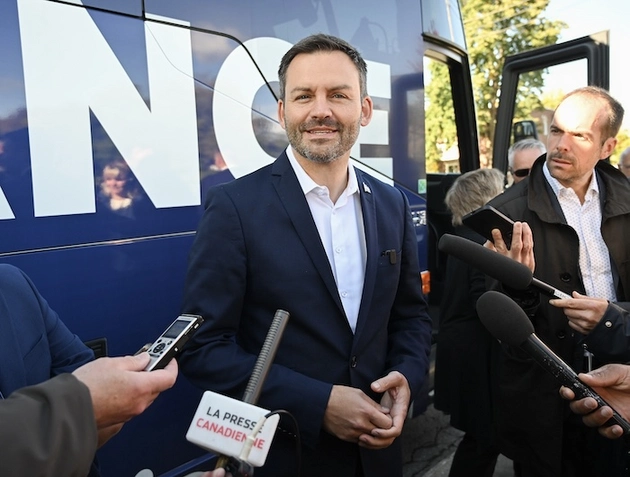
Premier-designate Paul St-Pierre Plamondon told reporters in Quebec City that sovereignty would not be an early priority. "We've got time. We've got plenty of urgent problems to solve," he said.
Also on Tuesday, outgoing Premier Christine Fréchette resigned as leader of the Coalition Avenir Québec, which lost every seat on Monday, including hers in Trois-Rivières. She said the party "must now renew itself."
A narrow mandate
On preliminary figures from the Monday, Oct. 5, vote, the PQ won 59 of the National Assembly's 127 seats, five short of the 64 needed for a majority. The chamber grew from 125 seats for this election. The PQ's share of the popular vote, 28.02 percent, is the lowest for any winning party in Quebec history.
The Quebec Liberal Party won 40 seats and 24.22 percent and will form the official opposition. Éric Duhaime's Conservative Party of Quebec won 19 seats on 20.67 percent, its first seats in a general election. Québec solidaire won nine seats on 12.43 percent.
St-Pierre Plamondon held his Montreal seat, Camille-Laurin. He led the PQ to just three seats in 2022. It then took four straight byelections from the CAQ: Jean-Talon on Oct. 2, 2023; Terrebonne on March 17, 2025; Arthabaska on Aug. 11, 2025; and Chicoutimi on Feb. 23, 2026. That brought the party to seven seats.
In Vachon, south of Montreal, the Liberal lead over the PQ fell from 14 votes to 10 in Tuesday's official tally. That margin lets the PQ candidate seek a judicial recount within four days of the tally. A PQ win there would still leave the party four seats short.
From 90 seats to none
François Legault founded the CAQ in 2011 and led it to 90 seats in 2022. On Jan. 14, 2026, with the party sinking in the polls, he announced he would resign once a successor was chosen. Fréchette, his former economy minister, won the party's first leadership race on April 12, beating Bernard Drainville with about 58 percent of the members' vote. She was sworn in on April 15.
Less than six months later, the CAQ won 13.35 percent and not a single seat. Fréchette was the only party leader to lose her own seat. "The defeat is mine, not yours; keep your head high," she told supporters in Trois-Rivières on election night.
Washington and the referendum clock
On Aug. 18, St-Pierre Plamondon said a PQ government would not hold a vote on independence while President Donald Trump is in office, meaning not before Jan. 20, 2029. He still promises one in his first term and has pointed to 2029 or 2030.
On Saturday, Oct. 3, the State Department said the election was a matter for Quebecers. It declined to say which U.S. officials the PQ had asked in February to meet, weeks after Trump threatened a 100 percent tariff on Canadian goods. St-Pierre Plamondon denied that his party had tried to arrange a meeting, which was ultimately canceled.
The trade war hits Quebec hard. According to an Aug. 26 analysis by Desjardins, nearly 70 percent of the province's merchandise exports go to the United States. Tariffs announced in August covered about 8 billion Canadian dollars more of those exports.
Little appetite for another vote
Under PQ governments, Quebecers rejected sovereignty on May 20, 1980, with 40.44 percent voting yes, and on Oct. 30, 1995, with 49.42 percent. Support is now near historic lows. The Qc125 polling average, updated Oct. 4, had "yes" at 31 percent and "no" at 69 percent.
In his victory speech, St-Pierre Plamondon called independence a "question of survival" for French speakers, who make up a small fraction of North America's population. "We deserve it just as much as any other people who possess their own country and democracy," he said.
He also said Quebecers "have decided to elect the Parti Québécois while also asking it to work with the other parties. I fully understand this message." He pledged to "ensure the budget reflects elements of the other parties' election platforms." Switching to English, he spoke to English-speaking Quebecers: "I just want to let you know very clearly that I'll be the premier of everyone in Quebec."
To call a referendum, he would need a majority in the legislature. The PQ and Québec solidaire together hold 68 seats, enough to clear the 64-seat threshold, which is why Québec solidaire's position decides whether a vote is possible at all. Co-spokesperson Ruba Ghazal did not commit either way. "Anything is possible," she said.
The Liberals rule out backing one. "We will oppose any move to hold a referendum during this term. Quebecers do not want one," said Liberal leader Charles Milliard, who was acclaimed leader on Feb. 13 after Pablo Rodriguez stepped down in December. He did not rule out triggering an election to stop one. Minority governments in Quebec have typically lasted less than two years.
Ottawa responds
Carney spoke with St-Pierre Plamondon on Tuesday, and the premier-designate called the conversation "perfectly respectful and constructive." In a post after the results, Carney wrote, "Building a stronger Québec is core to our mission of building a stronger Canada." Asked whether 28 percent amounted to a mandate, Carney noted that 43 percent of Quebecers had voted for his Liberals in last year's federal election.
"A mandate for separation needs to go through a referendum, so yesterday was an election, not a referendum," said Joël Lightbound, Carney's Quebec lieutenant.
Results remain preliminary. Élections Québec confirms them after the official tallies and any judicial recounts, including the one the PQ may seek in Vachon.
Ottawa faces a second test in two weeks. On Oct. 19, Albertans vote in a non-binding referendum on whether their province should remain in Canada or whether its government should begin the legal process under the Constitution toward a binding vote on separation.
Author

We cover the world’s chaos so you don’t have to scroll twelve feeds to understand it.
Sign up for Atlas newsletters.
Stay up to date with curated collection of our top stories.