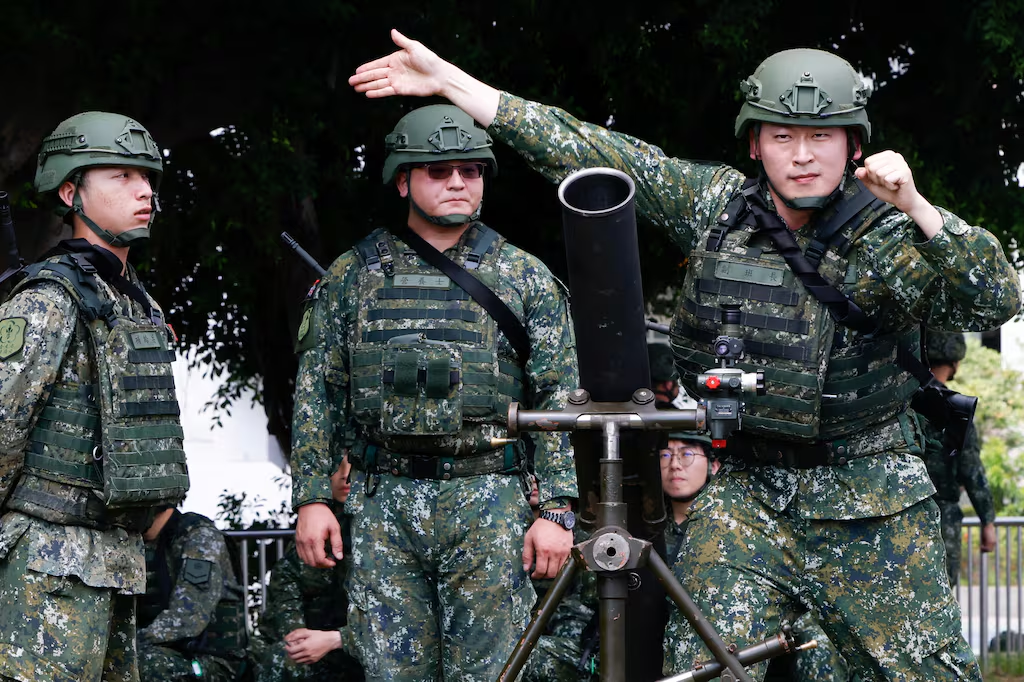
Taiwanese troops fired tank rounds and artillery across a Penghu beach before dawn Monday, rehearsing the defeat of a Chinese air landing assault on islands that sit in the middle of the Taiwan Strait. Later in the day, the government will deliberately slow mobile internet across central Taiwan for 30 minutes, the first time civilian communications have been degraded on purpose during the country's annual war games.
The Han Kuang exercise, now in its 42nd year, began August 5 and runs through August 14. It involves every branch of the armed forces and more than 20,000 reservists. Soldiers from the First Theatre Command used M60A3 tanks, artillery pieces, and anti-aircraft guns in Monday's drill, loading ammunition and taking up firing positions in darkness before the shooting started.
Penghu matters because of geography. The island group lies closer to Taiwan proper than to China, and Taiwanese strategists consider it a likely first target. If Beijing took it, missiles and drones based there could reach the main island. Reservists from Penghu joined the drill as part of their 14-day training program.
China claims Taiwan as its territory and has not renounced force to take it. Taipei rejects the claim and says only the island's 23 million people can decide their future. Chinese military aircraft flew about 2,600 sorties around Taiwan in 2025, up from 970 in 2021, according to Japan's latest defense white paper.
Officers Don't Know the Script This Year
The biggest change in this year's exercise is invisible from the beach. On US advice, Taiwan's military withheld the full exercise plan from its own participating officers, ending four decades of pre-distributed scenarios.
The exercise formally adopted the American "backbrief," in which a subordinate commander receiving an order must explain back to his senior how he intends to carry it out. The point is to confirm the officer understands the intent behind the order, not just its wording. Three other US rehearsal methods are being tested alongside it: combined arms rehearsals, support rehearsals, and battle drills.
The change targets a specific Chinese war plan. PLA doctrine for a Taiwan campaign calls for precision strikes on command centers, communications, and political leadership in the opening hours, and includes special operations forces tasked with leadership strikes. Officers who can keep fighting after losing contact with headquarters give that strategy nothing to decapitate.
The opening night of the exercise staged exactly that problem. President Lai Ching-te, in helmet and flak vest, was escorted from his residence after dark and driven through Taipei in an armored vehicle, one of three convoys meant to confuse enemy commandos hunting him. He ended the night at the National Political and Military Operations Command Center receiving briefings.
"The most important new development in this year's Han Kuang is the incorporation of American-style military training methods," said William Yang, senior Northeast Asia analyst at the International Crisis Group. The drills, he said, have moved away from "the mostly performative tasks of firepower display" of past years.
Abrams Tanks and Suicide Drones Make Their Debut
Two new pieces of the order of battle appeared in Han Kuang for the first time. Taiwan's M1A2T Abrams tanks joined a live-fire defense-in-depth drill with the 584th Armored Brigade in the north. The last of the 108 tanks, bought for roughly $1.26 billion, arrived in April. They are Taiwan's first new main battle tanks in more than 30 years.
The Littoral Combat Command, stood up July 1, is also exercising for the first time. It pulls the navy's anti-ship missiles, coastal artillery, mobile radar, and unmanned systems under one commander.
At Zuoying naval base Saturday, with Lai watching, the navy flew two locally built fixed-wing drones that officials described to reporters as "medium-size suicide drones." They loitered over the beach for about half an hour. A navy spokesperson said the Armament Bureau provided them for testing and declined to give specifications. Their design resembles the loitering munitions Ukraine has used this year against Russian supply lines 30 to 300 kilometers behind the front.
The drones fit a stated production goal. Taiwan plans to build 100,000 drones a month by 2030, and the defense ministry proposed a $6.6 billion budget in June to buy more than 210,000 attack, reconnaissance, and sea drones. Engineer units are separately running blockage drills at the Danjiang Bridge at the mouth of the Tamsui River, practicing how to slow an advance on Taipei from the north. On the east coast Sunday, troops ran a decontamination drill simulating a chemical weapons attack.
Civilians Are Part of the Test
The internet throttling hits central Taiwan on Monday and the north, including Taipei, on Thursday. Data slows for 30 minutes; voice calls, texts, landlines, fixed internet, ATMs, traffic signals, and ambulance calls are unaffected. The government sent text alerts to phones across the island Friday in Chinese and English and posted a weekend video explaining the drill.
The civil defense program goes further than in past years. It includes underground medical facilities, civilian and medical evacuations, drone-based resupply, a mobilized civilian factory, and urban resilience drills in Taipei, Taichung, and Kaohsiung. The military is also testing an embedded reporter system for distributing battlefield news and countering disinformation in wartime.
Two reserve brigades, one in the north and one in the south, were called up, as many as 5,000 reservists in that component alone. Taiwan moved from company-level to brigade-level reserve mobilization only in 2025; this year doubles that experiment. Officials say the long-term goal is to cycle all 30 reserve brigades through full mobilization.
The scenario behind it all comes from April's two-week command-post simulation: China using its own routine exercises around Taiwan as cover for the first stage of a real attack, leaving almost no warning time. In late July, Taiwan's defense ministry confirmed satellite imagery showing the PLA has built life-size replicas of the Presidential Office Building and other facilities on the mainland.
Money and Washington
Taiwan's cabinet will propose a 16% increase in defense spending for 2027, according to the official Central News Agency. The budget, to be unveiled August 20, would top NT$1.1 trillion for the first time and stay above 3% of GDP. China raised its own defense budget 7% in March, to 1.91 trillion yuan.
The spending push runs into an awkward fact: President Donald Trump has not approved a $14 billion US arms package for the island. After meeting Xi Jinping in Beijing in May, Trump called arms sales to Taiwan "a very good negotiating chip." Xi visits the US in September. Lai sought a $40 billion special defense budget at home; the opposition-controlled parliament passed $24.8 billion.
The American training methods on display this month are, for some observers, the more reliable signal. "Even though Trump and those close to him have flip-flopped on supporting Taiwan, the connection between the two militaries remains strong," said Lev Nachman, a political science professor at National Taiwan University.
Lai, watching drills in Taoyuan on Sunday, kept his own assessment short. "Every bit of solid preparation in peacetime," he said, "adds another measure of stability and strength for our nation."
Author

We cover the world’s chaos so you don’t have to scroll twelve feeds to understand it.
Sign up for Atlas newsletters.
Stay up to date with curated collection of our top stories.