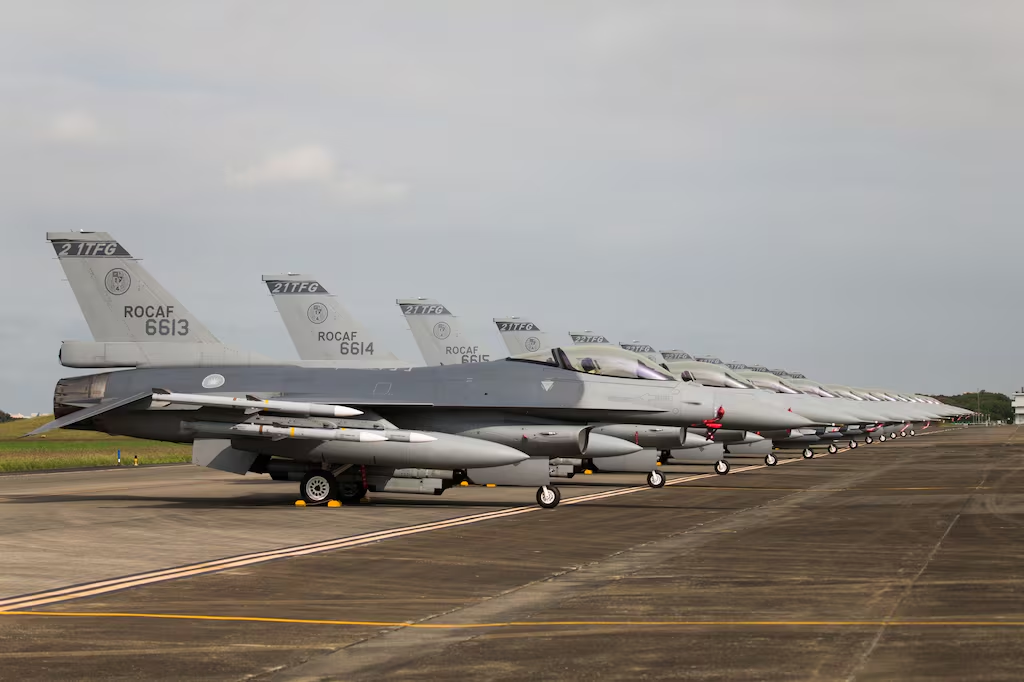
The first two of 66 new F-16V fighter jets Taiwan ordered from the United States have sat grounded in Hawaii since late August with no official reason disclosed, turning a long-delayed 2019 arms deal into the immediate measure of whether Washington's weapons pipeline to Taipei is still moving after last week's Trump-Xi summit.
Defense Minister Wellington Koo said Tuesday that production has reached a stage where delivery is possible and that Taiwan is coordinating with the United States on the ferry flight and on compensation for the delay. He did not give a new arrival date.
First jets grounded in Hawaii since August
The jets left the continental United States on Aug. 17 and reached Joint Base Pearl Harbor-Hickam on Aug. 21. They were expected to continue through Guam to Chihhang Air Base in Taitung. Instead they have remained in Hawaii for more than five weeks. On Sept. 7 the two single-seat aircraft, serial numbers 6727 and 6728, were seen taxiing toward departure before returning to the apron. Taiwanese reporting has said no reason for the hold has been released.
Koo told reporters at the Legislative Yuan that the Air Force is preparing for acceptance under the U.S. program office's plan.
Payment, assembly and compensation without cash penalties
Taiwan ordered the 66 Lockheed Martin F-16C/D Block 70 jets under a U.S. Foreign Military Sales case valued at about $8 billion. Taipei's special budget for the program is NT$247.2 billion. A Kuomintang lawmaker's accounting cited in legislative questioning has put Taiwan's payments to date at roughly $4.87 billion of that total, even as none of the new-build aircraft had reached the island by Tuesday.
Officials have previously said more than 50 of the jets remained in assembly on the U.S. production line. The original contract called for all 66 to arrive by the end of 2026. Relocation of Lockheed Martin's F-16 line and supply-chain disruptions pushed the schedule into 2027 and 2028. The company has run two shifts to accelerate output.
Koo said Tuesday that the sales contract did not include financial penalties for late delivery and that the United States has "shown goodwill" while talks on remedies continue. Local reporting, citing military sources, has pointed to non-cash options such as added technical support, spare parts and an extended warranty. Koo said a concrete compensation package is still being negotiated and will be disclosed when ready.
The Block 70 jets carry advanced avionics, AESA radar and conformal fuel tanks. They are intended for the air force's 7th Tactical Fighter Wing at Chihhang, alongside the island's earlier F-16 fleet upgraded to a related V configuration. Even after the first two jets leave Hawaii, most of the 66-aircraft order will still be outstanding, and Taiwanese officials have said year-end completion of the full fleet is no longer feasible.
End-of-month arrival framed as a litmus test
Koo told lawmakers earlier this year that the first aircraft would reach Taiwan by the end of September, the close of the third quarter. Two days remain, and the jets are still in Hawaii. Taiwanese reporting has cast an end-of-month arrival as a litmus test of whether last week's Washington summit altered the handling of already approved sales.
A China Times analysis published after the summit argued that an on-time September delivery would show prior Taiwan-U.S. scheduling commitments still hold, while a further slip would raise questions about other backlogged systems, including Patriot interceptors and Harpoon coastal defense missiles still awaiting full delivery. Those programs sit in Taiwan's multiyear U.S. arms backlog alongside the F-16s.
Summit peg and continuous sales talks
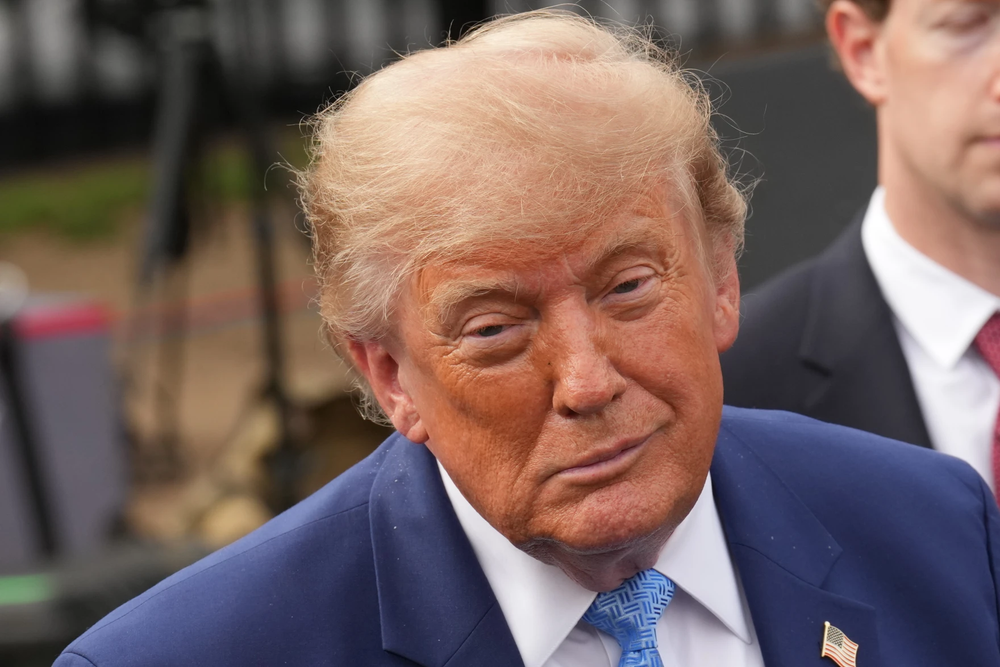
President Donald Trump hosted Chinese President Xi Jinping in Washington last week, with their principal White House meeting on Sept. 24. China's official readout said Xi urged the United States to "adhere to the correct position of opposing 'Taiwan independence'" and to handle the Taiwan issue with prudence — wording stronger than Washington's long-standing formula that it does not support Taiwan independence.
Koo said that since the summit Taipei has repeatedly been told U.S. policy toward Taiwan has not changed and that Taiwan remains in continuous discussions with Washington on pending military sales. "To my knowledge, we have not received any notifications of changes so far," he said.
Separately, a new U.S. arms package for Taiwan worth some $14 billion has remained in abeyance since May, when Trump said after a trip to Beijing that he was holding the sale. That package would follow a December 2025 notification valued at about $11.1 billion, described at the time as the largest U.S. arms package ever for Taiwan. Trump has previously called arms sales to Taiwan "a very good negotiating chip," language that unsettled Taipei even as deliveries of previously ordered systems continued case by case.
The United States is Taiwan's principal weapons supplier despite the absence of formal diplomatic ties and is bound by the 1979 Taiwan Relations Act to provide the island with the means to defend itself. Taiwan's elected government rejects Beijing's claim of sovereignty over the island.
Asked Tuesday when the Hawaii pair would fly on, Koo said the ministry would make the information public as soon as the delivery date is confirmed. "We will continue to coordinate with the US side" on the deliveries, he said.
Author

We cover the world’s chaos so you don’t have to scroll twelve feeds to understand it.
Sign up for Atlas newsletters.
Stay up to date with curated collection of our top stories.