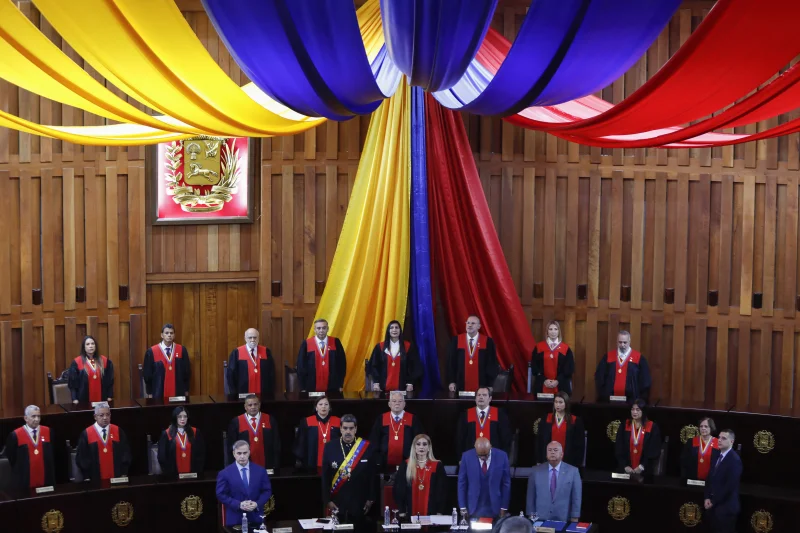
Delegations from Venezuela’s interim government and the opposition-led 2015 National Assembly were scheduled to open a third round of U.S.-backed talks in Caracas at 2 p.m. CT on Wednesday, Oct. 14. Finishing an overhaul of the Supreme Court comes first. A date for an election is not on this round’s agenda.
The session was set for 3 p.m. local time at the Hotel Meliá Caracas, according to Cuba’s state news agency Prensa Latina, which cited official sources.
Two assemblies, one table
Two rival legislatures are at the table. Dinorah Figuera heads the opposition delegation. She is president of the National Assembly elected in 2015, which the State Department calls the last democratically elected legislature recognized by all Venezuelan parties.
The government side is led by Jorge Rodríguez, president of the current National Assembly, according to the State Department. His sister, Delcy Rodríguez, is acting president.
Prensa Latina described the talks as a dialogue with former lawmakers of the “extinct” 2015 Assembly.
Opposition leaders María Corina Machado and Edmundo González Urrutia are not part of the talks, and neither side has said whether they were offered seats. Machado’s team said in September that she had been denied entry to Venezuela from Panama three times in 24 hours, part of seven failed attempts to return. The Venezuelan government denies blocking her.
Washington’s stake
The talks are part of a U.S.-backed transition that followed the capture of Nicolás Maduro in a U.S. military operation in Caracas on Jan. 3. The State Department calls that action Operation Absolute Resolve.
Maduro and his wife, Cilia Flores, are in federal custody in New York. On Oct. 8, the Justice Department unsealed a superseding indictment adding a charge of conspiring to commit torture to the narcotics and weapons counts he already faced. Their trial is set for June 2027.
Delcy Rodríguez has not been elected. She was sworn in as acting president on Jan. 5. She remained in office past the 90-day limit on her temporary role set by the high court, and lawmakers have not taken a public vote to extend it, the Associated Press reported in April. The court order still lists Maduro as president.
At the U.N. General Assembly on Sept. 23, she said, “In Venezuela, there will be elections,” but set no date.
Secretary of State Marco Rubio met Figuera at the State Department on Friday, Oct. 9. “She has our 100 percent support,” Rubio said, according to a State Department transcript. “They have already achieved concrete results; more results will be necessary.”
The department’s readout said Rubio “urged continued progress on political freedoms and electoral reform” ahead of the round beginning Oct. 14. A same-day fact sheet was titled “Reconciliation Talks Deliver Concrete Progress for Venezuela’s Democratic Transition.”
The court comes first
The first two rounds were held in Caracas in August and September, the State Department said. The second ended Sept. 25.
The talks have produced a law under which 32 new justices of the Supreme Court of Justice, known by its Spanish initials TSJ, are to be selected by December, the fact sheet says. The new court will rule on any challenge to the next election’s results.
The talks also created a seven-member Credentials Council made up entirely of judges, a majority of them chosen by the 2015 Assembly. It will screen candidates.
A Judicial Nominations Committee of 11 current lawmakers and 12 civil-society members will then choose 32 nominees from the council’s list, according to the fact sheet. On Sept. 1, the Assembly enlarged the committee from 21 to 23 members, giving civilians the majority.
Interviews of the 127 civil-society applicants for the committee’s 12 seats began Tuesday, Oct. 13. Three timelines for filling those seats are now in play.
Juan Miguel Matheus, a member of the opposition delegation, wrote on X: “We are working so that on Oct. 15 they are designated and sworn in.”
Lawmaker Luis Florido has since said the selection is expected Oct. 20, with the committee installed Oct. 21. “Some 60, 70 applicants were expected. 127 applied,” he said.
Giuseppe Alessandrello, a lawmaker from the governing PSUV who chairs the Assembly’s preliminary commission, said interviews should finish Friday and the 12 picks should go to the floor next week. He said the final list of high-court candidates could reach the plenary in the first week of December.
The two sides’ positions
The opposition delegation says the courts must be fixed before any vote. “There will be no truly free elections while the courts can disregard the popular will, persecute candidates or strip citizens of the right to decide their destiny,” Matheus said.
Machado, outside the talks, has called for a new National Electoral Council (CNE) and a presidential election date as soon as possible. The State Department says CNE reform will come in future rounds.
Jorge Rodríguez and the government had not commented on the opening as of Wednesday morning.
Prisoners and the count
The State Department says more than 1,000 political prisoners have been freed since January, with 177 more releases announced since August.
The independent rights group Foro Penal counts 322 political prisoners still held as of Oct. 5, including 140 military personnel. It reported five releases that week and 1,104 releases so far in 2026. The government denies holding political prisoners.
Under the timeline the talks have set, the 32 justices who will rule on the next election are due to be seated in December. No date has been set for the election itself.
Author

We cover the world’s chaos so you don’t have to scroll twelve feeds to understand it.
Sign up for Atlas newsletters.
Stay up to date with curated collection of our top stories.