France’s prime minister on Monday asked regional authorities to impose “partial” and “localized” curfews in some cities. The government is trying to contain a weekend of rioting and looting that has rattled its bond market and drawn a warning from President Donald Trump.
“France is burning! The immigration of people from an entirely different world, people with hatred in their hearts, has shattered that once great country,” Trump wrote on Truth Social at 7:11 a.m. CT Sunday, according to an archive of his posts. “Close your Borders and take control, before it is too late!”
The French government has given other causes. President Emmanuel Macron said Sunday that the demonstrators’ demands and concerns were legitimate, and he said the government was working to secure fuel and gas supplies. Ministers and the Paris police have blamed much of the violence on “ultra-left” groups and criminals. The protests began in mid-September with high school students demanding better conditions at their schools. They grew into a nationwide movement against rising living costs.
The Yellow Vests movement, which organized the weekend’s rallies, has called for new protests across France on Saturday, Oct. 24.
Curfews, and a state of emergency held in reserve
Prime Minister Sébastien Lecornu did not say which cities would impose curfews. He said some areas of Paris could be affected. In Marseille, the police prefecture banned all gatherings and demonstrations Monday from noon to 8 p.m. local time, or 5 a.m. to 1 p.m. CT.
Lecornu said a state of emergency remained an option. “If declaring a state of emergency is deemed necessary, we would do so,” he said. He has promised firm judicial follow-up and is backing a bill that would make rioters pay for the damage they cause.
A minister’s offer to resign
Interior Minister Laurent Nuñez offered his resignation to Macron on Sunday, the Élysée Palace said in a statement Monday morning. “I submitted my resignation because I am responsible for everything that is happening,” he told France Inter radio.
Nuñez acknowledged that authorities had “lost control” in some major cities on Saturday. “You can’t look shopkeepers in the eye when hundreds of businesses have been looted and say we haven’t lost control in some of these major cities,” he said.
Macron refused the resignation. The Élysée cited the need for continuous command of law enforcement in the current context and pointed to failures in anticipation and intelligence. Macron asked Nuñez to deploy new tactics against rioters and looters as quickly as possible.
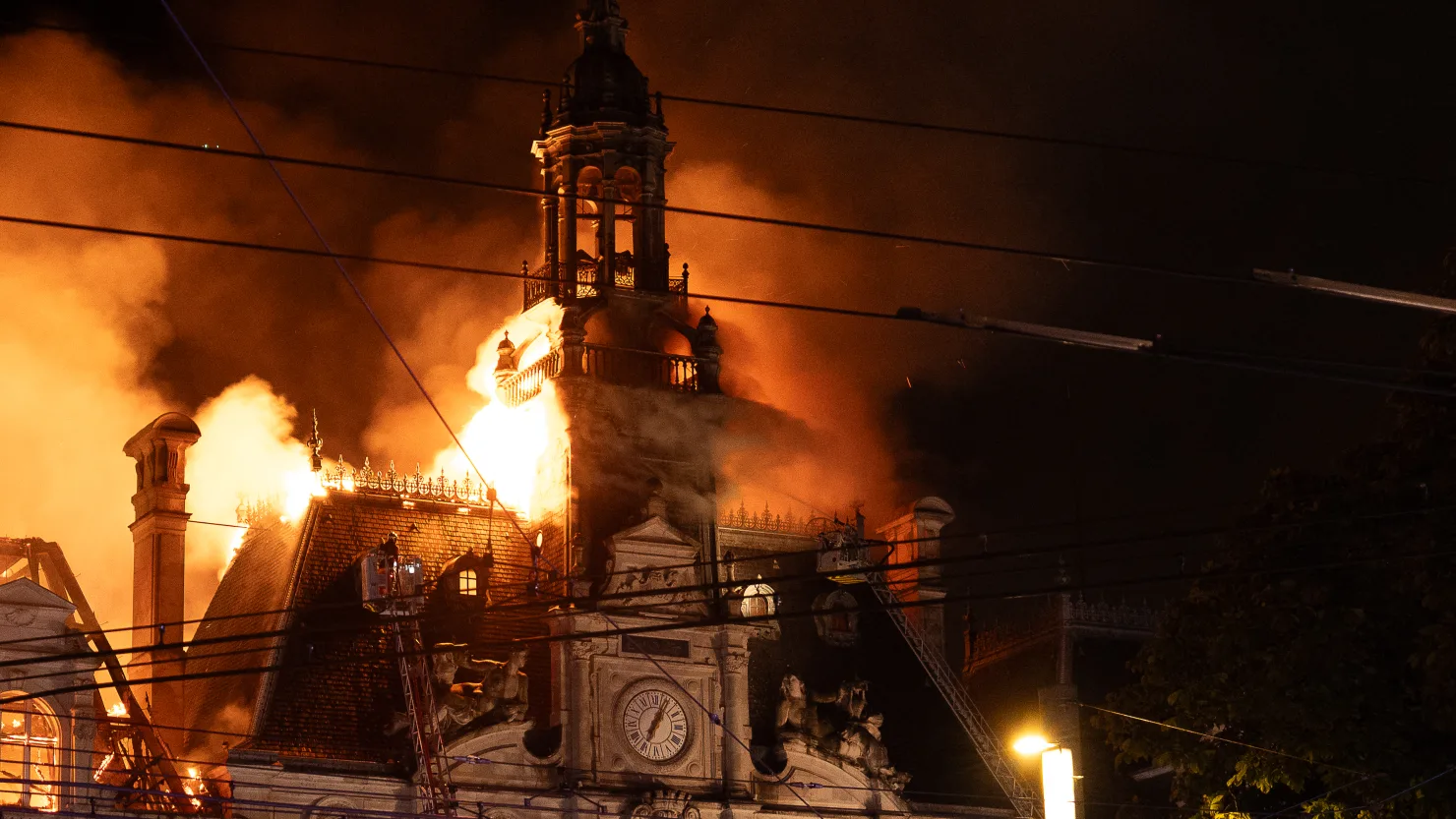
About 550,000 people marched across France on Saturday, according to Nuñez, who said intelligence had expected about 200,000. Masked groups on the edges of the marches attacked police, set public buildings on fire and looted shops. In Limoges, the 19th-century city hall was set on fire and its spire collapsed.
In a televised address Sunday evening, Macron said, “Those who destroyed must pay. Those who looted must repay. Those who sought to bring down the Republic will have to answer for it,” according to the Élysée’s transcript. The country was feeling “anger and shame,” he said, in franceinfo’s account of his remarks.
Arrests, injuries and damage
The Interior Ministry put the number of arrests on Saturday at 2,397, with 997 police officers and gendarmes injured, seven of them seriously.
The Paris prosecutor’s office gave figures for the capital alone. It said 855 people were arrested in Paris in connection with Saturday’s demonstrations, leading to 557 people held in custody. A provisional count as of 8 a.m. Paris time Monday, or 1 a.m. CT, showed 208 more arrests in Paris on Sunday, including 49 minors, leading to 145 people held in custody.
Justice Minister Gérald Darmanin said Monday that more than 2,330 people had been taken into custody nationwide. “We failed, unquestionably,” he told France 2 television, referring to the weekend.
Alain Di Crescenzo, president of CCI France, the national body of chambers of commerce, estimated that the number of businesses hit across France would exceed 2,000, with damage running into “hundreds of millions of euros.”
On Monday, students from the École du Louvre blocked the entrance to the Louvre in support of the high school movement. The museum could not open at its usual 9 a.m. local time.
Markets, Brussels and the Gulf
The yield on France’s 10-year government bond rose about 7 basis points early Monday, to about 4.85%, Reuters reported. Earlier this month the yield touched 4.99%, its highest since 2002.
France’s public finances were already under strain. Its deficit remains above 5% of gross domestic product, and public debt is just under 120% of GDP. Moody’s rates France Aa3 with a negative outlook, and it has called passage of the 2027 budget “highly uncertain.”
The European Commission called on France to protect the right to peaceful protest. Spokesman Markus Lammert called the weekend’s looting and arson “unacceptable” but said peaceful demonstrators must not be conflated with those who commit violence. The Commission said it was in “close contact” with Arcom, France’s digital regulator, about social media platforms’ obligations.
Macron went ahead with a Gulf tour of Kuwait, the United Arab Emirates, Bahrain and Qatar. In his Sunday address, he said he would travel to the Gulf to secure France’s fuel and gas supplies. Senior executives from TotalEnergies and Engie are traveling with him on the tour, which runs through Wednesday.
Moody’s is scheduled to update France’s credit rating on Friday, Oct. 23, according to the French Treasury.
Author

We cover the world’s chaos so you don’t have to scroll twelve feeds to understand it.
Sign up for Atlas newsletters.
Stay up to date with curated collection of our top stories.