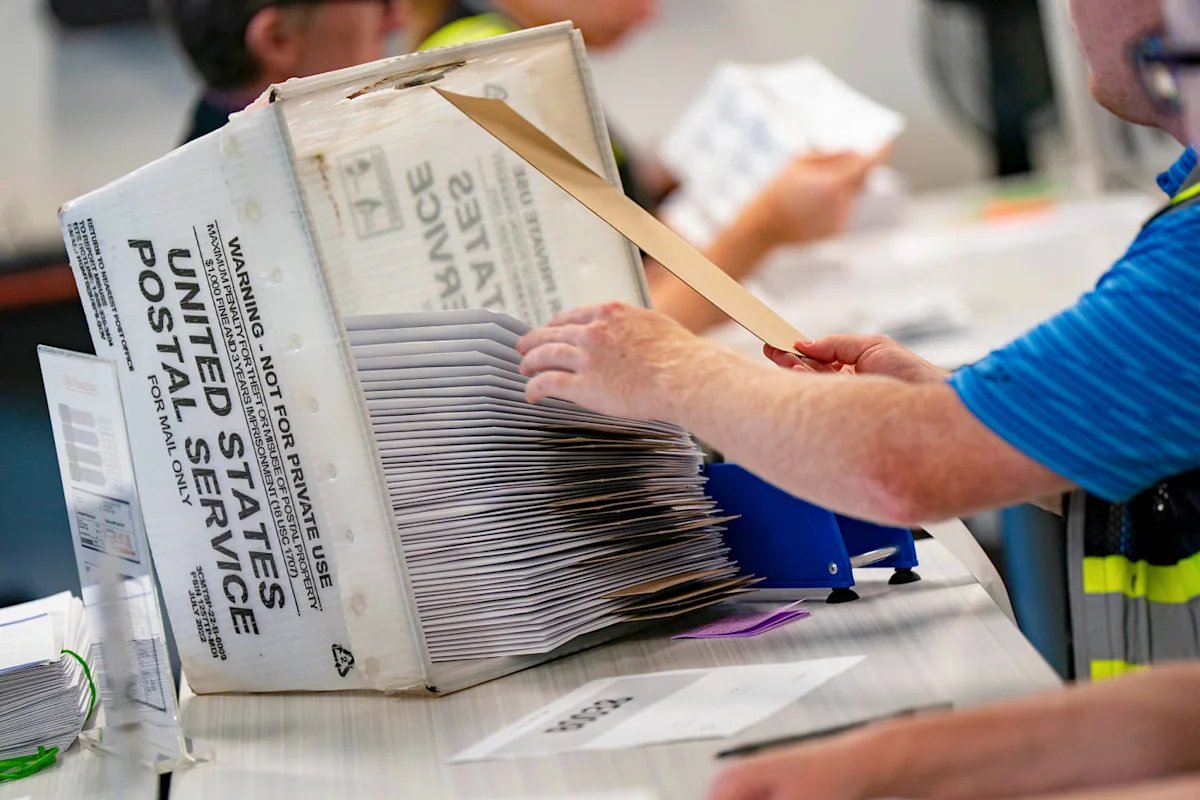
A First Circuit panel on Sept. 10 denied the Trump administration’s bid to stay a preliminary injunction blocking key parts of a U.S. Postal Service rule that would have conditioned delivery of federal election ballots on new barcodes, envelope designs, and a postal data portal before the Nov. 3 midterms.
The lead plaintiff is the League of Women Voters of Massachusetts, joined by allied civic groups. A parallel challenge comes from 23 states and the District of Columbia.
What The Final Rule Would Require
Under the final rule, ballots would not be delivered unless a voter-specific Intelligent Mail barcode on outgoing and return envelopes matches the barcode uploaded to a Postal Service database. States would have to obtain Postal Service approval for new ballot-envelope designs, replace stock already ordered, and field systems that can generate the barcodes. They would also have to upload voter-specific information to a Postal Service online portal that is still not operational. Noncompliant mail would be returned to election offices rather than delivered to voters.
Those mechanics are what made the district court’s findings of chaos and practically inevitable disenfranchisement concrete: ballots are already moving while the portal is not ready and envelope stock is already printed.
From Executive Order To Final Rule To A Ripe Challenge
The rule implements Trump’s March 31, 2026, Executive Order 14399, “Ensuring Citizenship Verification and Integrity in Federal Elections,” published at 91 Fed. Reg. 17125. The administration says the measure advances citizenship verification and election integrity and aims to stop illegal voting by noncitizens. The rule text cites protecting election integrity.
On Aug. 24, 2026, the Supreme Court stayed an earlier injunction in Trump v. California, No. 26A124, as premature because the Postal Service had not yet issued a final rule. The service finalized the Ballot Mail for Federal Elections rule at 91 Fed. Reg. 54966 on Aug. 26, 2026. Plaintiffs then returned with a ripe challenge before U.S. District Judge Indira Talwani, who again blocked enforcement of the core requirements.
The First Circuit order states there is no record evidence of past fraud or of a likelihood of impending fraud related to Nov. 3.
Elections Clause And The Stay Denial
The district court concluded the rule is likely a manner regulation of federal elections under the Elections Clause, not ordinary postal housekeeping, and that an agency cannot do by rulemaking what the Constitution assigns to the states and to Congress. The First Circuit panel said it agreed.
On the district court’s findings that the rule would create chaos and practically inevitable disenfranchisement, the panel reasoned that appellants “have not even seriously challenged this aspect of the district court’s ruling, much less demonstrated why it is clearly erroneous.”
The panel was Judges Gustavo Gelpí, Julie Rikelman, and Seth Aframe, all Biden appointees. Talwani is an Obama appointee.
North Carolina began mailing ballots around Sept. 4. Alabama began around Sept. 9, according to government filings. Alabama led intervenor states including Missouri, Florida, Texas, Indiana, Kansas, Louisiana, Montana, Nebraska, Oklahoma, South Carolina, and South Dakota.
Plaintiffs and counsel said in a joint statement: “The U.S. Postal Service is not the gatekeeper for mail ballots. It does not have that authority. And it cannot usurp election authority from the states and Congress.”
The Live Application At The Supreme Court
The administration’s emergency application, No. 26A305, remains pending at the Supreme Court, where Justice Ketanji Brown Jackson is managing the briefing schedule.
Author

We cover the world’s chaos so you don’t have to scroll twelve feeds to understand it.
Sign up for Atlas newsletters.
Stay up to date with curated collection of our top stories.



