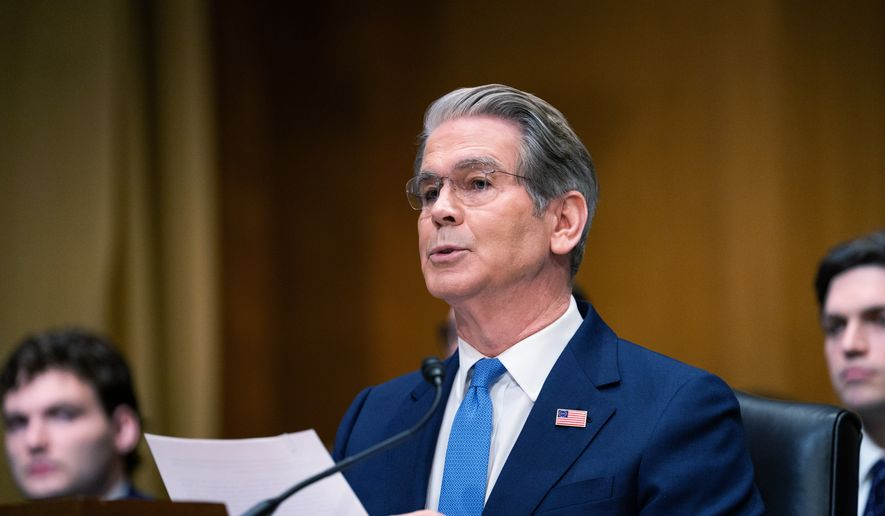
Treasury Secretary Scott Bessent said the United States will unveil unprecedented economic actions against Iran next week, signaling a new phase in a nearly six-month war that has shifted from bombing campaigns to a contest of financial endurance built around the blockaded Strait of Hormuz.
"Watch this space for more announcements coming next week because we are going to apply measures like have never been seen in the history of the economic isolation of a country," Bessent said Thursday night on Newsmax's "Rob Schmitt Tonight." "It will be a combination of economic isolation like the world has never seen before, and the continued blockade in the Strait of Hormuz that will keep anything from going in or out of the Iranian ports."
Bessent did not elaborate, and the Treasury Department is legally restricted from previewing specific sanctions actions, leaving unclear what the new tactics might entail. His department has already moved aggressively against Iranian money-changers, cryptocurrency channels, and other revenue streams, layered atop the naval blockade that has halted most of Iran's oil exports.
The secretary framed the effort as the successor to the air war. "The kinetic war ended after several weeks, and we went from Epic Fury to Economic Fury. And at the president's orders, we have raised the level even again," he said, referring to the Treasury-led campaign supporting the Pentagon's military operation. He called the approach a "one-two punch," arguing it distinguishes Iran's situation from other sanctioned states. "People say, 'Well, you know, Cuba lasted a long time. Venezuela lasted a long time.' Venezuela immediately crumbled when we put the blockade on."
Trump's Bet on Pressure Over Bombs
The comments cement President Donald Trump's pivot away from renewed military strikes in favor of what he has described as "low-keying it" with Tehran. "It will work out. It always works out. It's like a chess game," Trump said Sunday. "We are only semi-negotiating with them. We are just watching Iran with its huge inflation and the fact they have no money."
Trump escalated his own rhetoric Friday, claiming that after the US defeats Iran, "pretty soon I'll be declaring the Hormuz Strait a territory of the United States." He has previously floated imposing tolls on the waterway — an open, un-tolled international passage before the war began February 28 — before dropping the idea.
Defense Secretary Pete Hegseth, speaking to reporters during his trip to Panama, said the military can sustain the blockade as long as required. "Indefinitely, the United States Navy can maintain a blockade like that because we'll rotate ships in and out, as we have, and we'll continue to," he said.
The economic toll on Iran is mounting. The blockade had cost Tehran nearly $5 billion in oil revenue by early May, and the head of the Iran-China Joint Chamber of Commerce, Majidreza Hariri, said this week it could cost $18 billion annually if it continues — while warning his own government against trying to evade it. "We did something similar with the sanctions," he told the Iranian outlet Khabar Online. "Instead of lifting them or finding mechanisms to neutralize them, we turned to circumventing the sanctions, and the result was a weakened economy and major corruption." Bessent's pressure campaign last year helped fuel an inflation crisis that sparked mass protests across Iran in December and January.
Tehran Digs In, and the Attacks Continue
Iran has met the economic threats with defiance. The country's Persian Gulf Strait Authority rejected Trump's claims of American control over Hormuz, posting that the strait "remains blocked and will not be reopened until Iran's conditions are accepted." Iranian officials say no ships may transit without Tehran's authorization and have called Trump's war a "miscalculation." Only a handful of vessels passed through the waterway this week.
The violence has not fully paused. The United Arab Emirates said two tankers tied to its national oil company, ADNOC, were struck Thursday while transiting the strait, drawing condemnation from Arab governments; no injuries were reported. Diplomacy, meanwhile, is stalled: a senior Iranian source said this week there have been no discussions about reviving the interim ceasefire signed in June, which Trump declared "over" on July 7. Tehran insists Washington return to the pact with a definitive timeline for meeting its obligations.
Analysts warn the standoff invites escalation. Behnam Ben Taleblu of the Foundation for Defense of Democracies said Iran is likely to answer economic containment with force by early fall, as it did during the pressure campaign of 2019. "More attacks on ships, potentially more attacks on U.S. bases, potentially more attacks on Arab infrastructure in the Persian Gulf," he said, predicting the regime would build "a tiered list of targets" weighing economic value against the risk of American response.
Strain on the Blockade Force
The instrument of the pressure campaign is itself showing wear. The USS Abraham Lincoln, the carrier anchoring blockade operations, has been deployed more than 250 days — its tour was to end in May — and reports in Navy Times and Stars and Stripes, citing family members, described declining morale, supply shortages, and cases of suicidal ideation aboard. Representative Mike Levin of California wrote to Hegseth and the Navy citing "moldy showers, broken toilets, lack of hot water, lack of access to fresh produce," and crew burnout.
Hegseth dismissed the accounts as "completely misrepresented," and Central Command denied Iranian media claims of a deadly brawl aboard the ship, saying no service members have died. The Navy is sending relief: the USS George Washington strike group departed Vietnam on Wednesday, reportedly bound for the Middle East to take over from the Lincoln.
The costs are visible at home as well. Gasoline averaged $4.08 a gallon Friday, up 37% since the war began, and Bessent pushed back on critics who argue the campaign has strengthened Tehran's resolve, saying Democrats who believe Iran "has never been stronger" are "uninformed, deranged, and have no idea what they're talking about." Whether next week's promised measures shift the stalemate — or simply deepen the siege on both sides of the strait — is now the question hanging over a war with no talks underway and no end date attached.
Author

We cover the world’s chaos so you don’t have to scroll twelve feeds to understand it.
Sign up for Atlas newsletters.
Stay up to date with curated collection of our top stories.



