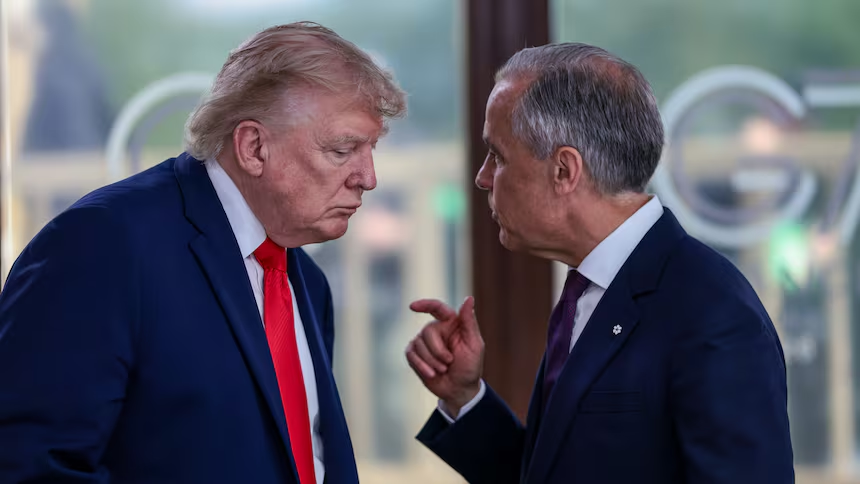
The United States and Canada remain divided days before punitive 50% tariffs hit nearly $20 billion in Canadian goods, with negotiators locked in what Prime Minister Mark Carney called "intense" and "delicate" talks and both sides signaling a deal is possible — but not done — before the duties take effect at 12:01 a.m. Wednesday.
President Donald Trump signed three proclamations July 20 invoking Section 338 of the Tariff Act of 1930, a Depression-era provision never before used, which permits tariffs of up to 50% against countries deemed to discriminate against American products. The duties cover a wide range of imports — wine, furniture, dairy products, cement, clothing, fishing rods, and hockey equipment among them — and apply even to goods that qualify for preferential treatment under the US-Mexico-Canada Agreement, stripping away protection that has shielded most Canadian trade.
Canada's trade minister, Dominic LeBlanc, and chief negotiator Janice Charette stayed in Washington through the weekend, meeting US Trade Representative Jamieson Greer and Commerce Secretary Howard Lutnick on Monday afternoon for their longest session yet — LeBlanc's sixth meeting with Greer in four weeks. LeBlanc told an advisory committee Friday that the two sides remain far from a draft agreement despite the regular contact, according to a source briefed on the matter.
Carney declined Monday to discuss specifics but said he expects to speak with Trump before the deadline. He has said he wants a full settlement rather than a limited deal, and that "all options are on the table" if Washington proceeds.
What Washington Says Canada Did
The administration frames the tariffs as an answer to Canadian discrimination against three American industries: autos, alcohol, and dairy. A White House fact sheet says Canada imposes tariffs and quotas on US-made cars that it does not apply to other countries' vehicles, administering them in a way that pushes American automakers to invest in Canadian production; Canadian imports of US motor vehicles fell roughly 22%, or $5.6 billion, from April 2025 through March 2026 compared with the prior year.
All but two provinces and territories have halted purchases of US alcoholic beverages since March 2025, when they pulled American wine and spirits from government-run stores in retaliation for Trump's earlier tariffs — a move that cut Canadian imports of US alcohol by about 81%, or $582 million, over a year. And Canada's dairy system imposes tariff-rate quotas on American cheese that are more restrictive than those applied to European cheese, despite Canada holding trade agreements with both.
Administration officials, including Treasury Secretary Scott Bessent and Greer, have taken particular exception to Canada's decision to retaliate at all, noting that only Canada and China responded to the 2025 "Liberation Day" tariffs with countermeasures rather than negotiations. Ottawa maintains it had every right to hit back after Trump raised barriers against its exports.
The Contours of a Possible Deal
Industry executives and trade specialists following the talks describe an emerging package: Canada would drop its retaliatory 25% auto tariffs, restore American alcohol to provincial shelves, and rework its dairy quota arrangements, paired with commitments on energy, defense, and critical minerals — including Canadian participation in Trump's "Golden Dome" missile shield and purchases of F-35 fighter aircraft. In exchange, Washington would shelve the Section 338 tariffs and relax the 25% national security levies on steel and aluminum, potentially converting them to a mix of tariffs and quotas. Canada could also see long-standing antidumping duties on lumber drop by around 10 percentage points under a routine Commerce Department review.
"I'm optimistic that there'll be a resolution in full or in part that will stave off the Section 338 tariffs. That's the trajectory we're on," said Dan Ujczo, a veteran trade attorney in Columbus, Ohio. "Both sides want a deal."
Ontario Premier Doug Ford, among the most vocal opponents of the tariffs, said last week he would bring US alcohol back to shelves if Canada gets a fair deal. On dairy, expectations of an easy fix are low. "It is more than a sticking point," said Ted McKinney, chief executive of the National Association of State Departments of Agriculture. "It is probably the major issue." Auto tariffs on Canadian-made vehicles have emerged as another key snag, according to industry sources.
Businesses Brace, Economists Shrug
The targeted goods amount to about 5.2% of the $383 billion the US imported from Canada in 2025, a share that leads some economists to play down the direct hit. "In the macroeconomic sense, the tariffs are actually not that big of a deal," said Joseph Steinberg, a University of Toronto economics professor, who argued the greater risk is that another escalation freezes the broader USMCA process.
The sector-level picture is harsher. Canada's wood products and wine industries, already strained by wildfires in the country's west, sit squarely in the tariffs' path. "A 50% tariff is simply not something that manufacturers can absorb, nor can we reasonably expect our US customers to absorb it," said Alain Ouzilleau, owner of custom cabinet maker Cabico Ltd. "It could make certain Canadian-made products economically noncompetitive in the US market virtually overnight." Dan Kelly, president of the Canadian Federation of Independent Business, warned of "massive dislocation for small businesses that rely on US clients and American buyers that rely on Canadian suppliers."
The Bigger Prize: USMCA
Hanging over the deadline is the fate of the North American trade pact itself. Trump declined last month to renew USMCA for another 16-year term at its July review, subjecting the agreement to annual reviews instead — a formula for prolonged uncertainty that has already sapped investment and job growth in Canada. Formal renegotiation talks with Ottawa have not begun, even as Washington has held multiple rounds with Mexico City.
A deadline deal could open that door; a breakdown could slam it. "You've now put the Canadian government, with these 338s, in a position where if we don't do a comprehensive deal, we may just end up having to politically retaliate and we will be years away from having trade peace," said Flavio Volpe, president of the Automotive Parts Manufacturers' Association in Toronto. An Oxford Economics study commissioned by the Canadian American Business Council put the cost of a permanent USMCA collapse at $1 trillion to the US economy over a decade.
The personal temperature has not helped. Trump called Canadian leaders "nasty" in a Las Vegas speech this month; Carney responded that the adjective better described the trade relationship. A new legal front may also await: the untested Section 338 authority invites the same court challenges that felled Trump's emergency-powers tariffs and now shadow his Section 301 and 232 levies. Whether Wednesday brings a handshake or a 50% wall, the answer will land within hours of Carney's promised call with the president.
Author

We cover the world’s chaos so you don’t have to scroll twelve feeds to understand it.
Sign up for Atlas newsletters.
Stay up to date with curated collection of our top stories.



