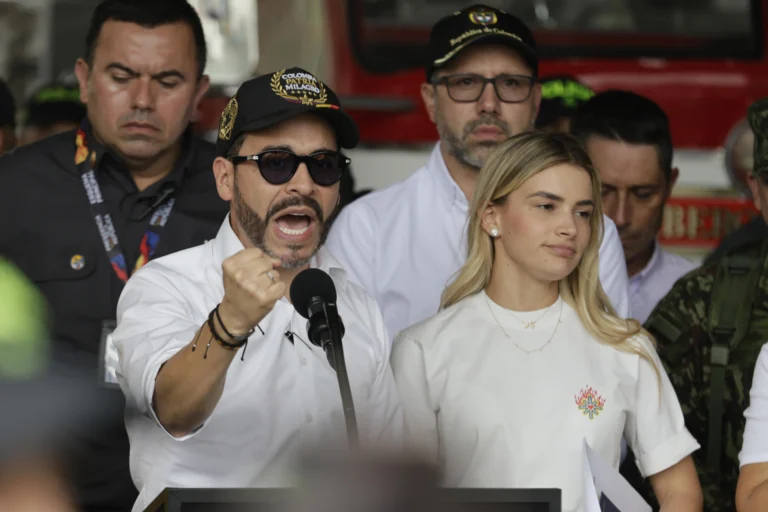
Colombian President Abelardo de la Espriella asked President Donald Trump on Saturday to temporarily suspend US tariffs on Colombian goods, arguing his country's businesses need breathing room as the nation confronts reconstruction from the August 10 earthquake that killed nearly 300 people.
The request came during a 10-minute phone call between the two leaders, which de la Espriella described on X as "very friendly and cordial." He said Trump expressed condolences for the victims of the magnitude 7.4 quake and solidarity with affected Colombian families.
"I asked him to consider temporarily suspending the high tariffs that are affecting Colombian products, in order to give some relief to our business owners, who are facing very difficult times due to the effects of the earthquake," de la Espriella wrote. "I told him that we have a huge challenge ahead: rebuilding Colombia amid the extremely difficult and apocalyptic economic situation that I inherited."
The Colombian leader also thanked Trump for US assistance to the emergency response — $26.5 million in humanitarian aid committed by Washington, along with specialized rescue teams supporting search operations. "Today, more than ever, the alliance between Colombia and the United States is an imperative for the reconstruction of our beloved nation," he wrote, closing with his campaign slogan: "Strong for the Homeland!"
The White House has not announced whether it will grant the request.
The Tariffs in Question
US tariffs on Colombian products rose from 10% to 12.5% on July 24, with exceptions for key exports including coffee and oil. The new duties were imposed under Section 301 of the Trade Act of 1974 as part of an administration investigation into countries it accuses of failing to stamp out forced labor — a measure applied to some 60 nations.
The Section 301 levies replaced an expiring duty enacted under Section 122 of the same law, which the administration had imposed in February after the Supreme Court struck down Trump's sweeping tariffs under the International Emergency Economic Powers Act, ruling they were illegally imposed without congressional authorization.
The stakes for Bogota are considerable because the United States is Colombia's largest export market. The 12.5% rate functions as an additional tariff layered onto the existing schedule, and while certain products and raw materials are excluded, exporters say the duties erode the competitiveness of Colombian goods against rivals from other countries. A suspension, de la Espriella's government argues, would lower the cost of reaching American buyers and help preserve jobs and economic activity as rebuilding begins.
A $6.4 Billion Reconstruction Task
The earthquake, centered in western Colombia, devastated Cali and Pereira and caused heavy damage across Valle del Cauca, Risaralda, and Choco. At least 294 people were killed, according to the National Unit for Disaster Risk Management, with almost 13,000 homes destroyed and tens of thousands of buildings damaged, including schools, health facilities, and infrastructure.
Reconstruction is expected to cost around $6.4 billion. Finance Minister Miguel Gomez said the government is not yet considering tax increases to fund the effort, according to local media — leaving external relief, credit, and assistance among the tools available to an administration that had been in office less than a week when the disaster struck.
The tariff request reflects that arithmetic: with rescue operations winding down and the rebuilding phase beginning, de la Espriella is seeking to convert his government's warm relationship with Washington into concrete economic terms, not just humanitarian support.
Betting on the Trump Relationship
The appeal tests a partnership both leaders have cultivated rapidly. Trump endorsed de la Espriella, a millionaire lawyer turned politician, during the campaign that ended in his narrow June runoff victory over leftist Ivan Cepeda, and the two governments have moved in lockstep since the Colombian's August 7 inauguration.
De la Espriella has joined the Shield of the Americas, the US-backed anti-cartel alliance that includes Argentina, Ecuador, and El Salvador, and Colombia became the 19th member of the Americas Counter Cartel Coalition last week, with the president authorizing joint military operations with US forces against armed groups on Colombian soil. His government recognized Israeli sovereignty over the Golan Heights on August 11 — only the second country to do so — and he has said he intends to forge a trilateral military alliance with the United States and Israel to intensify the fight against guerrillas.
The posture marks a full reversal from his predecessor, Gustavo Petro, whose administration clashed repeatedly with the White House. Petro was sanctioned by the Treasury Department last October and has been reported to be the subject of a federal narcotics investigation.
What Happens Next
Whether the relationship yields tariff relief now rests with Washington. A temporary suspension would require a decision from the administration that imposed the duties, and Trump has made no public commitment. The request also lands amid an active legal challenge: a 25-state lawsuit is contesting the Section 301 and Section 232 tariff regimes in federal court, arguing they repeat the constitutional defects of the levies the Supreme Court already struck down.
For de la Espriella, the calculation is immediate. His first weeks in office have brought a car bombing on the Pan-American Highway, the strongest earthquake recorded in Colombia this century, and a reconstruction bill approaching 2% of national output. The president is wagering that a demonstrated alignment with Washington — on security, cartels, and foreign policy — will now return dividends measured in trade terms. The answer will indicate how far the administration's embrace of its newest regional ally extends when the request carries a price tag.
Author

We cover the world’s chaos so you don’t have to scroll twelve feeds to understand it.
Sign up for Atlas newsletters.
Stay up to date with curated collection of our top stories.



