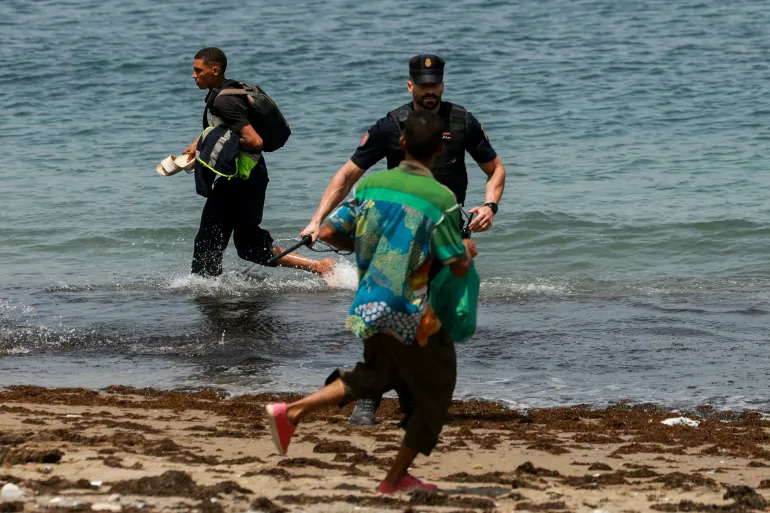
Several thousand migrants, most of them young Moroccans, have swum or scrambled around border barriers into Ceuta over recent days, overwhelming reception facilities in the Spanish enclave on the North African coast and reigniting a long-running dispute between Madrid and Rabat over border control.
Groups of swimmers set out from beaches near the Moroccan border town of Fnideq, timing their attempts to fog and low visibility, and rounded the breakwaters that extend into the Mediterranean on either side of the frontier. Spanish Civil Guard patrols and Red Cross workers pulled exhausted swimmers from the water along Tarajal beach, wrapping them in thermal blankets, while others arrived clinging to inflatable rings and improvised flotation devices made from plastic bottles.
Local authorities said the crossings have come in waves, with hundreds attempting entry on peak days. Many of those who reached shore were minors, who under Spanish law cannot be summarily returned and must be taken into the care of regional authorities. Ceuta's government said its shelter for unaccompanied minors is operating far beyond capacity and has appealed to Madrid for emergency transfers to the mainland.
The central government delegate in Ceuta said adult migrants intercepted at sea or on the beach were being returned to Morocco under the countries' bilateral readmission agreement, while those who evaded immediate interception entered a processing system already backed up from earlier arrivals.
Fnideq's Economy and the Push to Leave
The pressure on Ceuta's border reflects conditions across the frontier. Fnideq's economy depended for decades on cross-border porters carrying goods from the enclave into Morocco, a trade Rabat shut down in 2019 and Spain's border rules further curtailed. Youth unemployment in the town runs well above the national average, and rumors that circulate on social media — often claiming border restrictions have loosened — have repeatedly triggered mass movement toward the crossing.
Moroccan security forces have deployed reinforcements around Fnideq, setting up checkpoints on roads leading to the coast and detaining young people traveling toward the border without documentation. Videos circulating on Moroccan social media showed crowds of teenagers gathering on hillsides above the town at night, waiting for opportunities to move toward the water.
Human rights groups in Morocco have criticized both the crackdown and the underlying conditions driving departures, pointing to a lack of economic prospects in the country's north. Associations in Fnideq said many of those attempting the swim are repeat crossers who have been returned multiple times.
A Recurring Flashpoint Between Madrid and Rabat
Ceuta, along with the sister enclave of Melilla to the east, holds the European Union's only land borders with Africa, making the two territories persistent pressure points in migration politics. The current surge is the largest since May 2021, when some 10,000 people entered Ceuta in two days as Moroccan border guards stood aside during a diplomatic crisis over Western Sahara.
Relations between the two governments have since been repaired, with Spain endorsing Morocco's autonomy plan for Western Sahara and the two sides restoring cooperation on border enforcement. Spanish officials have been careful not to accuse Rabat of relaxing controls this time, instead crediting Moroccan forces with blocking what they said would otherwise have been far larger numbers.
Spain's interior minister traveled to Rabat for talks on reinforcing joint patrols and accelerating returns, and both governments described cooperation as functioning. The Spanish government has also faced pressure at home: the conservative opposition accused it of losing control of the southern border, while the far-right Vox party called for the army to be deployed to the enclaves. The government rejected both characterizations, saying returns are being carried out swiftly and legally.
The European Commission said it was monitoring the situation and reiterated that Ceuta and Melilla's borders are external EU borders, with Frontex support available if Spain requests it.
Minors at the Center of the Strain
The heaviest burden has fallen on Ceuta's child protection system. The enclave of 83,000 people has taken in hundreds of unaccompanied minors, housing them in converted warehouses and sports facilities after its dedicated center filled. Regional officials on the Spanish mainland have resisted mandatory transfer quotas, an argument that stalled a national distribution mechanism for months before a compromise allocated transfers among regions.
Aid organizations working in the enclave said many of the minors arriving report attempting the crossing repeatedly, and some are as young as 12. Under Spanish and international law, unaccompanied children cannot be returned without individual assessments and guarantees of family reunification or adequate reception in Morocco — standards courts have found were not met during past pushbacks. Spain's ombudsman opened an inquiry into returns carried out during the current surge after rights groups alleged some minors were handed back without process.
Local residents' associations in Ceuta have staged demonstrations both against the strain on services and, separately, in support of humane treatment of the arrivals, reflecting divisions within the enclave itself.
Where Things Stand
Crossings have slowed as weather conditions worsened and Moroccan deployments thickened around Fnideq, but officials on both sides of the border describe the lull as temporary rather than a resolution. The economic conditions in northern Morocco that drive the attempts remain unchanged, and each easing of surveillance or favorable tide has produced renewed movement toward the water.
Madrid is pressing Rabat to accept faster readmissions and to expand development programs in the border region, while Morocco has linked deeper cooperation to broader economic and political understandings with Spain and the EU. For Ceuta's administration, the immediate question is capacity: how long a small enclave can absorb arrivals faster than transfers to the mainland relieve them. The regional president said the enclave is "at the limit" and warned that without structural changes to the transfer system, the next surge will find the city with no remaining margin.
Author

We cover the world’s chaos so you don’t have to scroll twelve feeds to understand it.
Sign up for Atlas newsletters.
Stay up to date with curated collection of our top stories.