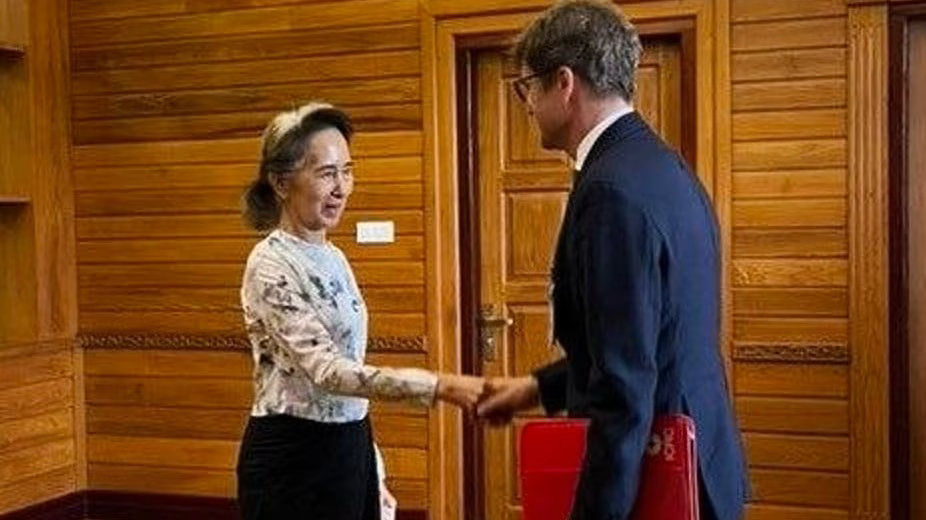
Representatives of the International Committee of the Red Cross met with Myanmar's detained former leader Aung San Suu Kyi, the organization confirmed, marking her first known contact with anyone outside the military's custody system in more than a year and the first independent assessment of her condition since her transfer to house arrest.
The ICRC said a delegation visited the 81-year-old Nobel laureate at the compound in the capital, Naypyitaw, where she has been held, and that its staff were able to speak with her and assess her health and detention conditions. In keeping with its standard practice, the organization declined to disclose details of her condition or the substance of the conversation, saying its findings are shared confidentially with detaining authorities.
"Our teams were able to visit Daw Aung San Suu Kyi and assess her situation directly," the ICRC said in a brief statement, using the Burmese honorific. "We will continue our dialogue with the authorities on visits to her and to other detainees."
Myanmar's military government confirmed the visit took place, with spokesman Zaw Min Tun saying it demonstrated that Suu Kyi "is being provided appropriate care in accordance with the law." The military has released almost no verified information about her since her 2021 arrest, and her lawyers, family, and foreign diplomats have been denied access for years.
Four Years Behind Closed Doors
Suu Kyi has been detained since February 1, 2021, when the army seized power from her elected government in a pre-dawn coup, ending a decade of political opening. She was convicted in closed trials on 19 charges ranging from corruption to election fraud and violations of COVID-19 restrictions — cases her supporters and independent legal observers described as fabricated to remove her from politics — and sentenced to a combined 27 years.
Her son, Kim Aris, has said the family receives almost no information about her, learning of her circumstances mainly through sporadic reports from sources inside the prison system. He has repeatedly appealed for proof that she is alive and in acceptable health, describing years of silence between scraps of secondhand news.
Reports last year indicated she had been moved from prison to house arrest in Naypyitaw, a transfer the military characterized as a health measure amid extreme heat, though it never permitted independent verification. Accounts from sources familiar with her detention have described episodes of low blood pressure, dental problems, and difficulty eating, none of which could be confirmed.
The ICRC visit represents the first independent verification of her whereabouts and condition since those reports surfaced. The organization had visited Myanmar's prisons regularly before the coup but suspended detention visits in most of the country after the takeover, when authorities stopped granting the access its protocols require — private interviews with detainees and the ability to repeat visits.
Why the Military Opened the Door
The junta agreed to the visit amid mounting international pressure and its own attempts to claw back legitimacy after elections in December that were boycotted by the opposition and dismissed by Western governments as neither free nor fair. The military-backed party claimed victory in polls conducted only in areas under army control, while large swaths of the country remained contested by ethnic armed organizations and resistance forces that emerged after the coup.
ASEAN, which has been shut out of meaningful engagement with the junta for years, welcomed the visit. Malaysia's foreign minister, whose country holds a leading role in the bloc's Myanmar diplomacy, called it "a small step that must be followed by many more," repeating the group's call for Suu Kyi's release and for implementation of the five-point consensus the junta agreed to in 2021 and has largely ignored.
China, which has deepened its ties with the military government while hedging through contacts with ethnic armed groups on its border, has also quietly pressed Naypyitaw to reduce its isolation. Analysts note the junta has a pattern of granting limited humanitarian gestures at moments of diplomatic need, and several cautioned against reading the visit as a precursor to release. The military has given no indication it intends to free her, and state media coverage of the visit emphasized the "rule of law" framing of her convictions.
The War That Has Consumed the Country
The visit comes as Myanmar's civil war grinds through its fifth year. The army has lost control of extensive territory to ethnic armed organizations and People's Defense Forces aligned with the opposition National Unity Government, though it has regained some ground with intensified airstrikes and conscription. The United Nations estimates more than 3.5 million people are displaced, and the military's use of air power against civilian areas has drawn repeated condemnation.
Suu Kyi remains the most potent political symbol in the country even in absence. The National League for Democracy, which won landslide victories in 2015 and 2020, was dissolved by the junta's election commission, and much of its leadership is imprisoned, in exile, or dead. Resistance groups invoke her detention as a rallying point, though the opposition movement has also evolved beyond her leadership, with younger activists and ethnic organizations setting much of its direction.
Her party's dissolution and her convictions bar her from politics under the junta's legal framework, and at 81, questions about her health carry political weight. Any confirmed deterioration would present the military with a dilemma it has sought to avoid: she remains, by wide agreement, the figure whose treatment the outside world watches most closely.
What the Visit Does and Does Not Change
The ICRC has said it hopes the visit opens the way to regular access, both to Suu Kyi and to the tens of thousands of political detainees held since the coup. The Assistance Association for Political Prisoners, which tracks arrests, puts the number of those still detained above 20,000, with documented deaths in custody continuing to mount.
Human rights organizations welcomed the visit while noting its limits. A single assessment, they said, verifies that she is alive and allows confidential representations about her treatment, but does not alter her legal situation or the conditions of the wider detainee population. The UN special rapporteur on Myanmar called for the access to be "sustained, unconditional, and extended to all those unjustly held."
For now, the visit stands as the first crack in four years of enforced silence around the country's most prominent prisoner — significant for that reason, and limited for the same one.
Author

We cover the world’s chaos so you don’t have to scroll twelve feeds to understand it.
Sign up for Atlas newsletters.
Stay up to date with curated collection of our top stories.