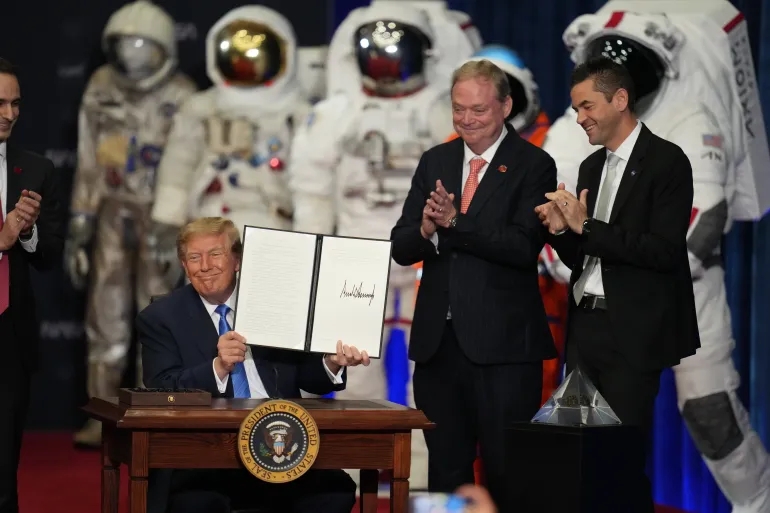
President Donald Trump signed an executive order Friday to begin creating a US Space Academy, a military and civilian institution modeled on West Point and the nation's other service academies that would train officers, engineers, and astronauts for the Space Force, NASA, and the growing commercial spaceflight industry.
Trump made the announcement at NASA's Johnson Space Center in Houston, where he presented the Congressional Space Medal of Honor to the four-member crew of Artemis II, the mission that looped around the far side of the moon in April and carried humans deeper into space than ever before.
"You think of West Point, and you think of Annapolis, and you think of the Air Force Academy, and you think of the Coast Guard academies. Great, they're all great," Trump told the gathered astronauts, engineers, and NASA managers. "But we're going to have now an academy for what the people in this room love the most." He said the school will "attract, train and graduate the very best of our nation" and pledged it would be "top line" — "the equivalent of the others, which are great."
The order establishes an eight-member commission, led by NASA Administrator Jared Isaacman, to advise the president on launching the institution, with membership including Defense Secretary Pete Hegseth, Air Force Secretary Troy Meink, and Office of Management and Budget Director Russ Vought. The commission will explore options for establishing the academy within NASA, and the proclamation says the school would "develop a professional corps of civically grounded leaders prepared to advance American interests within the space domain."
Trump said he would choose a location "very shortly," ribbing Senator Ted Cruz and the Texas delegation in attendance for their lobbying. "Just leave me alone, Ted, please, leave me alone," he joked. "Everybody wants it because it's the hot thing. Space is the hot thing."
Filling a Gap the Pentagon Left Open
The academy answers a question deferred since Trump created the Space Force in 2019 as the military's sixth branch. The Defense Department declined at the time to build a separate school for the new service; Space Force officer candidates have instead been commissioned largely through the Air Force Academy in Colorado Springs, where 93 cadets — about 10% of the graduating class — entered the branch in 2025. The Naval Academy has its own long tradition of producing astronauts.
Lawmakers have floated a standalone academy for years, and the idea appeared in the Heritage Foundation's Project 2025 blueprint, which envisioned a training institution for "aero–astro students, engineers, and scientists" that could grow to be "on par with the other service academies."
The rationale extends beyond the military. The Space Force's workforce runs 25% below what Congress requires, according to a 2025 watchdog report, and space companies have struggled to attract talent as demand for launches and spacecraft services soars — competition from giants like SpaceX and Blue Origin has driven up hiring costs across the industry. "Given the rapid growth of the Space Force and the commerce space industry and the expansion of our ambitions to the moon and far beyond the moon," Trump said, "it's clear we will need to educate and train an entire generation of skilled service members, engineers and civil operators."
The practical path remains unmapped. Building a campus, creating curriculum, and recruiting students would require congressional funding, and NASA itself faces a 25% budget cut in the administration's 2027 request — though House appropriators have drafted a bill rejecting most of the reductions. What access the civilian industry would have to a federal academy is also unclear, and the permanent home of US Space Command remains tied up in litigation over Trump's decision to move it from Colorado to Alabama.
Medals for the Moon Crew
The ceremony's centerpiece was the medal presentation to Artemis II commander Reid Wiseman, pilot Victor Glover, mission specialist Christina Koch, and Canadian Space Agency astronaut Jeremy Hansen, whose roughly 10-day flight ended with a Pacific splashdown near San Diego after reentering the atmosphere at 30 times the speed of sound. "They crossed behind the dark side of the moon and glimpsed sights never seen before," Trump said.
"We are going to wear them with pride," Wiseman told the president. "But please know, it is not pride for ourselves that we feel... It is pride for the grit that our families had when we left this planet. It is pride for this NASA team that sent us on this mission. And it is pride for the international community that stood alongside us."
Hansen became just the second foreign national to receive the medal, after Israeli astronaut Ilan Ramon of the shuttle Columbia's final crew — and Trump was gracious in pinning it on the Canadian despite the escalating US-Canada trade war. Established in 1969 with Apollo 11's Neil Armstrong among its first recipients, the honor has now gone to 34 astronauts. The crew presented Trump with a blue NASA flight jacket in return.
Trump later visited mission control and spoke with the International Space Station's crew, becoming the third sitting president to do so from that room. "I wouldn't do it," he admitted of spaceflight. "I would not want to do it."
A Crowded Calendar and a Race With China
The academy lands amid an ambitious and strained lunar program. The multibillion-dollar Artemis effort targets its first astronaut landing in 2028 — Trump's final year in office — but development delays with SpaceX's Starship lander have put the timeline at risk, with Blue Origin's competing lander a possible alternative. NASA refocused next year's Artemis III mission in February from a landing to Earth-orbit docking drills with both companies' lander mockups, and a Blue Origin rocket explosion at Cape Canaveral in May raised further readiness questions.
China is pursuing its own crewed landing around 2030, and both countries covet the lunar south pole, where water ice embedded in the soil could one day supply fuel. Trump also said the US would launch a nuclear-powered spacecraft to Mars in 2028 as "the gateway" to interplanetary travel, and pointed to Sunday's scheduled launch of the Nancy Grace Roman Space Telescope from Kennedy Space Center.
"A nation cannot be first on Earth if we're going to be second in space," Trump said. "We will explore it, tame it and we will win it."
The president credited his administration with reviving a program he described as dormant when he first took office, claiming NASA had been "absolutely closed." The record is more layered: the space station has been continuously staffed across every administration since 2000, and the commercial crew program that produced SpaceX's Crew Dragon began under President Barack Obama. What is not in dispute is the trajectory Trump has set — a service academy for space, a moon landing on his clock, and a legacy project measured in institutions as much as missions. Isaacman put the ambition in the ceremony's terms: the missions ahead, he said, would "inspire the next generation to carry the fire of exploration even further."
Author

We cover the world’s chaos so you don’t have to scroll twelve feeds to understand it.
Sign up for Atlas newsletters.
Stay up to date with curated collection of our top stories.



