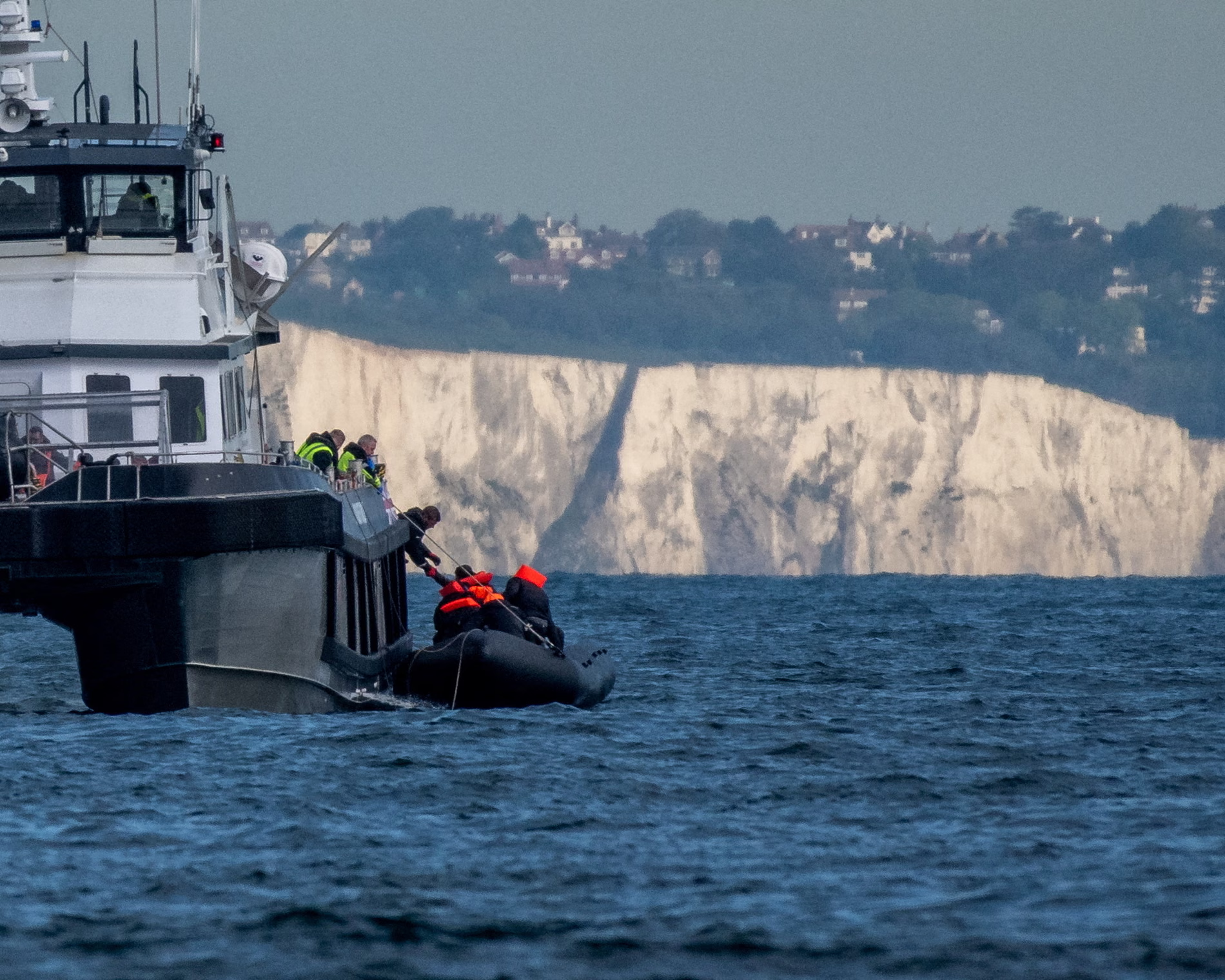
Reform UK leader Nigel Farage announced that a government led by his party would use the armed forces to prevent migrant boats from crossing the English Channel, unveiling a plan he called "Operation Fortress" that would place the Royal Navy in command of a blockade-style operation and return intercepted vessels to French waters.
"On day one, we will instruct the Royal Navy to take operational command of the Channel," Farage said at a campaign event in Dover, flanked by the party's deputy leader Richard Tice and its head of policy. "Boats will be intercepted, turned around where it is safe to do so, and taken back. The crossings will stop within weeks because the business model of the smugglers will be dead."
The plan calls for naval vessels and Border Force cutters to operate under a single military command, supported by aerial surveillance drones and additional patrol craft. Farage said migrants picked up at sea would not be brought to British shores for processing, and that those who do reach land would be detained and removed under a new legal framework stripping most avenues of appeal.
Reform UK has led national polling for months, and the announcement is the party's most detailed policy statement yet on the issue that has powered its rise. More than 25,000 people have crossed the Channel in small boats so far this year, on pace to approach recent annual records.
How the Plan Would Work
Under the proposal, the UK would withdraw from the European Convention on Human Rights and disapply sections of the Human Rights Act and the Refugee Convention's incorporation into domestic law, which Farage said "tie the hands of every government that has tried to deal with this." The party says primary legislation would establish that arrival by small boat bars any asylum claim, with detention followed by removal to the country of origin or a third country.
Farage said a Reform government would seek a returns agreement with France backed by what he called "serious leverage," including linking cooperation to broader trade and security arrangements. Absent French agreement, he said, the navy would carry out "tactical turnarounds" — escorting or towing boats back to the median line of the Channel and transferring passengers to French vessels or delivering them to the edge of French territorial waters.
"The French pick people up and hand them to us. We will simply reverse the flow," Tice said.
The party costed the operation at 2.5 billion pounds over a parliament, offset, it said, by savings from closing asylum hotels, which currently cost the government several million pounds a day. Reform's document names the operation's proposed commander as a serving rear admiral it did not identify, saying military figures had been consulted in drafting it.
Legal and Operational Obstacles
The plan drew immediate challenge on feasibility. Maritime law experts noted that turning boats around in the world's busiest shipping lane raises safety-of-life obligations under international conventions to which the UK would remain party regardless of ECHR withdrawal. The UN refugee agency said any policy of returning people without individual assessment would breach the principle of non-refoulement.
France's interior ministry said it would not accept unilateral returns to its waters or territory, calling the proposal "a fantasy that would end cooperation overnight." French officials have long argued that turnaround tactics create capsizing risks, a position British maritime commanders have echoed in past reviews. A previous Conservative government examined pushback tactics in 2021 before abandoning them on legal and safety advice; documents from that review concluded the tactics could be used against only a small fraction of boats, if any.
Defense officials past and present questioned the use of the navy in a policing role. A former First Sea Lord said warships are "the wrong tool" for mass migrant interception and warned of mission strain on a fleet already stretched by commitments in the North Atlantic and the Gulf. The Ministry of Defence declined to comment on opposition policy. When the navy briefly held primacy over Channel operations in 2022, crossings continued at record pace, and the role was returned to Border Force within months.
Farage dismissed the objections as "the same voices who have overseen total failure," saying the difference is political will. "Australia did it. The boats stopped. Everyone said it was impossible until it worked."
The Politics of the Channel
The announcement forced responses across the political spectrum. Prime Minister Andy Burnham, in office barely a week, called the plan "a slogan dressed up as a strategy" and said his government would judge policies "by whether they actually stop the crossings, not by how they sound." He pointed to the returns arrangement with France agreed under his predecessor, which has removed a limited number of arrivals, and said expanding it is "the only route that works with our neighbors rather than against them."
The Conservatives, seeking to recover ground lost to Reform, said they supported military involvement "where operationally sound" but stopped short of endorsing turnarounds. The Liberal Democrats and Scottish National Party condemned the plan outright. Several backbench Labour MPs in northern and coastal seats, where Reform polls strongest, urged the government to toughen its own approach rather than dismiss the proposal.
Polling on the issue shows majorities describing the crossings as a crisis and supporting stronger measures in principle, with support falling when specific tactics such as turnarounds at sea are described. Reform strategists regard the issue as their clearest dividing line with both major parties, and Farage said the party would make it "the central question" of the next general election.
Precedents and What Comes Next
Reform's document leans heavily on Australia's Operation Sovereign Borders, which combined naval turnbacks with offshore processing and is credited by its architects with halting maritime arrivals. Critics note the Channel differs materially: crossings span 21 miles of congested sea rather than open ocean approaches, France is yards away rather than Indonesia's hundreds of miles, and the UK's legal obligations run through European institutions Australia never joined.
The party says it will publish draft legislation within months, including the framework for ECHR withdrawal, which would require parliamentary passage and would trigger consequences for the Good Friday Agreement and the UK-EU trade deal, both of which reference the convention. Legal scholars said withdrawal alone would not extinguish non-refoulement obligations, which arise under separate treaties and customary international law.
With a general election not due until 2029 but the government's majority under strain, Farage said Reform is "preparing for power, not protest." Whether Operation Fortress becomes policy will depend on an election still years away; its immediate effect is to set the terms of a debate every party now has to answer.
Author

We cover the world’s chaos so you don’t have to scroll twelve feeds to understand it.
Sign up for Atlas newsletters.
Stay up to date with curated collection of our top stories.