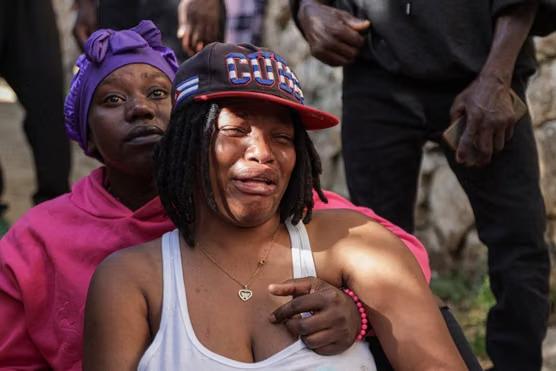
A powerful gang coalition attacked the farming community of Kenscoff in the hills above Haiti's capital late Sunday, killing dozens of people — some execution-style — in a raid that targeted a church sheltering families who had already fled earlier violence, and igniting furious protests over the failure of police stationed minutes away.
The United Nations Integrated Office in Haiti said at least 47 people were killed and more than 22 injured, cautioning that estimates could still change. Kenscoff Mayor Jean Massillon told reporters searchers had counted around 40 bodies with people still missing, describing "a night of terror" that began around 10:30 p.m. The Haitian rights group RNDDH put the toll at 30 to 40 dead and 15 to 20 wounded, warning a complete count remained difficult.
"The bandits raided a displaced persons camp located in a church. They executed several people. There are fatalities and dozens of wounded. Some people were abducted by the criminals," Massillon said. Several of those killed had fled gang violence earlier this year, he added. "It is still impossible to establish a definitive death toll due to access difficulties and communication problems."
Massillon blamed Viv Ansanm, the gang coalition the US government designated a foreign terrorist organization last year. "They sowed chaos," he said. Among the properties burned were homes owned by Dr. Jean "Bill" Pape, the renowned physician whose nongovernmental organization treats Haitians with HIV and tuberculosis.
Grief in the Streets, Anger at the Police
Wails filled Kenscoff at dawn Monday as survivors found bodies of friends and relatives in the streets, some wrapped in blood-spattered sheets. "They killed my son!" one woman repeated as neighbors tried to comfort her. Robert Jean said he heard shooting before dawn and ran to wake people so they could escape; he later learned his brother was among the dead. Mathurin Pierre, a 41-year-old farmer, said he lost 14 loved ones, with an unknown number still missing.
The rage turned quickly on the authorities. Residents demanded the resignation of the local police chief, noting the church sits just minutes from the police station, and tried to flip a car to block a street as they protested for intervention. "If only we had a good police force that would have placed an armored truck here, what happened here would have been prevented," said Verti Enold-Saint as he pulled a sheet over the body of his brother-in-law.
National Police Director Vladimir Paraison visited the area and defended his officers under press questioning. "The police never lowered their arms," he said. "Look at how many police officers are here; the response is in front of you." Jean Fritz Patterson Dorval, head of the Port-au-Prince prosecutor's office, said eight armored vehicles are assigned to Kenscoff, adding that "there are technical responses that only the mayor and the police can answer."
The office of Prime Minister Alix Didier Fils-Aimé condemned the "heinous attack," saying security forces were on highest alert and reinforcements were being deployed. "Kenscoff will not be abandoned. Haiti will not be handed over to bandits. The Republic will prevail," the statement said. Haiti's Office of Citizen Protection decried the massacre, saying the dead included "numerous" young Haitians.
A Strategic Town Under Repeated Assault
Kenscoff's suffering is not incidental. The mountainous municipality southeast of Port-au-Prince overlooks routes into Pétion-Ville — home to embassies, upscale hotels, and the temporary seat of government — as well as roads connecting the capital to Haiti's south, making it a prize for gangs seeking to encircle the city.
The town has absorbed roughly a dozen attacks since early last year, when an initial wave of assaults killed more than 260 people, destroyed or burned 200 homes, and displaced 3,000 residents, according to the UN. Many of Sunday's victims were among those uprooted then — displaced people attacked again in the place they had gone for refuge.
The raid unfolded as the UN-backed Gang Suppression Force, the multinational mission mandated to help Haiti's police fight the gangs and replace an underfunded predecessor, works toward a planned full strength of more than 5,500 troops by fall. A spokesperson for the force did not respond to a request for comment on the attack.
A Country Held by Its Gangs
The numbers behind the crisis have become grimly routine. Gangs control an estimated 70% of Port-au-Prince, and violence has displaced a record 1.5 million people in a country of 11 million, with more than 5 million facing severe food insecurity. UN statistics recorded more than 3,100 people killed and 1,189 injured in the first six months of this year alone.
Haiti has not held an election since 2016. President Jovenel Moïse was assassinated in 2021 and never replaced, and the gang offensive of early 2024 forced the resignation of the unelected prime minister then in office. A general election is now scheduled for December 13, with voter registration underway in Port-au-Prince and beyond — though security experts have warned the country remains too dangerous to vote safely.
Deportations Land in the Middle of the Crisis
The attack came less than a week after the United States deported more than 160 people to Haiti on August 20 — the first removal flight since the Trump administration won its legal fight to end temporary protected status for some 350,000 Haitians. Haiti's government has said the deportees included TPS holders who had been working legally in the US, and even some people of Haitian origin not born in Haiti. The Department of Homeland Security countered Monday that those aboard included several gang members with records ranging from assault to drug trafficking.
The collision of policies leaves Haiti absorbing returnees into the same landscape its residents are fleeing: a capital ringed by armed coalitions, a police force outgunned despite international reinforcement, and towns like Kenscoff where families displaced once, then twice, gathered in a church that offered no protection at all. The government has promised, again, that reinforcements are coming. The residents blocking roads with overturned cars on Monday were measuring that promise against the bodies in their streets.
Author

We cover the world’s chaos so you don’t have to scroll twelve feeds to understand it.
Sign up for Atlas newsletters.
Stay up to date with curated collection of our top stories.



