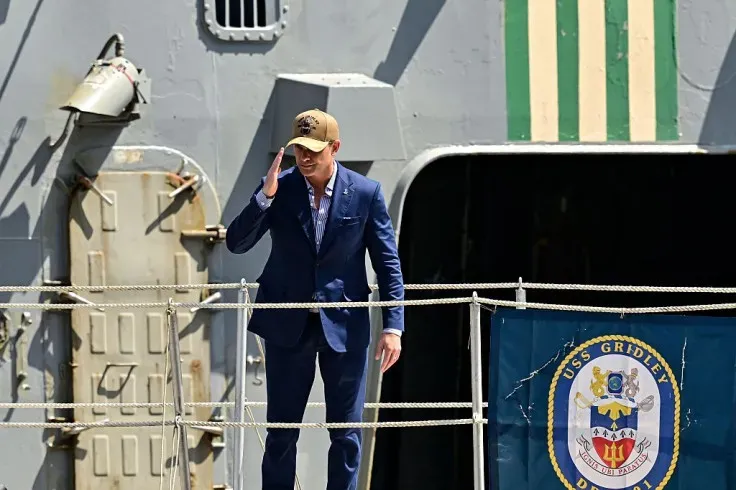
Defense Secretary Pete Hegseth capped a gathering of the Americas Counter Cartel Coalition in Panama by giving the US-led bloc a new motto — "we do bad things to bad people" — and announcing that Colombia's week-old government has invited the American military into joint operations against armed groups on its soil.
"Maybe formal, maybe informal, I haven't decided yet," Hegseth said of the slogan at the close of the two-day conference in Panama City on Wednesday. "That's the mentality I want to have inside this room. Now we're good people that do good things. But ultimately, we're dealing with bad people that have done a lot of bad things to a lot of good people for a very long time. And they're about to meet a new sheriff in town."
The centerpiece announcement was Colombia's entry as the coalition's 19th member. "Through the newly inaugurated president, as our president likes to say, President El Tigre, Colombia has already requested that the Department of War join Colombia in its fight against narco-terrorism, authorizing joint military operations to destroy terrorists and terror networks," Hegseth said, referring to President Abelardo de la Espriella by his nickname, "The Tiger."
Asked whether he had discussed joint strikes with his Colombian counterpart against groups such as the National Liberation Army, which the US designates as a terrorist organization, and remnants of the Revolutionary Armed Forces of Colombia, Hegseth answered, "Yes." He added: "Designated terrorist organizations, with partnered governments, will be legitimate targets of the United States government."
A Sharp Turn in Bogota
The invitation marks a dramatic reversal from the government of Gustavo Petro, the leftist former president who clashed repeatedly with President Donald Trump and was excluded from the March summit that produced the coalition. De la Espriella, sworn in Friday in Cali, pledged in his inaugural address to "definitively eradicate the scourge of illicit crops" and to join the US-backed Shield of the Americas initiative, and the Trump administration announced plans the same day to provide $1 billion in security assistance to his government.
Colombia's new defense minister, Jorge Eduardo Mora, a retired major general, told the gathering his country could play a critical role against traffickers on both its Pacific and Caribbean coasts. "I think the time has arrived for the narco-terrorist cartels to confront the power and the capabilities of the entire hemisphere, led by the United States," he said. A US official said the emerging partnership is expected to surpass the cooperation of Plan Colombia, the anti-narcotics program launched in the early 2000s.
The announcements came days after a magnitude 7.4 earthquake devastated western Colombia, and Hegseth opened his remarks with condolences, saying the Pentagon and State Department were mobilizing "critical life-saving aid" to support Bogota's response.
A Year of Strikes, and a Widening Land Campaign
The Panama meeting fell nearly one year into Operation Southern Spear, the campaign of military strikes on suspected drug vessels that began September 2, 2025. US forces have struck 66 boats, killing 218 people aboard and rescuing four survivors, with 47 strikes in the eastern Pacific and 17 in the Caribbean. A Pentagon inspector general report released in late July put the operation's cost at roughly $820 million.
Hegseth claimed sweeping results: reductions in narco-vessel movement of at least 65% in the western Caribbean, 60% in the eastern Caribbean, and nearly 50% in the eastern Pacific. "This is a bad time to get in a drug boat in the Western Hemisphere," he said. The mission has now been transferred to the newly established Joint Task Force Western Hemisphere, the action arm of US Southern Command.
The campaign is increasingly moving ashore. Hegseth commended Ecuador as the first coalition member to conduct a combined kinetic operation with US forces — a March strike on a training camp used by the Comandos de la Frontera — and thanked Honduras and Guatemala for inviting similar operations, along with Jamaica for a new Caribbean partnership. "Like you saw with the strikes on the drug boats, of the DTOs, same effect on land," he told reporters. The land campaign builds on precedents set this year in Venezuela, where a US-led commando raid deposed Nicolas Maduro in January and a June airstrike coordinated with the new government targeted the leader of Tren de Aragua.
Hegseth also kept pressure on Cuba, telling reporters that "all options are on the table, to include military options," and warning Havana "to pay attention to the willingness of President Trump to assert American strategic prerogatives."
Broadsides at the ICC and a "Trump Corollary"
The strikes have drawn accusations from critics — including some legal scholars and human rights organizations — that they amount to extrajudicial killings potentially within the International Criminal Court's reach. Hegseth met the criticism head-on, urging every coalition member to withdraw from the court entirely.
"There is no legitimate basis for the ICC's lawless power grab," he said, asserting that US operations are "100 percent lawful under the laws of armed conflict" and that the court "poses a threat to your national sovereignty, your constitutional mandates, and the national interests of your people — just as it does ours." He did not specify what actions the court has taken against US operations in the region. The Trump administration has waged a broader campaign against the ICC over its arrest warrants for senior Israeli officials and investigations into US personnel in Afghanistan.
Hegseth framed the entire effort as a revival of the Monroe Doctrine — updated as what he called the "Trump corollary," and what he has elsewhere dubbed the "Donroe Doctrine." "We will defend our hemisphere from external threats to national sovereignty, whether from narco-terrorism or foreign malign actors," he said. "And we will deny adversaries the ability to position forces, or otherwise threaten capabilities, in our hemisphere."
Panamanian President Jose Raul Mulino, hosting the conference as thousands of troops conducted the PANAMAX exercise in Panama for the first time in 14 years, called drug trafficking the region's biggest threat and dismissed sovereignty concerns about the coalition, saying the real threats to sovereignty are the criminal networks themselves. "There's never going to be a sustainable peace if this enemy advances," he said.
Partnership With Conditions
Hegseth paired the outreach with expectations. He pointed to the administration's proposed $1.5 trillion defense budget as evidence of American commitment and told members the Pentagon would prioritize support for countries making "substantial investment" in their own capabilities — including through status of forces, basing, and overflight agreements. "President Trump does not tolerate free riding," he said.
The secretary cast the coalition in civilizational terms, describing member nations as "the offspring of Western civilization" facing a shared test against "narco-terrorists, violence, radical Marxism and globalist exploitation." The Pentagon's annual civilian casualty report, sent to the Senate this week, stated that as of February 1 it had identified no instances in which civilian casualties "more likely than not resulted" from US operations in Southern Command's area of responsibility in 2025 — a conclusion critics of the boat strikes dispute, given the 218 killed and the classified basis for targeting decisions.
For Colombia, the immediate question is what joint operations will look like in practice — and how a country still digging out from its deadliest earthquake in decades absorbs a security partnership its new president sought within days of taking office. "Our citizens and our nations deserve and expect real, concrete actions," Hegseth said. "We believe there's no time to waste."
Author

We cover the world’s chaos so you don’t have to scroll twelve feeds to understand it.
Sign up for Atlas newsletters.
Stay up to date with curated collection of our top stories.



