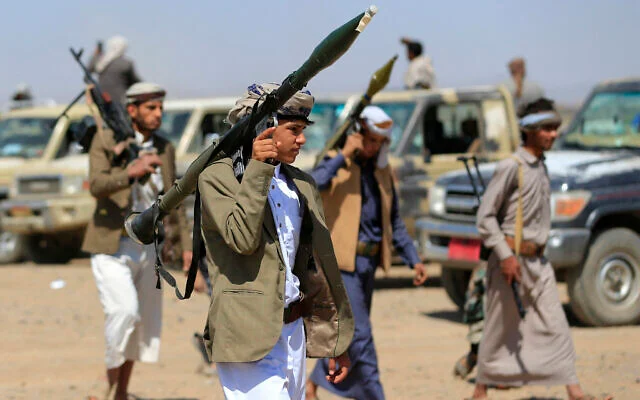
Yemen's Houthis launched ballistic missiles and drones at Saudi Arabia's Abha International Airport on Monday, their first claimed attack on the kingdom since an informal truce took hold in 2022. Saudi air defenses said they intercepted the missiles. No casualties were reported.
The strike was retaliation, the Houthis said, for airstrikes hours earlier on Sanaa International Airport, which they blamed on Riyadh. Yemen's internationally recognized government claimed those strikes itself, saying it had hit the runway to stop an Iranian plane from landing. Saudi officials said nothing about the airport attack at all.
The Iranian Plane
The whole confrontation turned on a single aircraft. Open-source flight trackers followed a flight bound for Sanaa on Monday, said to be operated by Iran's Mahan Air, leaving Iran and passing over Oman. It was carrying a Houthi delegation home from Tehran, where they had attended the funeral of the late Iranian supreme leader Ali Khamenei.
Yemen's defense minister, Gen. Taher al-Aqili, said the government had exhausted its diplomatic options and had tried and failed to get the delegation onto a flight with the domestic carrier Yemenia instead. "At this moment, we say that our patience has run out," he said, warning that his forces would confront any hostile aircraft violating Yemeni airspace "by all available means."
The runway was struck. Video from the Houthi-run al-Masirah channel showed a projectile hitting the tarmac and a plume of smoke rising. Residents reported explosions and aircraft overhead. The Iranian plane diverted and landed at Hodeidah, a Houthi-controlled airport on the Red Sea coast, roughly 90 miles away. It is unclear whether anyone tried to stop it there.
Rashad al-Alimi, who heads Yemen's Presidential Leadership Council, said Iran had requested permission to fly the delegation home and the government refused. The Houthis, he said, insisted on receiving the flight "outside the legal and sovereign frameworks governing civil aviation." For more than a decade, aircraft entering Yemeni airspace have needed clearance from the Saudi-led coalition, which says it enforces the requirement at the government's request. The Houthis have been trying to break that arrangement by arranging direct flights from Iran.
The Response
Houthi military spokesman Brig. Gen. Yahya Saree called the airport strikes "blatant aggression" and said Saudi Arabia had ended the de-escalation phase. "This aggression will not go unanswered or unpunished," he said.
By evening he was announcing the retaliation: ballistic missiles and drones aimed at Abha International Airport, in a mountainous southern Saudi province bordering Yemen where many Saudis go to escape the summer heat. He also issued a warning to commercial aviation, telling airlines to avoid Saudi airspace, and to take that seriously "until the blockade on Sanaa International Airport is lifted."
Maj. Gen. Turki al-Malki, spokesman for the Saudi-led coalition, said air defenses "intercepted a ballistic missile threat launched by the terrorist Houthi militia towards the southern region." He gave no further detail. A senior Houthi official, Hazem al-Assad, went further than Saree, saying the Saudi regime would find "it has dug its own grave."
Al-Alimi, for his part, said he had ordered that the scope of the confrontation not be expanded, and set up a crisis team to coordinate the military, diplomatic, and legal response. Tehran condemned the strikes on Sanaa as a clear violation of international law.
A Truce Under Strain
The 2022 arrangement between Riyadh and the Houthis has never been a formal ceasefire, but it has held for four years, ending a period in which Saudi jets bombed Houthi-held areas and Houthi missiles hit Saudi oil facilities. It survived the Gaza war, the Houthi campaign against Red Sea shipping, and the Iran war. Monday was the first crack.
Mohammed al-Basha of the Basha Report, a US-based risk advisory, said the pattern now matters more than any single strike. "If this cycle of action and retaliation continues, it could effectively mark the collapse of the April 2022 ceasefire framework and signal a return to a much more intense phase of the conflict," he said.
Andreas Krieg, a security lecturer at King's College London, said it is technically possible the Yemeni government carried out the airport strike with aircraft from the UAE, but noted its own jets date to the 1980s and are in poor condition. That, he said, makes Saudi involvement the likelier explanation, whatever Riyadh's silence.
The UN Security Council held an emergency meeting Monday afternoon. "Yemen and the wider region cannot afford another cycle of escalation," Khaled Khiari, the assistant secretary-general for political affairs, told the 15 members. Hans Grundberg, the UN's Yemen envoy, urged the parties to protect the relative calm that has held since 2022.
Wider Currents
The flare-up lands amid a region already on fire. The United States is bombing Iran for a third straight night, Iranian missiles are hitting Gulf states, and the Strait of Hormuz is contested. Saudi Arabia has weathered that better than its smaller neighbors, in part because it can move oil east to west by pipeline to its Red Sea coast, bypassing Hormuz entirely. A shooting war with the Houthis, who have attacked Red Sea shipping before, would put that route at risk.
There were early signs of exactly that. The UK Maritime Trade Operations center reported suspicious activity off Yemen on Monday, with six small boats approaching a tanker in the Gulf of Aden. The vessel fired warning shots as the boats kept trailing it. The incident is under investigation. Roughly $1 trillion in goods moves through the Red Sea each year, funneled through the Bab al-Mandab Strait, 20 miles wide at its narrowest.
The Saudi-led coalition that has fought the Houthis since 2015 is not what it was. It fractured late last year when a UAE-backed separatist movement swept through territory in the south, and the Emirates ultimately pulled out of Yemen. Separately Monday, the Yemeni government accused the Houthis of detaining a Red Cross aircraft at Sanaa airport and holding its pilot and co-pilot. The ICRC said its staff and crew were safe and accounted for, and declined further comment. An ICRC-brokered prisoner swap between the two sides collapsed in recent days, with each blaming the other.
Yemen's war has killed hundreds of thousands since 2014 and produced one of the world's worst humanitarian crises. The Houthis hold Sanaa and most of the populous north; the government holds much of the south from Aden. Whether Monday marks a return to that war, or a single exchange that both sides let cool, will likely be decided in the next several days.
Author

We cover the world’s chaos so you don’t have to scroll twelve feeds to understand it.
Sign up for Atlas newsletters.
Stay up to date with curated collection of our top stories.