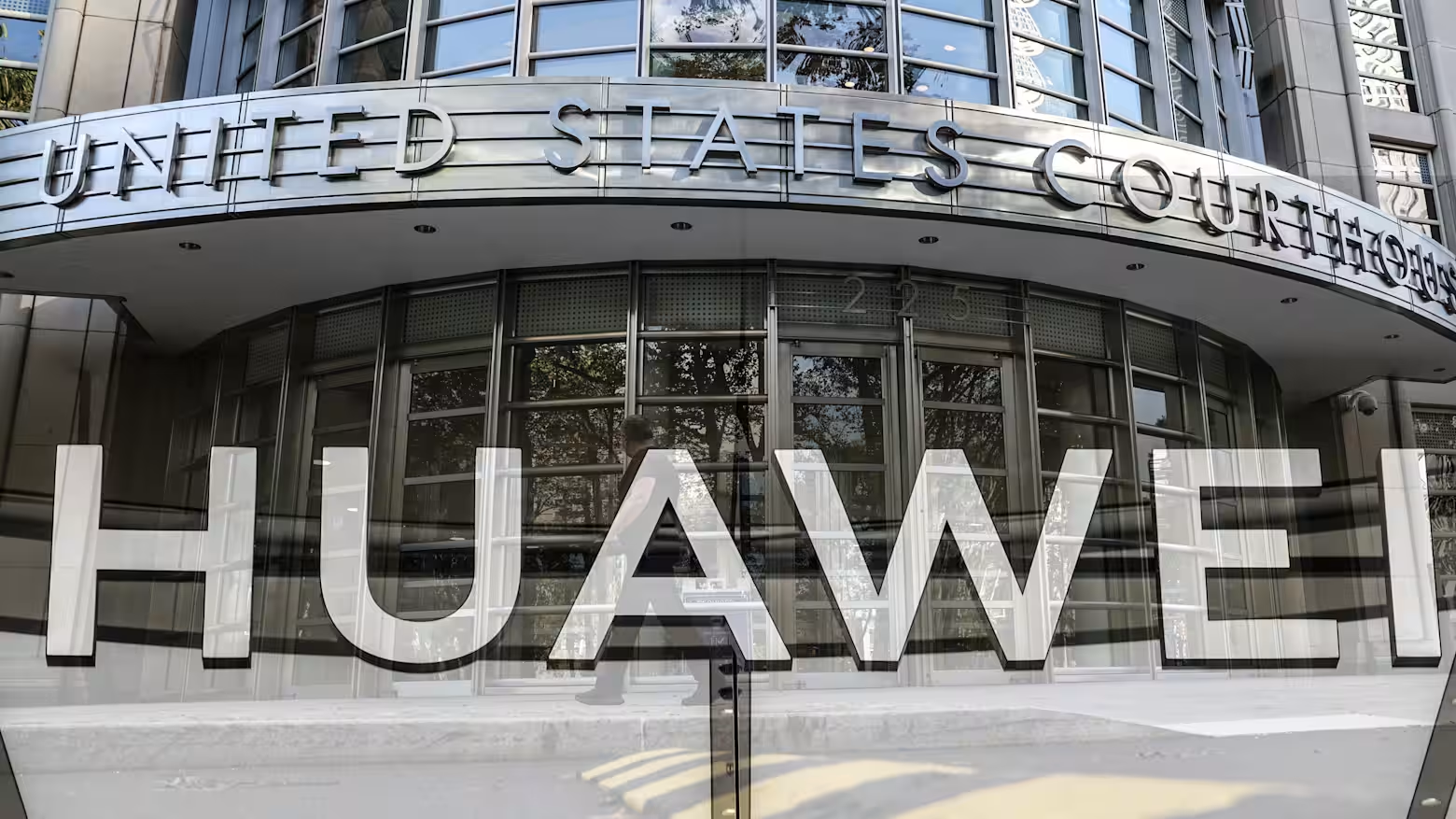
Jury selection began Tuesday in Brooklyn federal court in the long-delayed criminal case against Huawei Technologies, the Chinese telecom giant accused of running a decades-long racketeering enterprise built on trade-secret theft, bank and wire fraud, and sanctions evasion. U.S. District Judge Ann M. Donnelly of the Eastern District of New York opened questioning of potential jurors as the company pleaded not guilty to all 14 counts that prosecutors say stretch from roughly 1999 to 2020. Opening statements were expected no earlier than Wednesday; the trial is projected to last about three months.
This is not a new indictment. Secret charges dating to about 2018 became public in 2019 and were later expanded through superseding filings. The case was brought under the first Trump administration, sat through the Biden years, and is now being tried in Trump’s second term. What begins now is the public airing of a prosecution that has shadowed U.S.–China technology rivalry for most of a decade.
Prospective jurors filled out 27-page questionnaires that included questions about their views on the Chinese and Iranian governments — a signal of how tightly the docket sits against foreign-policy noise. Donnelly told them that China and the Chinese Communist Party are not on trial and that the ongoing U.S.–Iran conflict must not sway their judgment.
What Prosecutors Say The Enterprise Was
Federal prosecutors cast Huawei as a criminal enterprise that sought to dominate global markets by stealing intellectual property from U.S. technology firms and concealing business in sanctioned states. The indictment alleges trade-secret theft involving five American companies, money laundering, obstruction, and violations tied to Iran and North Korea. Internal code names alleged in charging papers labeled Iran "A2" and North Korea "A9."
A central strand involves Skycom, a Hong Kong company prosecutors describe as a shell that functioned as Huawei’s Iranian arm, routing sanctioned business while banks were allegedly misled about the relationship. Prosecutors say Skycom and related channels moved more than $100 million through the U.S. banking system in ways that violated Iran restrictions; the bank is not named in the indictment but has been identified in reporting and court-related accounts as HSBC. Huawei denies the characterization and the criminal intent.
The indictment also alleges that Huawei supplied surveillance equipment that helped Iran track protesters during the 2009 anti-government demonstrations in Tehran. Another episode cited in the indictment involves a Huawei engineer who, prosecutors allege, photographed and stole designs related to T-Mobile’s phone-testing robot arm, nicknamed Tappy. Huawei disputes it.
CFO Meng Wanzhou’s 2013 presentation to HSBC about Iran ties sits in the background. Criminal charges against her personally were later dropped after she completed a deferred prosecution agreement and signed admissions that her statements were false; Judge Donnelly has ruled those admissions may be used as evidence against the company.
Huawei’s Denial And Beijing’s Charge Of Overreach
Huawei calls the government’s "overarching narrative" demonstrably false. It attributes recent commercial strength — citing about $126 billion in global sales last year — to its own research and development, not to theft. Defense filings have argued the case is impermissibly extraterritorial and too vague, casting it as leverage in a wider U.S.–China tech and trade confrontation rather than a clean sanctions or fraud prosecution.
Beijing has framed the prosecution as economic bullying dressed in national-security language. Washington, for its part, has long treated Huawei as a security risk: the first Trump administration blacklisted the firm in 2019 and pressed allies to keep its equipment out of next-generation networks. Canada, Britain, and others later restricted or banned the company’s gear. A conviction could expose Huawei to large forfeitures and fines that legal experts say could run from hundreds of millions into the billions of dollars.
A Narrower Case Arrives At A Geopolitical Moment
Days before jury selection, prosecutors trimmed the indictment, dropping two export-control counts and a trade-secret predicate widely identified as involving Motorola, leaving a leaner slate of counts for the jury. The core theories — racketeering conspiracy, bank and wire fraud, remaining trade-secret allegations, and Iran- and North Korea–related deception — still stand.
Part of the three-month trial is expected to overlap a planned Sept. 24 meeting in Washington between Chinese President Xi Jinping and President Donald Trump.
Author

We cover the world’s chaos so you don’t have to scroll twelve feeds to understand it.
Sign up for Atlas newsletters.
Stay up to date with curated collection of our top stories.



