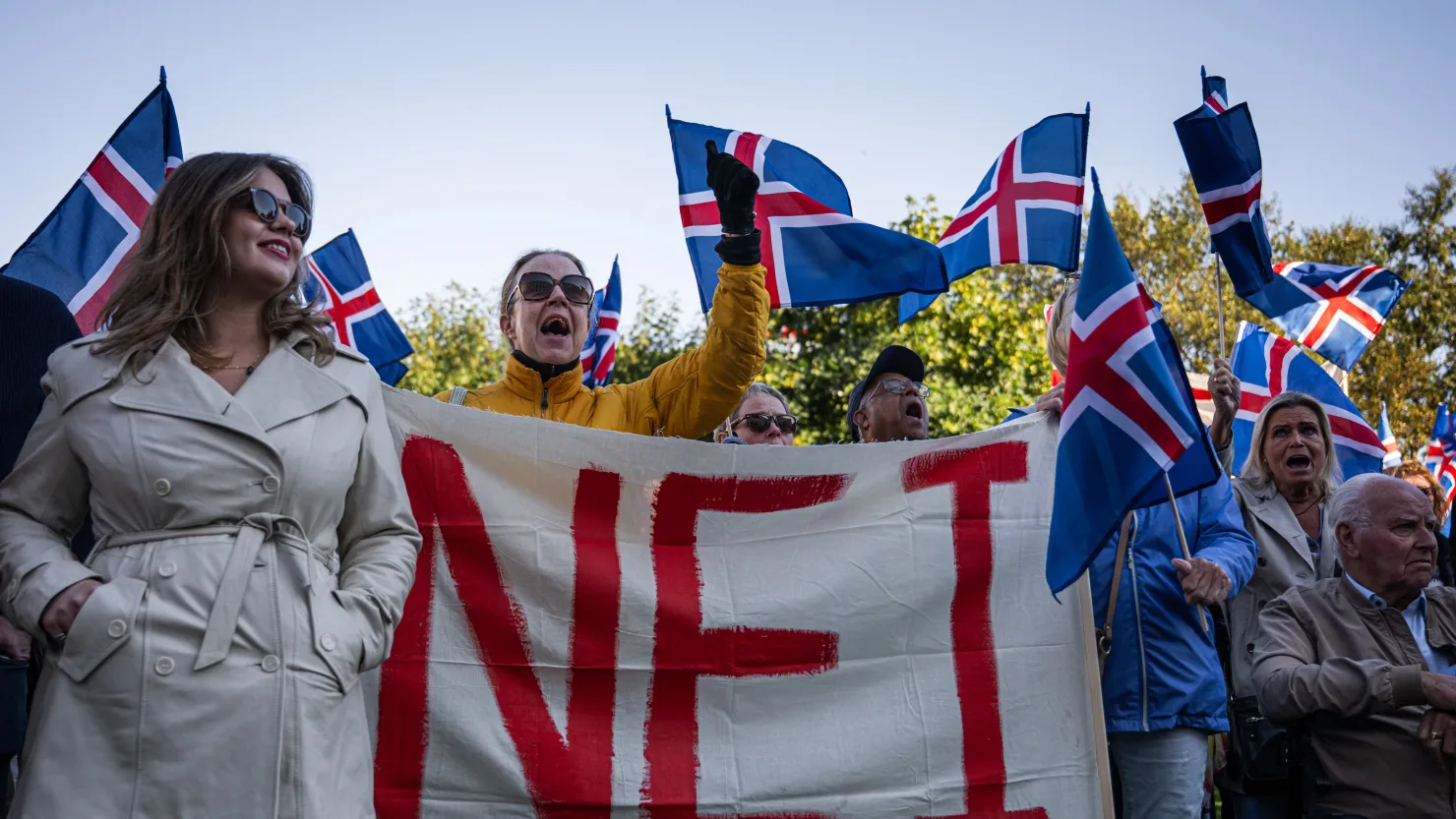
Icelandic voters rejected a government proposal to resume negotiations on joining the European Union, choosing national control of the country's fisheries over the security arguments that had pushed the question back onto the ballot 13 years after accession talks were shelved.
The "No" side prevailed 52.8% to 47.2% in Saturday's referendum, according to final results published Sunday by the National Electoral Commission and public broadcaster RUV, a margin of roughly 12,600 votes out of 225,031 cast. Turnout among the roughly 270,000 eligible voters reached 82.5% — the highest in any Icelandic election since 2009 — and the capital, Reykjavik, was the only area of the island nation of nearly 400,000 where a majority voted yes.
The count kept the country on edge through the night. The "Yes" campaign took an early lead on the strength of capital-area ballots before rural returns swung the result; by dawn only a few hundred votes separated the camps before the gap widened.
Prime Minister Kristrún Frostadóttir, whose center-left government backed resuming talks, said she would respect the outcome and would not revisit the issue during her term, which runs to 2028. "I don't see this as a setback. I see this as a victory for democracy," she said. "We had over 80% of the country participate in a matter like this." She left the door ajar for a distant future attempt: "Something big has to change in the next 24 months for this to be at the top of the agenda."
A Question of Fish, Answered Again
The ballot asked a single question — "Should Iceland resume accession negotiations with the European Union?" — and a yes would not have meant joining: any negotiated accession agreement would have required approval in a second referendum. The vote was technically nonbinding, though the government pledged in advance to honor it.
The campaign turned on the issue that has defined Iceland's EU debate since it first applied in 2009 amid the wreckage of its banking collapse: fisheries. Roughly 90% of companies in the industry opposed membership, fearing the bloc's common fisheries policy would open Icelandic waters to Spanish, Dutch, and other trawlers and cede control over catch limits to Brussels. Marine products and farmed fish accounted for nearly 47% of the country's exports over the past year, even as fishing's share of the broader economy has declined for decades.
The sector's weight is as much historical as economic. Icelanders won independence from Denmark in 1944 and successfully fought Britain in the Cod Wars of the 1970s to control their fishing grounds. "The 'No' side succeeded because it tapped into the most fundamental driver of Icelandic national identity: the demand for absolute self-governance," said Eiríkur Bergmann, professor of politics at Bifröst University. "This is inextricably linked to control over natural resources and fisheries, which forms the very heart of the Icelandic understanding of sovereignty." The Yes campaign, he said, "ran a highly technical and, frankly, passionless campaign."
Geopolitics Brought the Vote Forward — Then Vanished From It
The government had promised a referendum by 2027 but accelerated it in response to a turbulent security environment: Russia's war in Ukraine, increased Russian maritime activity near the island, and President Donald Trump's repeated threats to take control of neighboring Greenland. Trump mistakenly named Iceland four times while discussing his Greenland ambitions at the World Economic Forum earlier this year — a slip that sharpened anxieties in a NATO founding member that has no military of its own and sits astride the GIUK Gap, the strategic naval chokepoint linking the Arctic to the Atlantic.
Supporters argued EU membership would bring lower interest rates, a more stable currency than the volatile króna, and access to the bloc's joint defense infrastructure. In the end, the world stayed outside the voting booth. "The debate was firmly domestic," Bergmann said. "The tumults of the world didn't really penetrate."
Opponents countered that Iceland already enjoys the benefits that matter: membership in the European Economic Area since 1994 grants access to the EU single market, and the country belongs to the Schengen free-travel zone — arrangements unchanged by Sunday's result. Full membership would have added the customs union and, eventually, the euro. "This isn't the time to go," said voter Daniel Bjarkason. "Maybe in 10, 15, 20 years or more, we can take another look. But, for now, we're too divided and that's not a good look."
Brussels Absorbs a Setback
The result disappointed an EU that had courted Iceland openly. Enlargement Commissioner Marta Kos had signaled flexibility on the hardest files, saying Iceland's "unique specificities on fisheries and agriculture" would be "carefully considered" and expressing confidence in "creative solutions." A wealthy, stable democracy already aligned with most EU law, Iceland could have joined quickly — a clean enlargement win to set against the slow, reform-laden paths facing Montenegro, Moldova, Ukraine, and the Balkan candidates, and a bookend to the damage of Britain's 2020 departure.
European Council President Antonio Costa told Frostadóttir the bloc "fully respects the democratic choice" of Icelandic voters, with his spokesperson calling Iceland "one of the EU's closest and most trusted partners." An EU diplomat was blunter, calling the outcome "a clear setback for Brussels." Jacob Funk Kirkegaard of the Bruegel think tank said the union had failed at "selling itself" as a security actor in the Arctic and called the vote "a missed opportunity — certainly for Iceland, but also the EU."
Eurosceptics elsewhere celebrated. Nigel Farage said Icelanders had voted "to keep their independence," and France's Marine Le Pen said the result revealed an "obvious truth: membership in the European Union is not the natural horizon for every European democracy."
What Follows the No
The government now leaves to parliament the question of whether to formally withdraw Iceland's dormant membership application, while Foreign Minister Thorgerdur Katrin Gunnarsdottir said she will work to strengthen defense relationships through other channels. Opposition leader Gudrun Hafsteinsdottir of the Independence Party framed the mandate plainly: "The nation is sending a clear message that we intend to steer that course ourselves."
Nothing in the result loosens Iceland's existing European ties — the single market, Schengen, and NATO membership all continue. What it settles, for this political generation, is the further step: a second rejection of the accession road, delivered this time not by a euroskeptic government but by the voters themselves, at the highest turnout in seventeen years.
Author

We cover the world’s chaos so you don’t have to scroll twelve feeds to understand it.
Sign up for Atlas newsletters.
Stay up to date with curated collection of our top stories.



