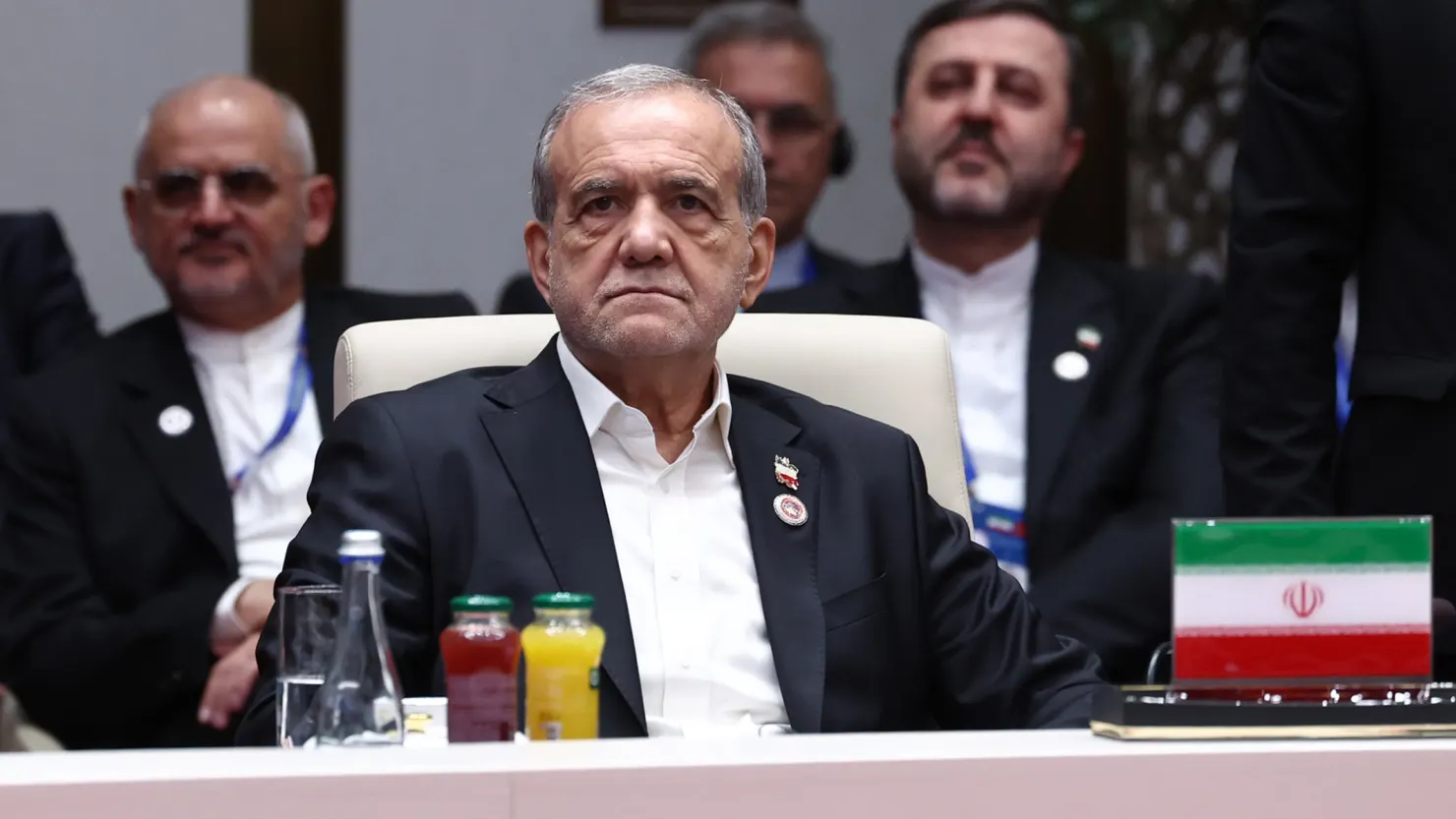
Iran can reopen the Strait of Hormuz within seven days if the United States eases military pressure and lifts its blockade of Iranian ports, senior Iranian officials said Tuesday, as President Masoud Pezeshkian arrived in New York for United Nations General Assembly week.
One of the officials said the initiative has been approved by Supreme Leader Mojtaba Khamenei and the Supreme National Security Council.
Offer and conditions
Iran's terms, as the officials laid them out, are that Washington ease military pressure and lift the blockade on Iranian ports. In return, Tehran says it can restore passage through the strait within seven days. One official said the United States needs to announce officially that it wants a diplomatic path and then agree on a timeline for how that process would move forward. That official said the proposal was delivered to Washington via mediators on Sept. 16, that Iran's General Assembly delegation has full authority to revive diplomacy, and that the assembly is a "golden opportunity" for Washington to return to talks if it takes tangible steps.
The second official said the aim is renewed talks toward a permanent end to hostilities. Qatar has been mediating short-term proposals in recent weeks. Foreign Ministry spokesperson Majed Al-Ansari said Qatari mediators had been discussing formulas for nearly two weeks, traveling between capitals, and that Doha had received assurances from U.S. officials that Washington wanted an agreement.
The June bargain
Pakistan was the primary mediator on the last written deal built on the same trade. On June 17, Trump and Pezeshkian signed the Islamabad Memorandum of Understanding, under which Iran was to reopen Hormuz to safe commercial passage and the United States was to end its naval blockade of Iranian ports. The interim arrangement collapsed on July 8 amid renewed strikes and tanker attacks.
Since then, Washington has maintained its blockade of Iranian ports while Tehran has restricted or conditioned passage through the strait. Before the war, roughly one-fifth of the world's oil moved through Hormuz, according to the U.S. Energy Information Administration.
Brinkmanship and threats
On Sunday, Iran's military central command said it had been informed that the United States was preparing to restart military operations with the support of regional countries, and warned that such a move would bring Iranian retaliation "without limitations and considerations."
Islamic Revolutionary Guard Corps spokesperson Hossein Mohebbi said that if another invasion were launched against Iran, Tehran would change the geography of the war, alter its defense and offense, introduce new weapons with new capabilities, and strike targets that have not previously been hit. "We will definitely change the war's geography," Mohebbi said. "We will certainly introduce new weapons with new capabilities into the fray, and the world will be astonished."
President Donald Trump, speaking Sunday in a television interview, said he was in "deciding mode" on Iran and that "very big things" were coming. He described his options as wiping Iran out, letting the country "rot economically," or making a deal, and said of Tehran, "They better behave." He also said he would probably be open to meeting Pezeshkian during the assembly week.
Diplomacy at the UN
Pezeshkian is the highest-ranking Iranian official to set foot on U.S. soil since the war began with U.S.–Israeli strikes on Iran on Feb. 28. Washington granted visas for part of his core delegation but imposed movement restrictions and denied visas to his communications team. Presidential spokesman Habibollah Abbassi called the denial "hostile."
Iranian lawmakers and officials at home have pushed back against a direct Pezeshkian–Trump encounter. One of the senior officials said Pezeshkian will not meet Trump at United Nations headquarters, and that Tehran plans to work through intermediaries in New York rather than stage a bilateral summit.
Parliament speaker Mohammad Bagher Ghalibaf, speaking Tuesday in Tehran, said negotiations were themselves a form of confrontation and that Iran would not bow to Trump's pressure. "Diplomacy is not surrender. It is about turning strength on the battlefield into political gains," Ghalibaf said.
Changes: cut the explanatory half of paragraph two, removed the three capstones and the duplicate Khamenei line, folded the thin shipping section into a new section on the June memorandum, attributed the one-fifth figure to the EIA, dropped "around" from the collapse date, gave Abbassi his title and quoted "hostile," and set headers in normal case.
Author

We cover the world’s chaos so you don’t have to scroll twelve feeds to understand it.
Sign up for Atlas newsletters.
Stay up to date with curated collection of our top stories.



