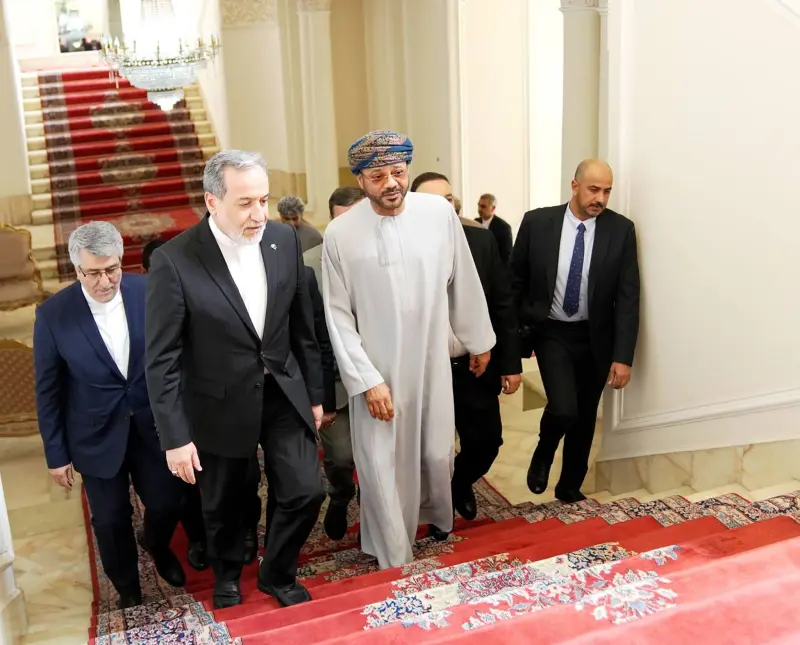
Iran and Oman announced a framework Tuesday for a temporary shipping corridor through the Strait of Hormuz and a joint project to clear the waterway of mines, the most concrete step yet toward restoring traffic through a chokepoint that has been largely paralyzed since the war began nearly six months ago — even as Tehran insisted the strait remains closed until Washington meets its conditions.
Omani Foreign Minister Badr al-Busaidi met his Iranian counterpart, Abbas Araghchi, in Tehran, and the two countries said in a joint statement that they "discussed a phased framework that could provide a practical and implementable basis for moving forward." The framework "includes the establishment of a joint temporary navigational corridor through the Strait of Hormuz and an agreement to implement a joint project to clear the Strait of mines."
Technical negotiations will continue toward "a permanent navigational corridor and future administration of the Strait, as well as a mechanism for information-sharing, traffic management, and the provision of relevant navigational and security services," the statement said. Both sides stressed the importance of consulting the Gulf's other littoral states and of arrangements that respect national sovereignty and international law.
Deputy Foreign Minister Kazem Gharibabadi filled in the geography on state television: inbound traffic from the Gulf of Oman into the Persian Gulf would pass entirely through Iranian waters, while the outbound route would run partly through Iranian and partly through Omani territorial waters. The two countries would then negotiate over 30 to 60 days to "reach an understanding on a new permanent and sustainable route." Activating the agreed corridor, he noted, "means closing the southern route in the strait" — the US-backed passage hugging Oman's coast that Iran has banned.
Al-Busaidi struck the optimistic register, writing on X that he hoped the countries would "soon announce" the temporary corridor. "Future management of the strait and a permanent solution will follow in due course," he said.
"Closed and Under Iran's Control"
Tehran moved quickly to cap expectations. Gharibabadi said the strait "remains closed" and under Iran's control, rejecting reports that vessels are transiting, and said any reopening must occur under arrangements set by Iran given its "ongoing state of war." Iran had informed Pakistan, Oman, and Qatar that normal navigation could not be maintained under current circumstances, he said, repeating that Washington must return to its commitments under the collapsed June memorandum of understanding — including lifting the naval blockade of Iranian ports, dropping oil sanctions, and unfreezing assets abroad — before the waterway fully opens.
The dangers of the interim were on display within hours. An oil tanker was struck Monday night off Oman's coast, disabling its engine, according to the United Kingdom Maritime Trade Operations agency, with all crew reported safe and no claim of responsibility. Iran periodically fires on vessels defying its transit rules, and its Persian Gulf Strait Authority published a list Sunday of 45 ships facing "fines, seizures or confiscations" on their next passage. A data analysis found at least 14 of those 45 — roughly one-third — have already been damaged in incidents around the strait classified as attacks, almost all along the American-protected route Iran prohibits.
The market has adapted in the meantime. Tracking firm TankerTrackers reported at least 15 simultaneous ship-to-ship transfer operations underway in the Gulf of Oman involving some 25 million barrels of crude and refined products, keeping Gulf oil moving even as direct transits sit at multi-month lows — down from more than 130 ships a day before the war.
Trump Declares the Strait De-Mined
The diplomatic movement followed an American announcement that removed one physical obstacle. President Donald Trump said on Truth Social that the US Navy has "removed and/or detonated" all mines in the strait's international waters, that the Space Force is monitoring the waterway, and that a "Zero Tolerance" policy is in effect: Iran has been notified that any vessel placing new mines "will be immediately and systematically destroyed." A source said the number, types, and locations of the cleared mines remain closely held.
How Washington will receive the Iran-Oman corridor is the open question. Trump threatened just last week to "bomb the s---" out of Oman if it "gets in the way" of reopening the strait, and the administration has insisted the waterway return to its prewar status as an open international passage — not one administered by Tehran. The emerging design, with entry routes through Iranian waters and Iranian sign-off on transit, formalizes a measure of the control Iran has asserted since February.
Yet a parallel report suggested Washington may be dangling a larger trade. A senior source told Al Arabiya that the US has offered to cancel its newly launched "Operation Economic Outcast," lift all sanctions, and end the naval blockade in exchange for Iran reopening the strait and halting proxy attacks — a proposal said to have been carried to Tehran by Pakistan's army chief, Field Marshal Asim Munir, who spoke with Trump before his visit and met the secretary of Iran's Supreme National Security Council. Pakistan's delegation departed Tuesday, with Interior Minister Mohsin Naqvi calling the talks with President Masoud Pezeshkian "very positive and productive" and reporting "significant progress" toward peace.
Sanctions Pressure Meets Chinese Resistance
The corridor talks are unfolding against the administration's escalating economic campaign. The Treasury Department on Monday sanctioned nearly 60 Iran-linked entities, including several in China, targeting five sectors — shipping, gold, digital assets, aviation, and technology — while stopping short of secondary sanctions on Iran's trading partners. Treasury Secretary Scott Bessent, outlining what he called the "economic asphyxiation" of Iran, warned that "no one is above the reach of US sanctions" when asked about Chinese banks financing Iranian oil purchases.
Beijing pushed back. Foreign Ministry spokesman Lin Jian said China's cooperation with Iran "should not be disrupted or undermined," conforms with international law, and that China would take "all necessary measures" to protect its interests. "Economic warfare and extreme pressure do not help solve problems; they only further intensify conflicts," he said.
Inside Iran, the pressure is visible: long lines formed at Tehran gas stations after the sanctions announcement, with the government signaling a fuel price hike and residents describing inflation and a sliding currency. "These sanctions have been in place for 47 years," said Mehdi Yazdian, a 55-year-old realtor, capturing the mix of strain and resignation.
A Narrow Channel Toward De-Escalation
The day's developments sketched the shape of a possible off-ramp — mines cleared, a corridor mapped, mediators shuttling, and Washington reportedly signaling flexibility — without closing the central gap: Iran ties full reopening to sanctions relief and the blockade's end, while the US ties relief to reopening. Secretary of State Marco Rubio has told counterparts no new American strikes are expected "for the time being," and Qatar said its priority is restoring normal navigation through a comprehensive diplomatic solution.
Whether the temporary corridor becomes the first working piece of that solution, or another arrangement announced but never activated, now depends on sequencing that has defeated every negotiation since February. The two foreign ministers in Tehran, at least, committed to keep talking — with a 30-to-60-day clock now attached.
Author

We cover the world’s chaos so you don’t have to scroll twelve feeds to understand it.
Sign up for Atlas newsletters.
Stay up to date with curated collection of our top stories.



