Japan lodged a diplomatic protest with China after a Chinese destroyer conducted a live-fire drill inside Japan's exclusive economic zone in the Pacific over the weekend, the government said Tuesday, the first time Tokyo has publicly disclosed such an exercise by a foreign warship in those waters. Russian vessels observed the drill, in what Japanese officials described as another sign of deepening military coordination between Beijing and Moscow.
The exercise, and Japan's response, drew a sharp rebuttal from China, which rejects Japan's claim to the waters where it took place. The dispute layers a fresh maritime confrontation onto already strained ties between Asia's two largest economies.
What Happened Near Okinotorishima
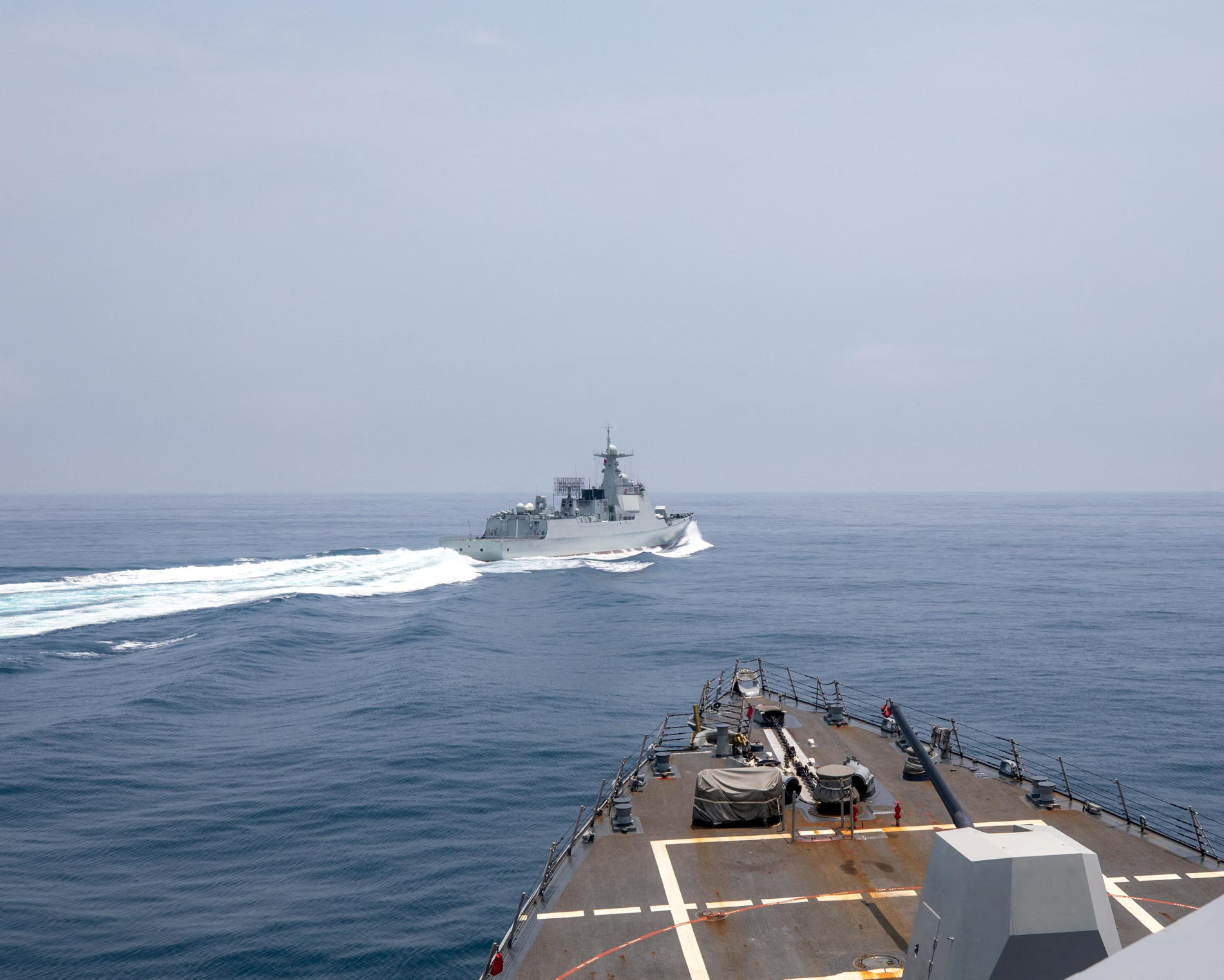
The drill occurred Sunday about 180 kilometers, or roughly 110 miles, southwest of Okinotorishima, Japan's southernmost territory in the Philippine Sea. According to Japan's Joint Staff, the Maritime Self-Defense Force first detected four vessels sailing northeast around 330 kilometers southwest of the island near 2 a.m.: a Renhai-class guided-missile destroyer, a Luyang III-class guided-missile destroyer, a Chinese replenishment ship, and a Russian frigate. One of the Chinese destroyers then carried out a machine-gun firing exercise squarely inside the zone.
The Chinese warship radioed nearby ships shortly before firing to give the drill's location and duration, a transmission picked up by a Japanese destroyer on monitoring duty. No damage to any vessel was reported, and no intrusion into Japan's territorial waters occurred.
The same four ships had passed southward between Okinawa's main island and Miyako Island days earlier before heading toward Okinotorishima. After the drill, they continued north and were later spotted east of Iwoto Island.
Tokyo's Complaint
Japan conveyed its concern to Beijing through diplomatic channels, focusing on safety rather than legality. Chief Cabinet Secretary Minoru Kihara told reporters the government protested on the grounds that live-fire drills could endanger vessels navigating nearby. "We will continue to watch China-Russia operations around Japan with concern, while doing utmost for the warning and surveillance of the Japanese airspace and territorial waters," he said.
Notably, Japan did not allege that China broke international law. Under the UN Convention on the Law of the Sea, an exclusive economic zone grants a coastal state sovereign rights over natural resources such as fishing and energy, but not full control over all activity within it. Foreign militaries generally retain freedom of navigation there, and military exercises in another country's EEZ are not automatically unlawful, a principle the United States and other maritime powers rely on. That legal reality shaped Tokyo's careful framing: the drill was cast as unsafe and deliberately timed, not illegal.
Defense Minister Shinjiro Koizumi, speaking at an air show in Britain, placed the exercise in a wider pattern. He called it "yet another manifestation of the deepening military cooperation between China and Russia," pointing also to a Chinese submarine-launched ballistic missile test on July 6 and at least 10 joint bomber flights the two countries have conducted around Japan.
Beijing's Rebuttal
China rejected the protest and disputed Japan's rights to the waters entirely. Foreign Ministry spokesman Lin Jian called Tokyo's concerns "groundless," arguing that Okinotorishima is "a rock rather than an island" under the Law of the Sea convention and therefore cannot generate an exclusive economic zone. "Japan's claim of an EEZ around the Okinotori violates international law," he said. "China's activities in the high seas are fully consistent with international law and international practice."
Lin went further, accusing Japan of inflating external threats. "By smearing other countries for legitimate and lawful actions and peddling the so-called external threat, Japan is actually seeking excuses for accelerating its remilitarization," he said. China's Defense Ministry separately described the exercise as part of an annual cooperation plan with Russia, resting on principles of non-alliance and non-targeting of third parties, rather than a response to current tensions.
The Chinese position contains a notable tension. In pressing a permissive reading of naval freedom in Japan's claimed waters, Beijing invokes an interpretation it typically resists when the United States and its allies conduct military operations in the South China Sea, where China argues for greater coastal-state control over foreign military activity. Japan, for its part, has reinforced Okinotorishima with concrete over the years to preserve its status as an island capable of generating a zone.
A Pattern of Pressure
The drill fit into a broader expansion of Chinese and combined Chinese-Russian activity around Japan that Tokyo has watched with growing unease. The two navies wrapped up a joint exercise near Qingdao earlier in the month before some vessels moved into the Pacific for what they described as a joint patrol, of which the live-fire drill is believed to have been part. Analysts note that what were once largely symbolic shows of political solidarity are approaching genuine operational interoperability, with the two navies coordinating command and geography across an ever wider stretch of the Western Pacific.
Recent months have brought a steady accumulation of such episodes: joint bomber flights over the seas around Japan, repeated transits through the Miyako and Tsushima straits, and, last year, the near-simultaneous appearance of two Chinese aircraft carriers near another southern Japanese island. Former Vice-Defense Minister Masahisa Sato described Sunday's drill as an early stage of what he called China's "salami-slicing strategy," the taking of incremental steps to expand control without triggering open conflict.
The confrontation also unfolds against frayed relations dating to comments by Prime Minister Sanae Takaichi in late 2025, when she said a Chinese attack on Taiwan could prompt a Japanese military response, remarks that drew a furious reaction from Beijing. The same week as the drill, Chinese and Philippine crews clashed at a disputed shoal in the South China Sea, and Secretary of State Marco Rubio arrived in Manila for a regional summit where he was expected to meet Chinese Foreign Minister Wang Yi. Japan, meanwhile, said it would keep monitoring the waters and air around the archipelago, treating the gunnery exercise near a tiny, uninhabited outcrop as a marker of a shifting balance in the Western Pacific.
Author

We cover the world’s chaos so you don’t have to scroll twelve feeds to understand it.
Sign up for Atlas newsletters.
Stay up to date with curated collection of our top stories.