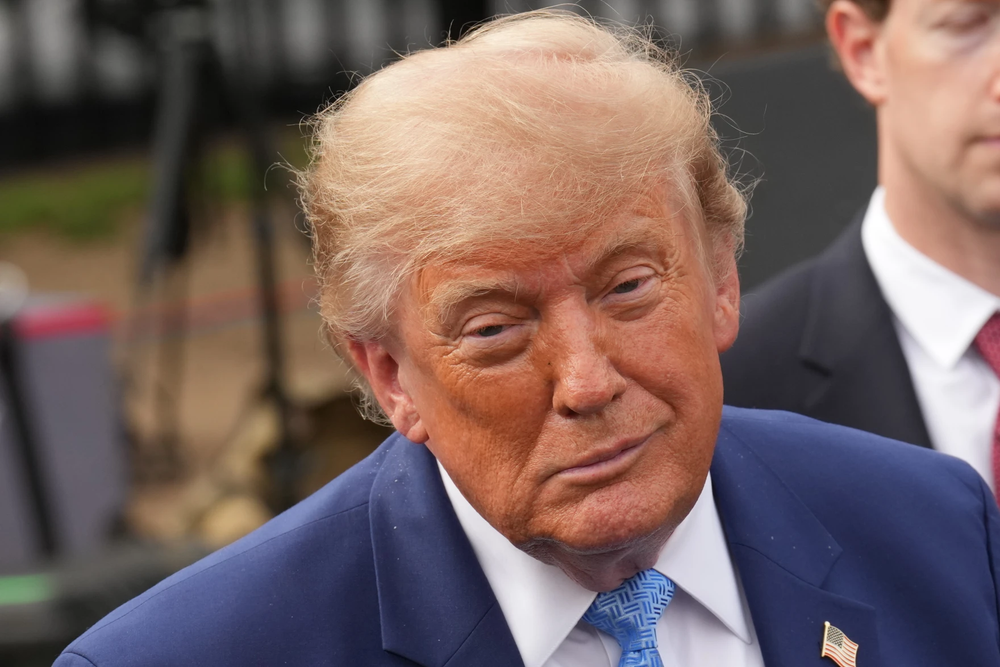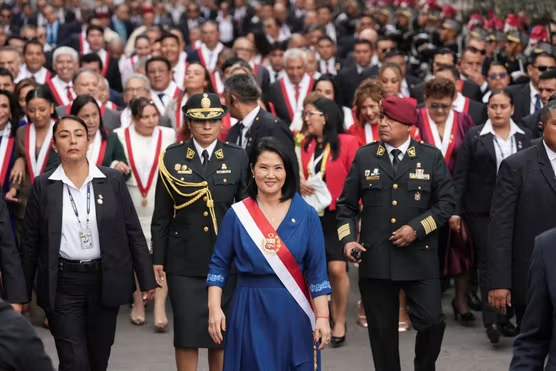
Conservative leader Keiko Fujimori was sworn in as Peru's president Tuesday after winning June's presidential runoff by a margin of fewer than 50,000 votes, becoming the country's first elected female head of state and its ninth president in a decade.
"I swear ... that I will faithfully carry out the duties of president of the republic, which the nation has entrusted to me for the 2026 to 2031 term," the 51-year-old daughter of former President Alberto Fujimori stated before Congress.
The four-time presidential candidate and leader of Peru's largest political party takes office hoping to stabilize the country's turbulent politics, reduce crime, and boost economic growth. Over the past decade, only three of Peru's presidents have been elected by popular vote; the rest came into office after their predecessors resigned or were removed by Congress amid protests or corruption scandals. No leader has completed a full five-year term since 2016.
"The country we today inherit is one of enormous potential, but hampered by disorganization, plagued by insecurity and fractured by mistrust that has deeply damaged the social fabric," Fujimori said in her inaugural address. "I am committed to bringing about order and national reconciliation, two goals that are entirely compatible."
Her Popular Force party and its main ally, Popular Renovation, will hold half the seats in the newly installed Senate, making it harder for legislators to attempt to remove her, though right-wing parties still fall short of the majority needed to push her agenda through a Congress that has returned to a bicameral structure for the first time in three decades. On Sunday, her coalition won the presidency of the Senate, while opposition factions united to take leadership of the Chamber of Deputies.
An Iron Fist Against a Security Crisis
Fujimori centered her campaign on law and order as Peru confronts its worst security crisis in decades, fueled by the spread of local and foreign criminal gangs that oversee contract killings and extortion.
She has pledged to fight crime with an "iron fist," adopting policies modeled on those of Salvadoran President Nayib Bukele, including building a megaprison patterned after El Salvador's CECOT penitentiary. She has also proposed expelling undocumented people, establishing courts with anonymous judges to protect their safety during criminal trials, and making prisoners work for their food.
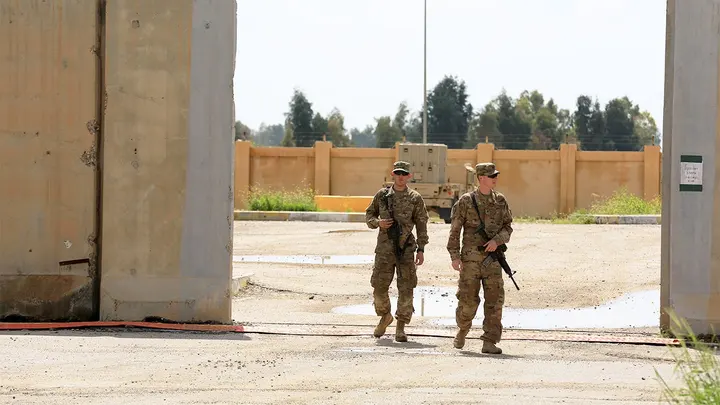
In her address, Fujimori announced that the military will "temporarily" lead security operations in crime-afflicted areas. "During states of emergency, the armed forces will temporarily take the lead in security operations" until they can "return these territories to the citizens," she said.
She also announced a 15% increase in the national minimum wage, plans to reorganize social services to fight malnutrition in rural communities, and preparations for a severe El Niño weather event that meteorologists predict will be the most intense since 1998. "My goal is not only to administer the state," she said. "My main objective is to narrow the enormous social deficit that affects millions of Peruvians."
On the economic front, Fujimori named former central bank board member Elmer Cuba as economy minister and Carlos Espa, a former presidential candidate who worked for the US embassy in Lima, as foreign minister. She tapped former Deputy Minister Guillermo Shinno to lead the Ministry of Energy and Mines in the world's third-largest copper-producing nation, and has promised to develop infrastructure by easing partnerships between government agencies and private investors.
A Divisive Dynasty Returns
Fujimori's victory marks the return of one of Peru's most influential and polarizing political dynasties. Her father ruled from 1990 to 2000, credited by supporters with defeating the Shining Path insurgency and taming hyperinflation, but later jailed for corruption and crimes against humanity committed during his government's campaign against armed groups. He was pardoned in December 2023 and died in September 2024.
That legacy helped propel his daughter to victory and remains the source of deep apprehension. "She is going to be a replica of her father," said 80-year-old retiree Cesar Fuentes, who fears a crime crackdown will lead to abuses. Housewife Nelly Vega, 68, took the opposite view: Fujimori "is going to lead us to something better," she said. "We're in a country with a lot of terror."
Opposition lawmakers protested outside parliament during the ceremony, holding photos of the roughly 50 civilians killed during anti-government demonstrations in late 2022 and early 2023 that followed the removal of former President Pedro Castillo. Relatives of the dead have said they do not recognize Fujimori as president. A group of leftist lawmakers from her defeated rival's party walked out of Congress rather than listen to her speech.
Opposition leaders have asked the incoming government to reverse laws passed by the last legislature that critics say weaken efforts to fight organized crime — measures that eliminate preventive arrests, stop prosecutors from processing political parties involved in corruption under the same statutes as criminal groups, and make it harder for police to confiscate criminal assets. They have also called for a commission to investigate the protest deaths.
A Polarized Electorate and a Regional Shift
Fujimori narrowly defeated leftist congressman Roberto Sanchez, an ally of Castillo, in one of Peru's closest elections in modern history. She was widely backed by voters in Lima and along the Pacific coast, while voters in the highlands, home to a larger Indigenous population, overwhelmingly supported Sanchez. He challenged the results, alleging irregularities in vote counting at Peruvian consulates abroad, but electoral authorities dismissed his complaints.
Her inauguration consolidates a rightward shift across Latin America, following conservative victories in Chile, Colombia, and Honduras. Conservatives have won seven major presidential elections in the region in recent years, most since January 2025, in a streak propelled by concerns over crime, immigration, and slow economic growth. Argentine President Javier Milei, Chile's Jose Antonio Kast, Bolivia's Rodrigo Paz, Ecuador's Daniel Noboa, and Uruguay's Yamandu Orsi attended the ceremony, as did US Deputy Secretary of State Christopher Landau and Spain's King Felipe VI.
Fujimori has said there is "very significant space" for cooperation with the Trump administration and expressed interest in joining the "Shield of the Americas," a proposed regional initiative to combat transnational crime. Washington has made one of its strongest pushes in years to deepen ties with Peru, a major copper and critical minerals producer with strategic Pacific ports, as it works to counter Chinese influence in the region.
Despite its political churn, Peru remains one of Latin America's more stable economies. The central bank has long kept its benchmark rate below 5%, recently raised its 2026 growth forecast to 3.4%, and the government is known for conservative public spending. But critics point to a widening gap in living standards between coastal areas and Andean highland communities, and growth slowed sharply in May as fishing output plunged.
"There won't be much room for a honeymoon period," said Peruvian political analyst Jeffrey Radzinsky. "She has to build confidence among a broad segment of the population that distrusts her, while also meeting high expectations."
Author

We cover the world’s chaos so you don’t have to scroll twelve feeds to understand it.
Sign up for Atlas newsletters.
Stay up to date with curated collection of our top stories.