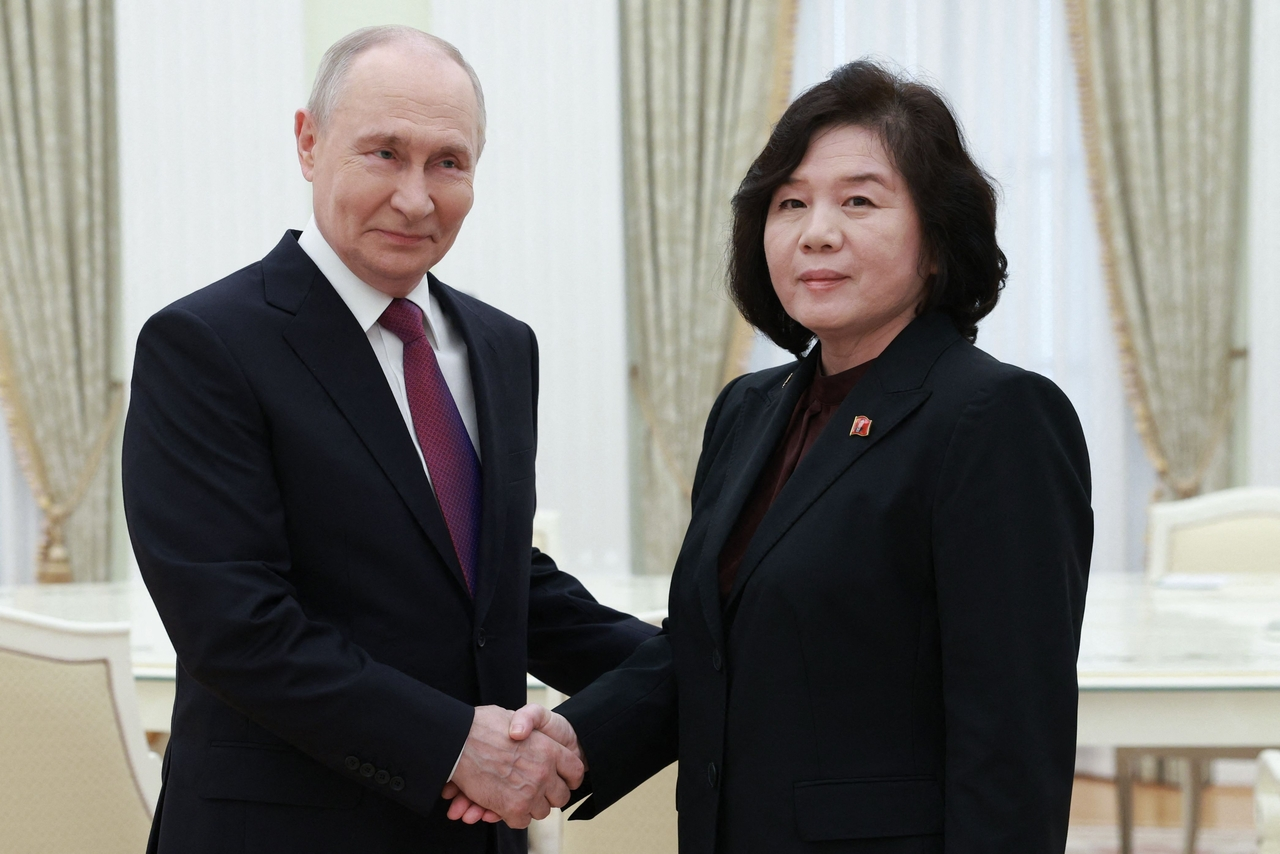
The Kremlin disclosed on Monday that Vladimir Putin had received North Korean Foreign Minister Choe Son Hui a day earlier, using the meeting to thank Pyongyang for sending soldiers to fight in Russia's war against Ukraine. Choe, for her part, told him North Korea would stand with Moscow until victory.
The trip came with no summit, no anniversary, and no multilateral event to explain it, an absence that has analysts in Seoul and elsewhere convinced the real business was arranging something larger: the return visit Kim Jong Un has owed Putin for more than two years.
Inside the Kremlin Meeting
Putin was blunt about what he was grateful for. "Once again, I would like to express gratitude for the support for our special military operation, for the decision to send soldiers of the Korean People's Army to take part in the liberation of the Kursk Region," he said, using Moscow's term for the war. He added that Russia would never forget the deeds of the Korean servicemen, and Russian state television aired footage in which he said Moscow would "honor the Korean heroes alongside our own compatriots." Kremlin spokesman Dmitry Peskov noted the troops had received Russian state decorations.
He asked Choe to pass along a message. "Please convey my greetings and best wishes to Comrade Kim Jong Un," Putin said, adding that he valued the mutual understanding between them. He also congratulated her on the coming 73rd anniversary of what North Korea calls its victory in the Fatherland Liberation War, the 1950-53 Korean War that ended in an armistice signed July 27, 1953.
Choe answered in kind, citing instructions from Kim. She said the leader had called from the outset for North Korea to "consistently and resolutely support and assist the Russian army and the Russian people in their sacred war, without regard for anyone else." Praising Putin's "wise leadership," she said Russia would achieve a great victory and added, "We once again assure you that, until the day of victory, we will always stand firmly alongside our Russian comrades."
She also committed Pyongyang to backing Russian efforts to defend its sovereignty, security interests, and territorial integrity, and to "addressing the root causes of the crisis in Ukraine," a formulation that mirrors Moscow's framing of the invasion as a response to NATO expansion. Kyiv and its allies reject that account as a pretext.
Putin was joined by his aide Yuri Ushakov and Foreign Minister Sergei Lavrov. North Korea's ambassador to Russia, Sin Hong Chol, also attended.
The Foreign Ministers' Track
Choe and Lavrov held their own session Monday, described by Pyongyang as the third round of a strategic dialogue between the two ministries. North Korean state media said the talks covered implementation of the June 2024 comprehensive strategic partnership treaty, high-level visits, cooperation plans, and coordination on international issues, and that the two sides "reached a consensus on all the issues brought up for discussion."
The joint statement reflected a mutual endorsement. Russia expressed full support for North Korean measures against what Pyongyang describes as hostile threats to its sovereignty and development. North Korea offered "invariable support" for Russian policies aimed at eliminating the war's root causes and defending its territorial integrity.
Lavrov praised North Korean troops for their role in retaking Kursk, saying Moscow would "never forget the unparalleled feats, exceptional courage, and selflessness of the Korean soldiers." He pointed to the memorial complex opened in Pyongyang in April honoring those who died, calling it a symbol of friendship between the two peoples, and cited North Korean participation in Russia's Victory Day parade on Red Square in May.
What Pyongyang Has Sent, and Received
The military relationship is now well documented. Under the 2024 treaty, which pledges mutual assistance if either country faces aggression, North Korea deployed an estimated 14,000 to 15,000 troops to help repel Ukraine's incursion into Kursk. South Korea's National Intelligence Service estimates roughly 2,000 have been killed. Pyongyang has also shipped thousands of containers of munitions.
What flows the other way is harder to verify but widely assessed to include food, fuel, hard currency, and technology transfers that South Korean, U.S., and Ukrainian officials believe are advancing North Korea's weapons programs. The arrangement has also given Kim leverage he lacked a decade ago, when China was his only meaningful patron.
Analysts expect Moscow to ask for more. Yang Moo-jin of the University of North Korean Studies said that with Ukrainian drone strikes intensifying, Russia may seek additional artillery shells and missiles, on which it has grown increasingly dependent. Chris Monday, a Russia researcher at Dongseo University, framed it in terms of Russian domestic politics: "Putin does not want to call a general draft. He may try again to get Kim to agree to send more troops."
The Summit Question, and Beijing
Kim has met Putin three times: at Vostochny Cosmodrome in September 2023, in Pyongyang in June 2024, and in Beijing in September 2025 on the sidelines of a Chinese war commemoration. Putin extended an invitation to Moscow during the Pyongyang summit. It has not been taken up.
Analysts see September's Eastern Economic Forum in Vladivostok as a plausible venue, though a separate trip to Moscow remains possible. "This will set the stage for a meeting between Kim and Putin," Monday said. Seoul declined to endorse the speculation. "Nothing has been made public yet, so we will continue to monitor the situation closely," Unification Ministry spokesman Yoon Min Ho said.
Hovering over the trip is China. North Korea has staged a run of high-level exchanges with Beijing in recent weeks: Xi Jinping's June summit in Pyongyang, Premier Pak Thae Song's visit to Beijing, and a trip to Pyongyang by Wang Huning, a member of the Politburo Standing Committee, for events marking the 65th anniversary of the two countries' friendship treaty.
Yang read Choe's Moscow visit partly as reassurance. "From North Korea's perspective, it also serves to reassure Moscow that improved ties with China will not come at the expense of North Korea-Russia relations," he said, adding that Pyongyang is working to position itself as the central pillar of a trilateral bloc with Moscow and Beijing, set against the U.S.-Japan-South Korea partnership. Monday offered a more pointed version, suggesting Beijing may have quietly blessed deeper North Korean involvement in Ukraine because "China cannot allow Putin to be defeated."
Kim has held no substantive talks with Washington or Seoul since his nuclear diplomacy with Trump collapsed in 2019, and he has made abandoning demands for denuclearization a precondition for any resumption.
Author

We cover the world’s chaos so you don’t have to scroll twelve feeds to understand it.
Sign up for Atlas newsletters.
Stay up to date with curated collection of our top stories.