Maine Democrats have three weeks to do what campaigns usually take months or years to accomplish: build an organization, raise money, debate, and choose a nominee. The scramble followed Graham Platner's July 9 withdrawal from the Senate race, and it has left a crowded field of Democrats competing to inherit both his progressive base and the task of unseating Republican Senator Susan Collins in November.
The stakes reach well beyond the state. Collins is the only Republican senator running for reelection in a state that backed Kamala Harris in 2024, and both parties view her seat as central to control of the chamber. To flip the Senate, Democrats need to gain four seats while holding all of their own, and Maine has long been seen as a crucial piece of any such path.
A Race Reset by Scandal
Platner, a 41-year-old oyster farmer and Marine veteran, had won the June primary with more than 70 percent of the vote, powered by an insurgent, populist campaign and an early endorsement from Senator Bernie Sanders. He withdrew after a former romantic partner accused him of rape, an allegation he strongly denied while saying he was stepping aside because he had lost access to the fundraising and campaign tools needed to win. He also accused the party establishment of conspiring to force him out.
His exit set off a rarely used replacement process. Under Maine law, the party has until July 27 to name a new nominee, and it scheduled a convention in Bangor on July 25 to do it. Candidates had until Wednesday to declare and must gather 500 signatures from registered Democrats, including at least 50 voters from eight different counties, by Monday to appear on the convention ballot.
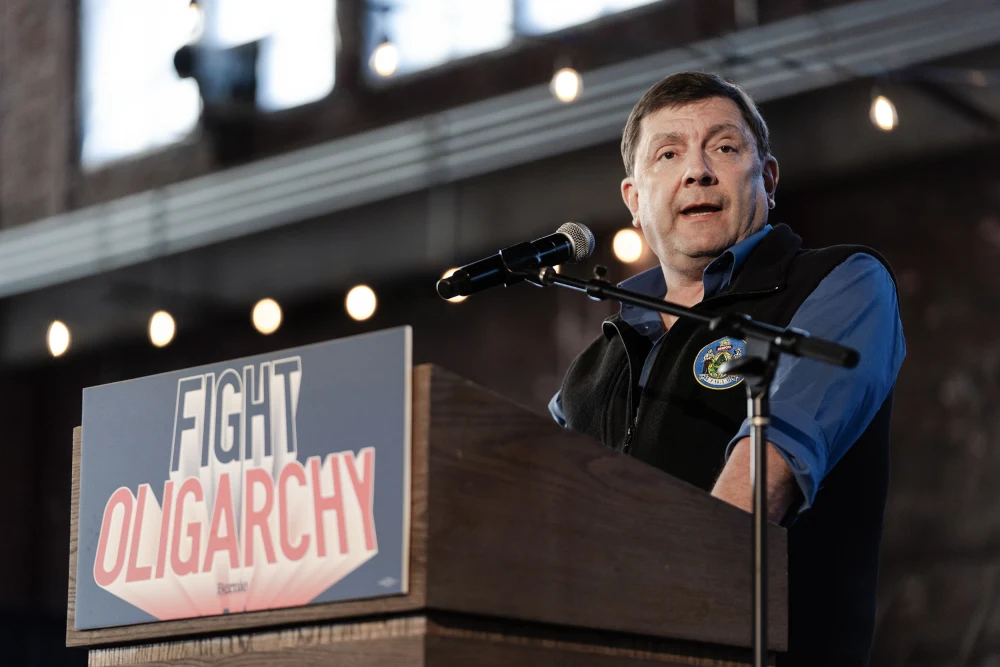
Platner's shadow hung over the field's first debate Thursday night, hosted by Portland's NBC affiliate. One of the opening questions asked candidates to name his best idea. Several praised or echoed pieces of his platform, from Medicare for All to his stance on the war in Gaza, which he described as genocide, even as they worked to establish their own identities. Jordan Wood, a former congressional chief of staff who had publicly called on Platner to leave the race last fall, argued the eventual nominee must be able to "very quickly separate themselves" from Platner, since Republicans would use him "to just sow distrust about our nominee."
A Crowded and Varied Field
At least a dozen Democrats filed to run, ranging from well-known statewide figures to first-time candidates. Several had sought other offices earlier this year and revived dormant campaigns.
The leading contenders are largely those who ran in June's gubernatorial and congressional primaries. Nirav Shah led the state's COVID-19 response as director of the Maine CDC and later served as a top official at the federal CDC; he drew the most first-round votes in last month's gubernatorial primary before losing on the ranked-choice runoff. Troy Jackson, a fifth-generation logger and former state Senate president, has been endorsed by the Sanders-aligned group Our Revolution. Shenna Bellows, the current secretary of state, challenged Collins in 2014 and has clashed publicly with the Trump administration over voter data. Jordan Wood, a former chief of staff to Representative Katie Porter, co-founded a group focused on election integrity.
Others include Dan Kleban, co-founder of Maine Beer Company; David Costello, who finished third in the June Senate primary; former state lawmaker Elizabeth Dickerson; physician Elizabeth Cote; Marine veteran Joseph Leveille; pharmaceutical executive Saundra Pelletier; technologist Kristina Libby; and musician and author Ashley Webb. One candidate, social worker Paige Loud, filed and then withdrew, citing disagreement with the selection process itself.
At the debate, the candidates were broadly aligned on Medicare for All, opposition to Trump, and abolishing or reforming Immigration and Customs Enforcement. The prediction market Kalshi listed Jackson as the front-runner, giving him a 74 percent chance of winning the nomination, followed by Bellows and Shah.
The ICE Shooting Reshapes the Debate
The race took on a sharper edge after a federal immigration officer fatally shot a man in Biddeford on Monday, days before the delegate process began. The killing pushed immigration enforcement to the forefront and led the field's leading candidates to embrace a once-fringe position: abolishing ICE.
Shah asked at a news conference how many more people must die "at the hands of Donald Trump's masked marauders" before the agency is abolished. Bellows wrote that it was "time to get ICE off our streets." Jackson called for answers, and several candidates criticized Collins for voting earlier this year to provide roughly $70 billion for immigration enforcement without new restrictions on agents.
Collins, for her part, called for a "full and impartial investigation" and said she had urged Homeland Security Secretary Markwayne Mullin to halt non-urgent vehicle stops; the administration soon after ordered ICE to suspend most such stops nationwide. She defended the agency's broader role, warning that eliminating ICE "would make our country less safe."
How the Nominee Gets Chosen, and Who's Staying Out
The mechanics are unusual. Each of Maine's 16 counties holds meetings this weekend to select 500 of the 601 delegates who will choose the nominee; the remaining 101 are members of the party's state committee. Delegates are not pledged to candidates, and at the convention they will take repeated rounds of voting, dropping the last-place finisher each round, until someone wins a majority. More than 3,000 people had applied for the 500 delegate slots, and campaigns have openly urged supporters to run as delegates.
That insider-driven process has drawn criticism. Some conservatives have contrasted it with South Carolina's Republican special primary to replace the late Senator Lindsey Graham, noting that Maine's nominee will be chosen by a few hundred party officials and activists rather than by voters. Loud cited the "spectacle" of the process in withdrawing.
National Democrats have largely kept their distance. Senate Minority Leader Chuck Schumer, known for aggressive intervention in primaries, said flatly, "I'm staying out of Maine," wary that his backing could become a liability for whichever candidate received it. His earlier recruitment of Governor Janet Mills had already faltered when she ran a listless campaign and lost to Platner. Progressive senators who had backed Platner, including Sanders and Elizabeth Warren, also said they would not endorse before the convention. The exceptions have been Representative Ro Khanna, who endorsed Jackson, and Senator Tammy Duckworth, who came out against Shah over his handling of a disease outbreak at an Illinois veterans' home during his tenure there. Whoever emerges on July 25 will have roughly three months to consolidate the party and take on an incumbent who has repeatedly outperformed her polls.
Author

We cover the world’s chaos so you don’t have to scroll twelve feeds to understand it.
Sign up for Atlas newsletters.
Stay up to date with curated collection of our top stories.