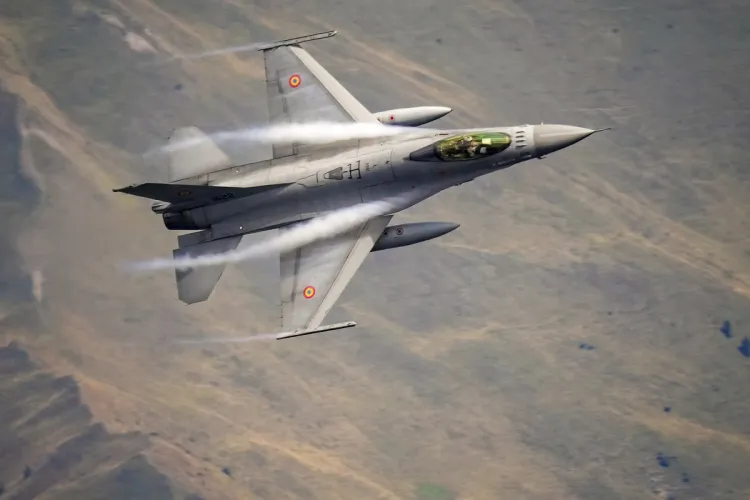
A Romanian F-16 fighter jet shot down a suspected Russian drone over the Black Sea on Sunday morning, the third interception in as many days, prompting Romania's foreign ministry to summon Russia's ambassador and drawing condemnation from President Nicusor Dan, who called the repeated breaches of the NATO member's airspace "inadmissible and intolerable."
"A new drone was shot down this morning, at 10:13, by an F-16 aircraft of the Romanian Air Force, over the territorial waters of Romania, in the Sulina–Chilia area," Dan said. The Defense Ministry said the drone was brought down safely, 12 kilometers northeast of the coastal town of Sulina, five minutes after it entered the country's airspace.
Two Romanian F-16s scrambled from the Fetesti airbase, under NATO's operational command, before one of the jets engaged the target in the Danube Delta region near the border with southwestern Ukraine. Martin O'Donnell, a spokesperson for NATO's Supreme Headquarters Allied Powers Europe, said the drone appeared to be of "Russian origin," while NATO said additional details of the incident remained under investigation.
Romania has experienced frequent drone incursions since Russia launched its full-scale invasion of Ukraine in February 2022, but had not destroyed any of the intruding aircraft until Friday. The Defense Ministry said Russian drones had entered national airspace without permission 33 times since the war began, including Sunday's breach.
Three Shootdowns in Rapid Succession
The weekend's interceptions unfolded in quick sequence. On Friday, a Romanian F-16 destroyed a drone at around 11 a.m. after it crossed into the country's airspace, with the pilot bringing it down safely in an uninhabited area. NATO scrambled four aircraft during that incident — two Romanian F-16s and two Italian Eurofighter Typhoons deployed under the alliance's Air Policing mission. Debris from the drone and the intercept missile landed close to two towns northeast of Bucharest, with no casualties or injuries reported.
A second drone was shot down Saturday morning, roughly 10 kilometers west of the village of Sfantu Gheorghe in eastern Romania, after radar systems picked it up at 8:22 a.m. local time. Two jets scrambled to identify and intercept the target, which was brought down in an unpopulated area near the border during another large-scale Russian drone attack against Ukraine.
Romania's Prosecutor General's Office determined that the drone intercepted Friday was a "Shahed model, used by the Russian Federation in its war of aggression against Ukraine," Dan said. Investigations into the drones downed Saturday and Sunday remain ongoing, and prosecutors have recovered fragments of Friday's drone but were still searching for pieces of the other two. Dan said the findings will serve as the basis for an official diplomatic protest to Moscow.
Sunday's shootdown marked the fourth recent downing by Romania of a drone violating NATO airspace in coordination with the alliance, O'Donnell said. Before the last three interceptions, Romanian jets shot down a drone in the sky above Estonia in May. Romanian pilots and planes are based in Lithuania, where they hold broad strike capabilities as part of NATO's force posture. "As we continue to prove, NATO is constantly on the watch and prepared to defend itself from any threat," O'Donnell said.
Bucharest Responds
Foreign Minister Oana Toiu said Romania was summoning Russia's ambassador following the "repeated violations." Moscow made no immediate public comment on the incidents.
"It is inadmissible and intolerable for the Russian Federation to continue violating Romania's airspace, which is, at the same time, NATO airspace and European Union airspace," Dan wrote on X. "Such actions are unacceptable, and we treat them with the utmost seriousness, alongside our allies." The president also congratulated Romanian pilots and ground crews "for the professionalism, courage and efficiency with which they carried out their mission."
Prime Minister Ilie Bolojan called the airspace breaches "unacceptable," while Defense Minister Radu Miruta said Romania "will continue to firmly defend its sovereignty and airspace but these provocations must stop."
Belgium, a NATO and EU ally with 300 troops based in Romania as part of the alliance's eastern flank force, called Sunday's incursion a "stark reminder of the ongoing threat Russia's war poses to European security." Foreign Minister Maxime Prevot said Belgium "stands firmly with Romania," noting that Romania's investigation had already confirmed one of the downed drones was a Russian Shahed.
Hardening the Eastern Flank
Romania shares a 650-kilometer land border with Ukraine, and drones have repeatedly strayed into its territory as Russia steps up attacks on Ukrainian ports across the Danube River. The country's army chief of staff said Friday that Russian strikes on the region around the Ukrainian port of Odesa had increased ahead of the harvest season, pressuring energy and trade routes in the Black Sea. The governor of Ukraine's Odesa region issued several air raid alerts for areas along the border in the early hours of Sunday, and Russia's Defense Ministry said it had attacked the Ukrainian port of Chornomorsk, targeting fuel tanks it said were used by the Ukrainian military.
The stakes of the incursions have grown over the past year. In late May, a drone carrying explosives struck an apartment building in the city of Galati, sparking a fire and injuring two people — the first time such a strike hit a populated area in a NATO country. The following month, a Ukrainian sea drone exploded in Romania's Black Sea port of Constanta; the Ukrainian military said it had veered off course as a result of Russian electronic warfare interference.
Romania's parliament adopted a law in 2025 allowing drones that breach its airspace to be shot down, and the country integrated the US-made MEROPS counter-drone system into its defenses at the end of June. The AI-powered mobile system fires relatively cheap, three-foot-long drones to take down incoming Shahed and other variants, part of a broader hardening of NATO's long eastern border against drone threats.
Drones intruding into NATO airspace have not been treated as attacks on the alliance, meaning they have not triggered discussions over a collective response from all 32 members. But the persistent incidents have pushed members along Europe's eastern edge to invest in anti-drone defenses. The Baltic states have reported repeated airspace violations in recent months, incursions that contributed to the collapse of Latvia's government in May.
NATO chief Mark Rutte has said Moscow's "reckless behaviour is a danger to us all," and US ambassador to NATO Matthew Whitaker has pledged the alliance will "defend every inch" of its territory.
Author

We cover the world’s chaos so you don’t have to scroll twelve feeds to understand it.
Sign up for Atlas newsletters.
Stay up to date with curated collection of our top stories.