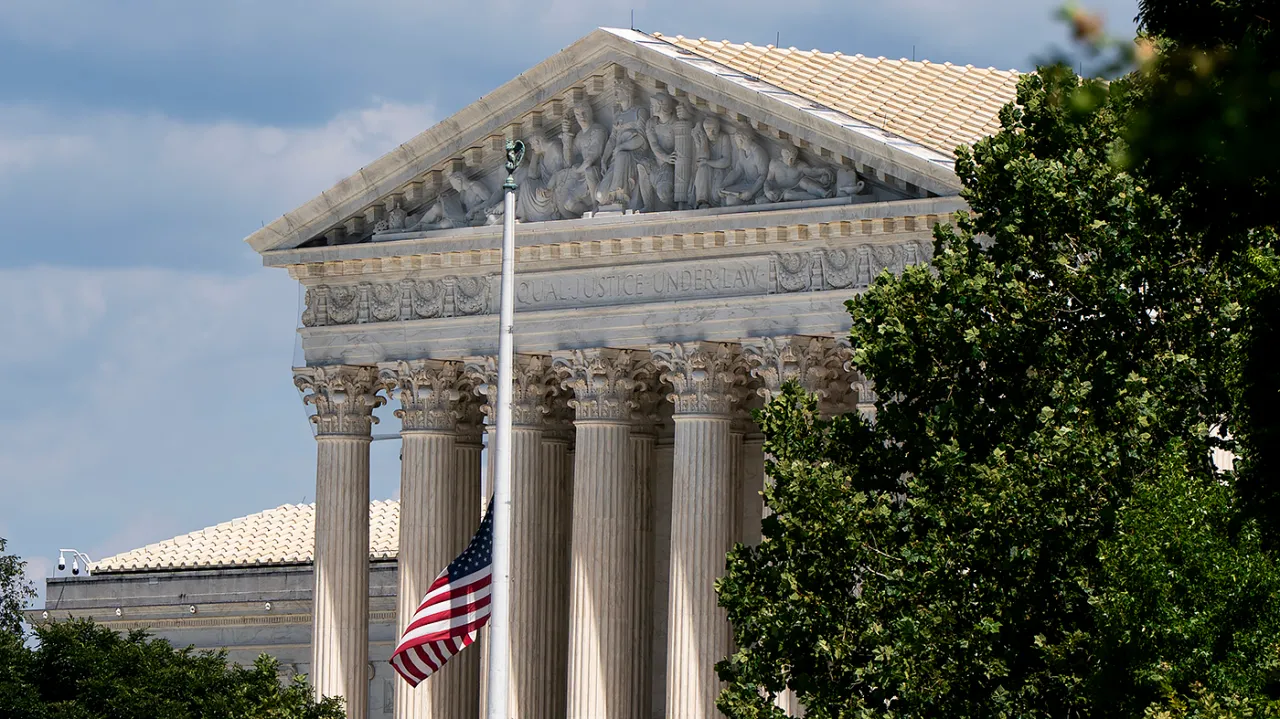
The Supreme Court on Friday ordered Missouri to hold its November congressional elections under the district map drawn in 2022, rejecting a Republican-drawn 2025 map that targeted the Kansas City seat of Rep. Emanuel Cleaver, D-Mo. Earlier the same day, a divided court let the Trump administration resume using an expanded federal database to check voters' citizenship.
Issued hours apart, the two emergency orders cut in opposite directions. One went against a Republican-backed map, and the other sided with the administration.
Missouri's Republican-led legislature drew the 2025 map at President Donald Trump's urging, part of a nationwide mid-decade push to shore up the GOP's House majority. Republicans hold six of the state's eight House seats under the 2022 map. The 2025 map was designed to produce a 7-1 split.
How the map fight reached this point
The Missouri order was unsigned, with no noted dissents. It paused Eighth Circuit and district court orders requiring the 2025 map, the court's third intervention in the dispute.
The Missouri Supreme Court ruled Sept. 3 that a citizen referendum petition kept the 2025 map from taking effect until voters approve it. The state justices held that the map "is not the law and has never been the law" in Missouri. On that basis, the U.S. Supreme Court wrote Friday, "as a matter of state law, the 2022 map—not the 2025 map—must be used in the 2026 congressional election."
After Justice Brett Kavanaugh declined on Sept. 8 to block the state ruling, U.S. District Judge Stephen Clark ordered Missouri to use the 2025 map. The full court stayed that order Sept. 10.
On Sept. 21, the Eighth Circuit directed Clark to issue a permanent injunction requiring the 2025 map anyway. "Given this Court's two prior orders in this litigation, our conclusion that this was error should come as no surprise," the Supreme Court wrote.
Ballots on the 2022 lines "have been printed and mailed," Friday's order said, and absentee voting opened Tuesday. "At this late date, ordering reversion to the 2025 map in the midst of an ongoing election would usher in electoral chaos," the court wrote.
Missouri officials warned of disorder either way
In the state's final brief, Missouri Solicitor General Lou Capozzi wrote that "regardless of what this court does — Missouri will not be able to run an orderly 2026 general election."
Keeping the 2022 map, Capozzi warned, meant "hundreds of thousands of voters in the primary election will be disenfranchised." Switching to the 2025 map, he wrote, meant "Missouri will undoubtedly violate" the federal deadline "for sending ballots to military and overseas voters."
Under the 2022 map, voters in 28 counties will be in different districts than they were in the Aug. 4 primary. The 2025 map goes before voters in November as Proposition A.
In the 5th District, Cleaver faces Republican state Sen. Rick Brattin under the old boundaries, on which Cleaver won 60% of the vote in each of the last two elections. Brattin and Republican Rep. Bob Onder were plaintiffs in the federal suit.
A 6-3 split revives the SAVE database
The court voted 6-3 to pause a June ruling by U.S. District Judge Sparkle Sooknanan that found the revamped database violated federal privacy laws. Justice Ketanji Brown Jackson dissented, joined by Justices Sonia Sotomayor and Elena Kagan.
SAVE, short for Systematic Alien Verification for Entitlements, is a Department of Homeland Security system for checking immigration status. In 2025, the government added Social Security records and allowed bulk searches of voter rolls.
Solicitor General D. John Sauer told the justices the old system "was not up to the job because it lacked comprehensive data about natural born citizens, permitted searches only one record at a time, and required the user to supply a person's alien registration number."
The unsigned majority said a 1996 immigration law likely overrides the disclosure limits in the Social Security Act and Privacy Act. "Under section 1373(c), the Federal Government has an obligation to respond to requests from state and local election officials seeking to verify the citizenship of voters," the court wrote.
Jackson faulted "the majority's omission of any consideration of the harms that might occur" and warned that stale Social Security records put recently naturalized citizens at risk. "The harm caused by burdening or disenfranchising even a few lawful voters outweighs the nonexistent harm that the Government experiences when it is prevented from taking an action that it likely lacks the authority to take," she wrote.
At least 67 million registrations have been run through the expanded system. Travis County, Texas, officials said they reviewed 97 voters flagged as apparent noncitizens and found that at least 10% were U.S. citizens.
Limits before November
The National Voter Registration Act bars states from running systematic programs to remove ineligible voters within 90 days of a federal election. The majority said that moratorium "limits the potential impact" of its order, while noting that individualized checks remain allowed. States also decide for themselves whether to use SAVE. Oregon, Minnesota and Washington said they will not. North Carolina welcomed the ruling but said no voters would be removed automatically.
The plaintiffs, led by the League of Women Voters, called the decision "profoundly disappointing" and said it puts Americans "at risk of being unlawfully targeted by the administration's unreliable voter purge database weeks before the midterm elections."
"However, this case is not over," their statement said. "The D.C. district court ruled that the expanded SAVE program violated multiple laws."
Author

We cover the world’s chaos so you don’t have to scroll twelve feeds to understand it.
Sign up for Atlas newsletters.
Stay up to date with curated collection of our top stories.



