Ten years to the day after an international tribunal gutted China's claim to most of the South China Sea, the United States, the Philippines, Japan, and eleven other countries issued a joint statement on Sunday declaring that Beijing's expansive maritime claims still have no basis in law. The European Union put out a separate statement to the same effect.
Beijing's answer came within hours. The 2016 award, its Foreign Ministry said, "is nothing but a piece of waste paper that is illegal, null and void, and has no binding force." By the end of the day, China had summoned a senior Japanese diplomat in Beijing to lodge a protest.
What the Fourteen Said
The statement's core line reaffirms that the award handed down on July 12, 2016, by an arbitral tribunal constituted at The Hague under the UN Convention on the Law of the Sea, is "a significant milestone and is final, legally binding, and definitive between China and the Philippines" on the maritime entitlements it addressed.
It also restates the tribunal's central holding: there is no legal basis for China's sweeping claims, including those resting on so-called "historic rights."
Beyond the law, the signatories aimed at conduct. They voiced "strong opposition to any destabilizing or unilateral actions including by force or coercion," and, more pointedly, opposition to "the use of coast guard, military, and maritime militia forces to harass, obstruct, or intimidate lawful operations by other States at sea or in the air," which they said endangers crews and fishermen and degrades regional security. They called for freedom of navigation and overflight and for disputes to be settled peacefully under the 1982 convention.
Alongside the United States, the Philippines, and Japan, the statement was joined by Australia, Britain, Canada, Estonia, Germany, Italy, Latvia, Lithuania, New Zealand, Romania, and Slovenia. The European Union, in its own statement, urged full implementation of the ruling and backed the ongoing negotiations between ASEAN and China on a legally binding Code of Conduct.
Who Wasn't There
The signatory list is as revealing for its gaps. South Korea did not sign, an absence widely read in Seoul as a nod to Beijing. So did none of the other nine members of ASEAN, the Southeast Asian bloc the Philippines currently chairs, even though Vietnam, Malaysia, and Brunei have all had their own standoffs with Chinese vessels.
President Ferdinand Marcos Jr. has been pushing for ASEAN and China to finally adopt the Code of Conduct at the bloc's summit in Manila this November. Talks on it have dragged since 1992. Chinese scholars are openly skeptical it will land. Wu Shicun, founding president of China's National Institute for South China Sea Studies, said profound disagreements persist over the code's geographic scope, whether it binds, and its relationship to the 2002 declaration that preceded it. He also said Beijing will never accept language drawn from the arbitration award, and that China views the code strictly as a crisis-management tool, not a way to settle sovereignty disputes.
The Case, and Why Beijing Rejects It
The Philippines filed the case in January 2013, a year after a standoff at Scarborough Shoal that ended with China effectively taking control of the feature. Manila asked the tribunal to rule on maritime rights, the legal status of certain reefs and rocks, and the lawfulness of Chinese conduct. The tribunal did not touch sovereignty over the islands themselves or draw maritime boundaries, matters outside its jurisdiction. A five-member panel decided unanimously, largely for Manila.
China refused to take part and has never budged. Its Foreign Ministry says the tribunal "seriously contravened the general practice of international arbitration" and infringed on China's rights as a sovereign state and party to the convention. Beijing does not accept, it says, "any means of third-party dispute settlement or any solution imposed on China," and it blames intensified military deployments by outside powers, chiefly the United States, for tensions in the sea. It also argues Manila broke its own commitment under the 2002 declaration by going to arbitration rather than negotiating bilaterally.
The convention itself has been ratified by more than 170 parties, China and the Philippines among them.
A Decade of Confrontations
The stakes are commercial as much as legal. Somewhere between a fifth and a third of global maritime trade moves through the South China Sea each year, including energy bound for Japan, South Korea, and Taiwan. The seabed holds oil and gas; the water holds fisheries that several nations depend on.
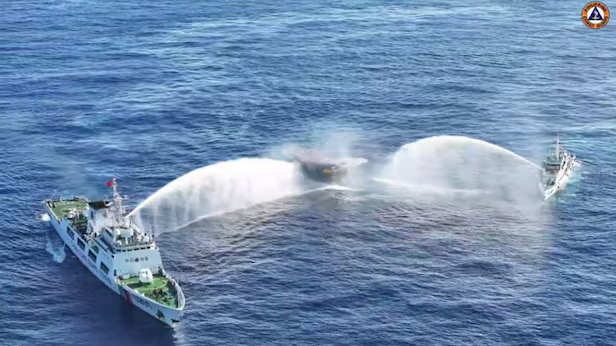
The confrontations have grown more frequent, not less. Chinese coast guard vessels have trained water cannons on Philippine ships, used military-grade lasers, and executed blocking maneuvers that have led to collisions. Manila accuses Beijing of dangerous maneuvers inside its exclusive economic zone. Philippine officials this month demanded China remove a floating platform, buoys, and other structures from Scarborough Shoal, installed without consent, and filed diplomatic protests.
Wu, in an interview published Monday, said Beijing has not ruled out building fixed facilities at the shoal, framing it as a response to pressure rather than a choice. If China takes that step, he said, "it is because external forces have left us with no choice."
Washington, under both the Biden and Trump administrations, has said it is obligated to defend the Philippines, its oldest treaty ally in Asia, if Filipino forces, ships, or aircraft come under armed attack in the disputed waters.
Anniversary Politics
In Manila, the day was marked with a National Peace Walk at Quirino Grandstand, led by Defense Secretary Gilberto Teodoro Jr., armed forces chief General Romeo Brawner Jr., and Coast Guard spokesman Rear Admiral Jay Tarriela. The National Maritime Council said the award "does not belong to any administration, institution, or political party."
At a forum in Manila, envoys from a dozen countries pledged deeper defense and technical cooperation. France's ambassador, Marie Fontanel, argued that legal principles are not sufficient on their own: "Defending international law requires power... it requires ships, aircraft, joint drills, agreements." Australia said it expects to sign a new defense arrangement with Manila this year; Britain is negotiating a visiting forces agreement; Canada recently signed one. Germany's ambassador called stability in the waters a "litmus test for the global rule of law."
Taiwan, which holds Itu Aba and was excluded from the case, restated its own four principles and said it should not be shut out of talks affecting its interests.
Ten years on, the ruling stands, unenforced. China's ambassador to the Philippines called it a "thorn" in relations between the two countries, which is one way of describing a decision that neither side can make the other accept.
Author

We cover the world’s chaos so you don’t have to scroll twelve feeds to understand it.
Sign up for Atlas newsletters.
Stay up to date with curated collection of our top stories.