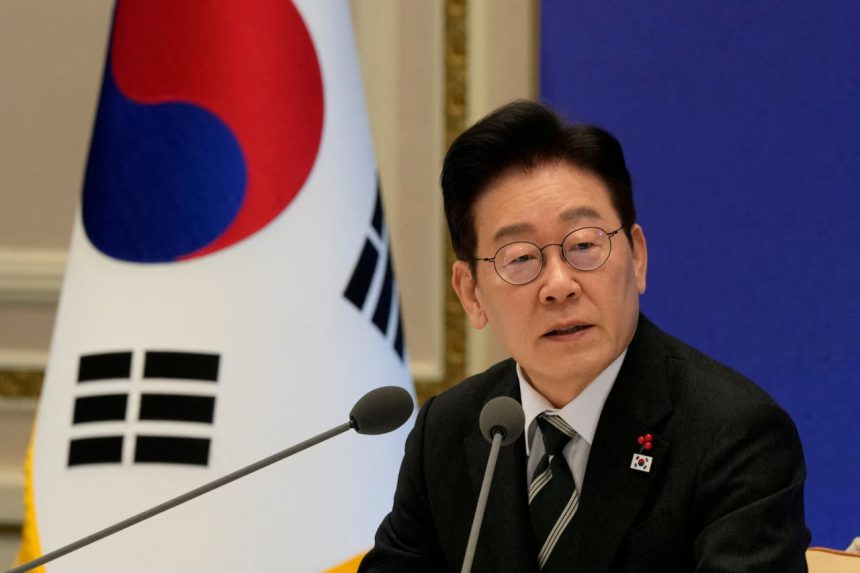
South Korean President Lee Jae Myung has urged the United States to ease sanctions on North Korea in exchange for a freeze on additional nuclear weapons and intercontinental ballistic missile technology, arguing that waiting for complete denuclearization all at once is not realistic while Pyongyang's arsenal keeps growing.
Lee took office in June 2025 after Yoon Suk Yeol's hard-line tenure ended in impeachment and has pivoted toward engagement. He made the sanctions-for-freeze case in interviews as he arrived in New York for United Nations General Assembly week, and in written replies before leaving Seoul. The proposal follows Sunday's test of what North Korean state media called a new-type combat weapon, which Kim Jong Un supervised and where he appeared in released images with his daughter, Kim Ju Ae.
Lee's trade-off
"I believe there is significant value in a trade-off between sanctions — which are not particularly effective anyway — and a stop to the development of additional nuclear weapons and intercontinental ballistic missile technology," Lee said.
Under current circumstances, he said, pursuing denuclearization as the immediate goal meant that nothing would be accomplished. Once a freeze was secured, trust could be built through reciprocal incentives that might eventually lead North Korea to reduce its arsenal, a "peace first" framing that sets aside denuclearization as the opening demand. Lee cited South Korean assessments that the North is capable of producing, or may already be producing, an additional 10 to 20 nuclear weapons each year.
"Once it believes it has accumulated enough nuclear weapons and missiles to guarantee its survival, it will be tempted to export them to make money," he said. "That will be a truly dangerous moment."
Freeze, then dismantle
In written answers, Lee framed the sequence as stop, then reduction, then dismantlement. "To change the direction of a moving vehicle, it must be brought to a halt first," he said. "A phased approach of stop, reduction and dismantlement is a practical way of effectively resolving the North Korean nuclear issue."
"Given the extent to which North Korea's nuclear and missile capabilities have advanced, it is not a realistic solution to wait until complete denuclearization can be achieved all at once," he added. Lee said Seoul and Washington "remain open to engaging in dialogue with North Korea without preconditions," and pointed to talks that could formally end the 1950–53 Korean War as another track. Pyongyang has not responded to that offer.
Seoul Mayor Oh Se-hoon of the opposition People Power Party, speaking at an August National Assembly seminar, warned that a direct U.S.–North Korea deal freezing the North's nuclear program for sanctions relief, with South Korea left out, "is no longer an unrealistic scenario," and called peace under a nuclear threat hanging overhead a false peace.
Kim's terms
Last September, in a speech to the Supreme People's Assembly, Kim said he would never give up his nuclear arsenal to end U.S.-led sanctions and would not treat those weapons as a bargaining chip. He rejected phased suspension-reduction-denuclearization formulas as disingenuous copies of earlier South Korean approaches. Talks with Washington were possible, he said, if the United States stopped insisting on denuclearization and accepted the reality of North Korea as a nuclear state.
UN week and Washington
Lee said he would press the freeze-for-relief case in his General Assembly address. Trump scaled back last month's Ulchi Freedom Shield exercises with South Korea, and Lee called that a deliberate signal of no hostile intent toward the North. North Korea dismissed the cut and has continued weapons launches. Washington has not announced a sanctions shift tied to Lee's proposal.
On Trump and Kim, Lee said: "What is needed now is a political decision at the leaders' level. The two leaders should build trust and work together to identify a common ground, face-to-face."
Changes: cut the duplicate test line, the second Kim's terms paragraph, and the teaser in paragraph two; simplified the speech date; trimmed "that offer of talks without preconditions" to avoid repeating the quote; set headers in normal case.
Author

We cover the world’s chaos so you don’t have to scroll twelve feeds to understand it.
Sign up for Atlas newsletters.
Stay up to date with curated collection of our top stories.



