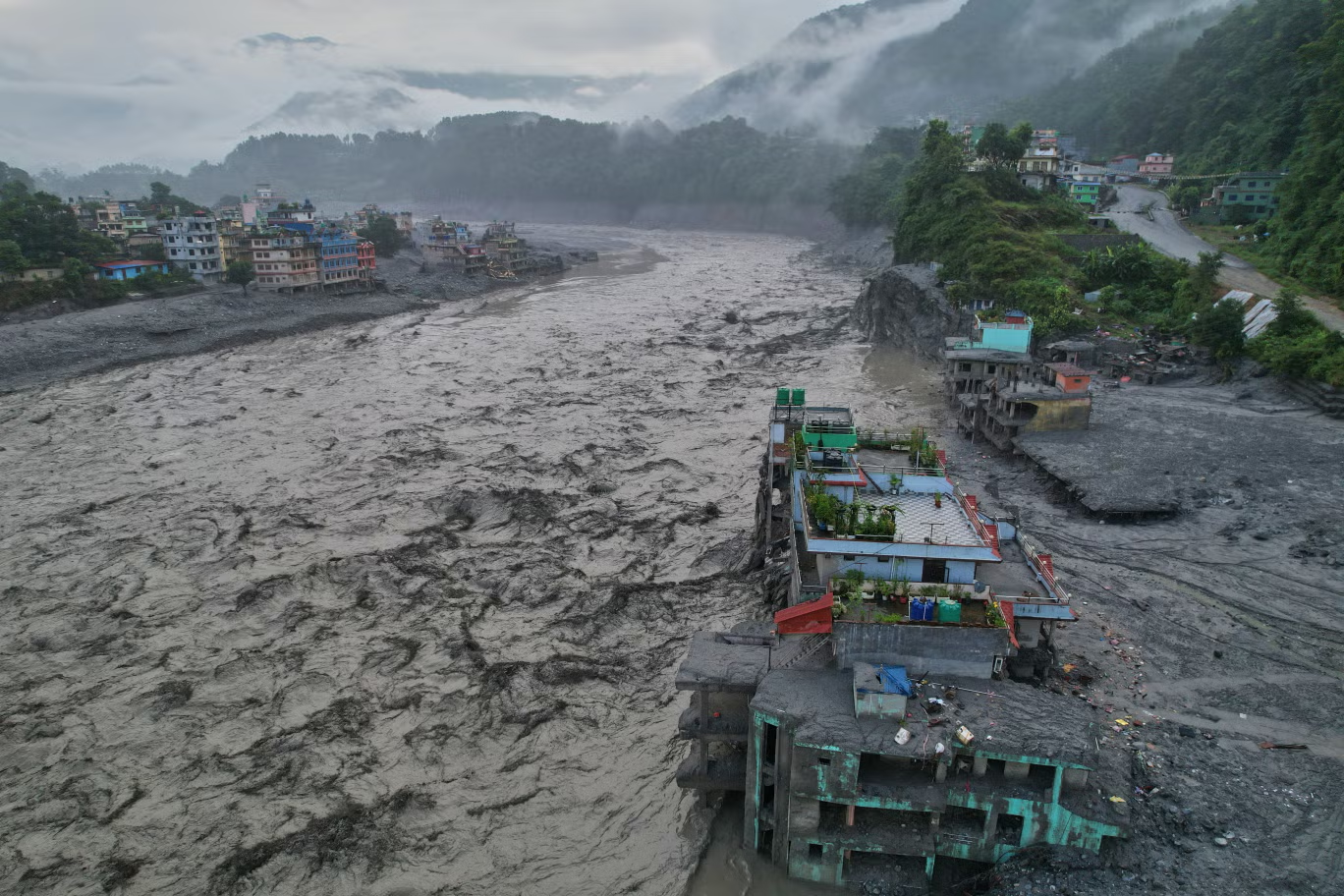
More than 3,000 people remain missing five days after a glacier collapse in the Himalayas sent a wall of water, rock, and mud through valleys along the Nepal-China border, as fresh flood warnings, heavy rain, and a still-draining mountain lake hamper a search that has already confirmed at least 800 dead.
Nepal's disaster agency said Sunday the country's death toll had climbed to 788, with 2,502 people missing — including 592 foreign nationals — while Chinese authorities reported 16 deaths and 546 missing on the Tibetan side of the border, among them 261 foreigners and more than 100 Nepalis. The missing come from more than 30 countries, a mix of workers, trekkers, and pilgrims traveling to a sacred peak.
The disaster began Wednesday morning when bedrock beneath a glacier at roughly 5,200 meters gave way, carrying part of the glacier with it in a fall of some 1,200 meters that gathered rock and debris before slamming into the river system below. The collapse was violent enough to register seismically as a magnitude 5.2 earthquake; the US Geological Survey initially logged it as a quake before analysis of the waves showed the energy came from a glacial collapse and debris flow. The surge swelled the Bhotekoshi and downstream rivers, sweeping away buildings, bridges, and entire riverside settlements in Tibet's Gyirong County and Nepal's Rasuwa, Nuwakot, and Dhading districts.
A Race Against Mud at the Hydropower Tunnels
The most concentrated hopes — and frustrations — center on Nepal's hydropower sites, where more than 100 workers are believed trapped inside flooded tunnels and at least 897 people associated with the projects remain unaccounted for, according to the Nepal Electricity Authority and the Independent Power Producers' Association.
At the Trishuli-3A project, army teams drilled into the upper section of a mud-filled tunnel Saturday evening, breaking through far enough to pump in air and lower a camera. Heavy rain after 2 a.m. Sunday raised the river and refilled the excavation area, stalling progress as the operation entered its fifth day. Crews, including specialists from China and India, have attempted to make contact but have received no response from inside; mountain rescue veterans more accustomed to Everest operations have now joined the effort.
Families keep vigil on a thinning margin of hope. "I still have a 50% hope that he is alive because there is an oxygen system inside," Sita Pandey, whose husband was working in the tunnel, told the newspaper Kantipur. "But with every hour that passes, that hope becomes thinner." Others fault the pace. "The longer it takes, the more our hope dies," said Jiban Khadka, whose relative is also inside. "It's a frustratingly slow operation."
Warnings That Won't Stop, and Burials That Have Begun
Recovery has been repeatedly suspended by weather and the threat of renewed flooding. Alerts went to phones across Rasuwa, Nuwakot, and Dhading early Sunday after Chinese authorities reported increased water flow upstream. China's water resources ministry said a lake formed by Wednesday's disaster has largely drained, but a crater 5.6 kilometers upstream still holds an estimated 1.4 million cubic meters of water and requires close monitoring.
For residents, the constant alarms have become their own ordeal. "Sometimes they say a flood is coming, then we have to run again to higher ground, even at night," said Govind Shreshta, who carries his elderly parents each time. "It's going on like this for those who are still alive."
Downstream in Chitwan, authorities have begun mass burials of unidentified victims whose bodies washed ashore, collecting DNA samples, post-mortem reports, and serial-numbered grave markers so families can identify remains later. Nearly 200 of 272 recovered bodies were buried Sunday. Many of the dead were carried far from where they were lost, leaving relatives searching photograph boards outside hospitals in Kathmandu.
Amid the losses are narrow escapes. In Nuwakot, head teacher Rajendra Dawadi evacuated roughly 1,600 students about 10 minutes before floodwaters swept away his three-story school. "If we didn't make a quick decision, if it were 10 minutes later, we all... wouldn't be able to speak to you today," he said. A five-year-old girl named Ishara survived two days after being caught in a net, having watched her mother swept away; hospital staff are searching for her father. Save the Children says at least 69 schools have been destroyed or damaged, disrupting education for nearly 19,000 children.
The Foreigners Among the Missing
The international toll is unusually broad for a Himalayan disaster. A State Department spokesman said Sunday that approximately 85 Americans remain unaccounted for, with nine safely evacuated and no US citizen deaths known. Washington has activated $3.6 million in emergency humanitarian assistance — including up to three months of food for 10,000 flood-affected households — on top of $500,000 in relief channeled through Catholic Relief Services, and deployed a disaster response adviser.
Australia says 43 of its citizens are missing. "We haven't given up hope that we can rescue those Australians safe and well," Assistant Foreign Minister Matt Thistlewaite said, after one initially missing hiker walked to safety with her Nepali trekking partners. Teams from India, China, South Korea, and Malaysia have joined the search, with Kuala Lumpur pledging $1 million; the European Union has promised $2.3 million, and the International Federation of Red Cross and Red Crescent Societies has launched a $31 million appeal. The Red Cross estimates some 90,000 people in Nepal are affected.
A Disaster in a Warming Range
Nepal's government has framed the catastrophe in climate terms. "Despite having only 0.1% contribution to the global emissions, people of Nepal have become major victims of climate change," Foreign Minister Shisir Khanal said Saturday, calling for a global response.
Scientists are more cautious about this specific event while pointing at the trend. Geologist Daniel Shugar of the University of Calgary, among the first to identify glacial activity as the trigger, said it is too early to link the collapse definitively to warming, though thinning glaciers raise landslide risk. Simon Cook of the University of Dundee noted that degrading permafrost "is partially holding some mountainsides together" — and its thaw promises more failures in a Himalayan region warming faster than much of the planet.
On the ground, the accounting is more immediate: villages entombed in gray sediment, a power plant serving 20,000 people under inspection, bridges gone and communities severed. "Everything is finished. Nothing is left. Not even our home," said Sharmila Tamang, salvaging what she could in Dhading. With rain still falling and thousands of names unresolved, the search continues into its sixth day — divided between the mud where the missing may lie and the tunnels where, families insist, some may yet be waiting.
Author

We cover the world’s chaos so you don’t have to scroll twelve feeds to understand it.
Sign up for Atlas newsletters.
Stay up to date with curated collection of our top stories.



