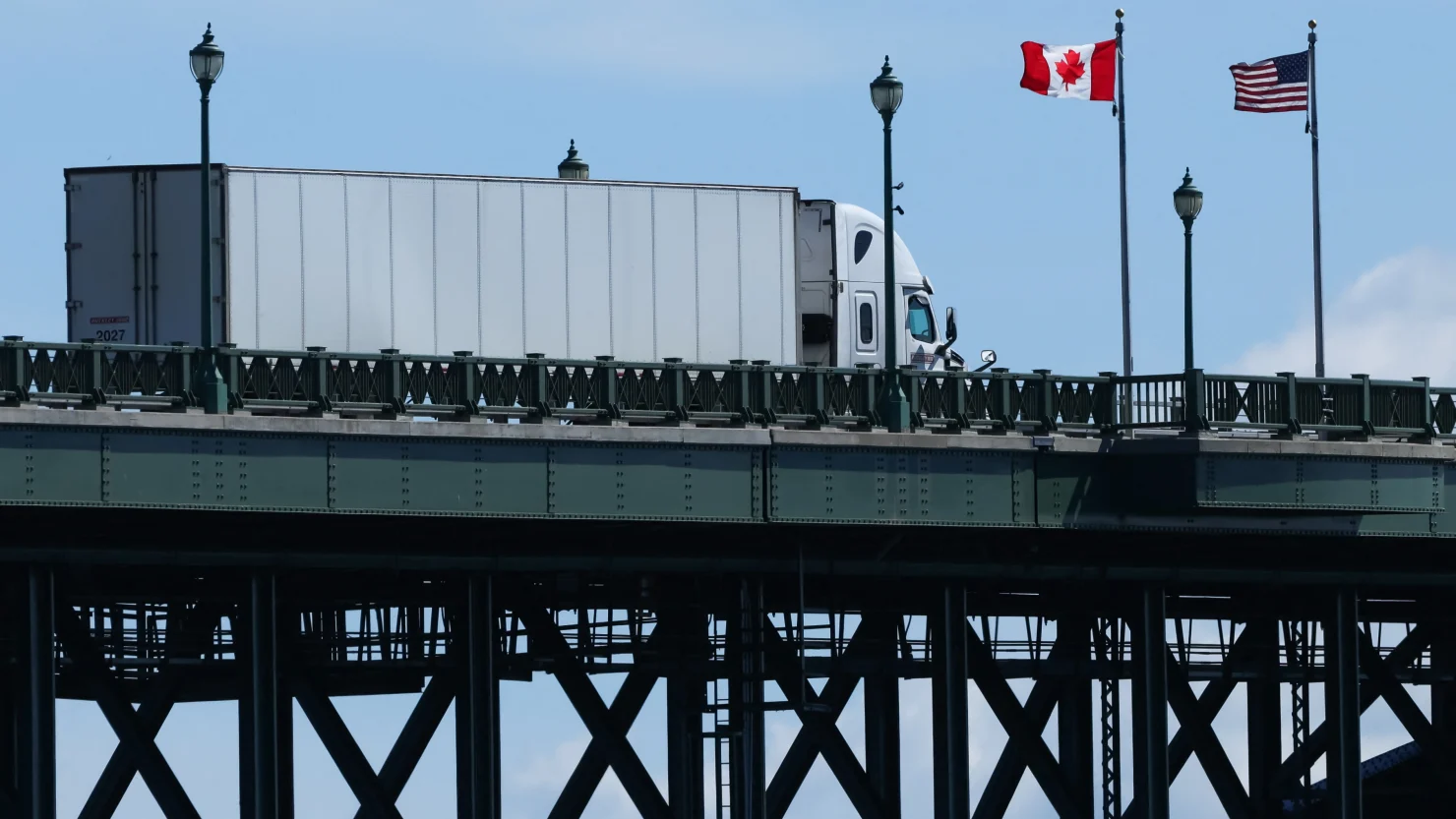
The United States imposed 50% tariffs on roughly $20 billion worth of Canadian products early Saturday after two weeks of negotiations collapsed in the final hours, with each government blaming the other for walking away and Prime Minister Mark Carney vowing to retaliate "dollar for dollar."
The duties took effect at 12:01 a.m. Eastern time, hitting about 5% of what Canada ships to the United States annually — a range of goods that includes wine, furniture, dairy products, cement, clothing, fishing rods, hockey sticks, and tongue depressors. Because the tariffs apply even to goods qualifying for preferential treatment under the US-Mexico-Canada Agreement, trade specialists have warned they expose already vulnerable sectors to damage that could bring job losses and business closures.
"Tonight, Canada declined to finalize the trade deal under the terms agreed earlier this week," US Trade Representative Jamieson Greer said in a statement read to reporters shortly before midnight. "Despite the U.S. offer to Canada to receive the best treatment of any major exporter to our market, new demands and walk-backs of other commitments by Canada have upended the careful balance reached in the past days." He called the outcome "a missed opportunity for Canada to partner with the United States, which is the fastest-growing economy in the G7."
Carney announced he had suspended negotiations entirely and ordered his team home. "They have worked hard, in good faith, to defend the interests of Canadians throughout these negotiations up until the very last minute," he said. "However, last-minute changes in the U.S. proposed terms were unfair, uneconomic, and called into question the reliability of any deal." Canada, he said, "will match those tariffs dollar for dollar to protect our workers and businesses," with additional support for affected industries to be announced in the coming days.
A Deal That Was "Pretty Much" Done
The breakdown stunned observers on both sides of the border because an agreement had appeared imminent. Trump told reporters Friday afternoon that negotiators had "pretty much" struck a deal, citing his "good relationship" with Carney, and Canada's lead negotiator, Dominic LeBlanc, had said Thursday, "We're very close, we continue to make progress." The tariffs were originally set for August 19 before Trump paused them three days, citing major progress.
The package on the table was substantial. Greer said the US offered "significant tariff reductions" on steel, aluminum, autos, and lumber — reportedly cutting auto tariffs from 25% to 15% and halving steel and aluminum duties to 25% — alongside aerospace supply chain coordination, critical minerals cooperation, expanded forced-labor enforcement, and the announcement of formal renegotiation of the USMCA, which Trump declined to renew last month.
A senior administration official said the offer would have given Canada the best tariff position of any major US trading partner, but that Ottawa pressed for additional concessions, particularly on steel, aluminum, autos, and softwood lumber. The official described the talks as candid rather than acrimonious — and said no further meetings are scheduled.
Carney's account inverted the blame: it was Washington, he said, that changed terms at the last minute. "In recent weeks, we made important progress toward improving Canada's position as having the best deal in the world with the U.S.," he said, but the result "has not been enough to meet our objectives for Canadians."
The Grievances Behind the Duties
Trump signed the proclamations in July under Section 338 of the Tariff Act of 1930, a never-before-used Depression-era authority, citing what the White House called "discriminatory treatment" of American alcohol, automobiles, and dairy. Canadian provinces pulled US alcohol from government-run liquor stores in early 2025 in retaliation for earlier tariffs; Canada's supply management system restricts American dairy; and Ottawa has maintained counter-tariffs on autos, steel, and aluminum even after removing most other retaliatory measures, arguing the US duties on those sectors violate the USMCA.
The pieces of a resolution had been visibly assembling. Provincial premiers had agreed to restock American alcohol if negotiations succeeded, according to Newfoundland and Labrador's premier, and Ottawa had signaled the dairy system would be protected but discussed. Those steps now sit in limbo, alongside the USMCA renegotiation both countries say they want.
Domestic politics constrained both leaders. A Leger poll released Wednesday found 56% of Canadians want their government to take a hard line and make no further concessions, and Carney — elected last year on promises to stand up to Trump — remains broadly popular for doing so. "America has changed," he said Saturday, repeating his message that the countries "will not return to our old relationship." Vice President JD Vance offered the American read: Carney, he said, tried to "out-tough" Trump.
The Costs of No Deal
The direct economic hit is real but bounded. The targeted goods represent just over 5% of Canadian exports to a market that absorbs roughly 70% of everything Canada sells abroad. The greater damage, economists and business groups argue, lies in what the collapse forecloses: relief from the existing steel, aluminum, auto, and lumber tariffs that have battered Canadian industry for 18 months, and a stable path for the trilateral trade pact. The Canadian Chamber of Commerce warned previously that dueling tariffs "would damage both economies, drive up costs for U.S. families, further disrupt critical supply chains, and risk the 13 million American jobs that depend on trade" under the agreement.
Former US officials see pressure building quickly for an off-ramp. "If Canada has agreed to also impose retaliatory tariffs, that will make de-escalating this a lot harder," said Ryan Majerus, a trade lawyer and former Commerce Department official. "But I think both sides will face significant pressure in the coming days to find an off-ramp." Christopher Padilla, a former trade official now with Brunswick Group, noted "a lot of hope among businesses on both sides" for a deal to close the book on a bruising stretch in the relationship.
What Comes Next
For now, escalation is the operative direction: American duties in force, Canadian counter-tariffs promised, negotiators recalled, and no talks on the calendar. Quebec Premier Christine Frechette had said she would assess any deal before taking a position, while Manitoba's Wab Kinew urged Canada to keep fighting — sentiments that leave Carney room to hold firm.
Whether Saturday marks a bargaining pause or a durable rupture may depend on how quickly the costs register — in provincial liquor revenues, American grocery prices, cross-border supply chains, and the annual USMCA review process that now proceeds under a cloud. Both governments spent the week insisting a deal was within reach. Both spent the weekend explaining why it wasn't.
Author

We cover the world’s chaos so you don’t have to scroll twelve feeds to understand it.
Sign up for Atlas newsletters.
Stay up to date with curated collection of our top stories.



