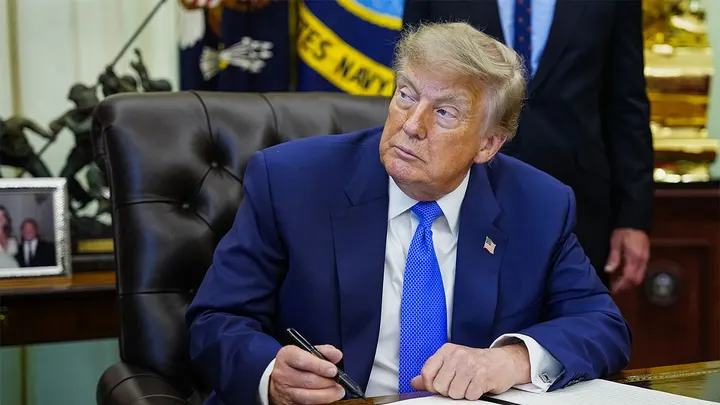
President Donald Trump capped a week of beef politics Friday by announcing he will authorize farmers and ranchers to process their own meat, a direct challenge to the four companies that dominate American meatpacking — days after he signed a proclamation temporarily lifting tariffs on imported ground beef that drew furious objections from the very ranchers he now says he is defending.
"For years I have heard that they have had a tremendous problem with the Big Processors, who many say are a nasty Monopoly," Trump wrote on Truth Social. "There are, essentially, 4 of them, a very non-competitive number, and they make life miserable for our wonderful Farmers and Ranchers, and I can't let that happen, can I? So, in order to break this powerful monopoly, with much of its ownership based outside of the U.S., I am authorizing legal documents to be drawn in order to allow Farmers and Ranchers to be given the right to PROCESS THEIR OWN FOOD. This should move quickly."
Four companies — Cargill, Tyson Foods, JBS USA, and National Beef Packing — control about 85% of US meat processing. The idea appears to have crystallized during Trump's interview Wednesday with conservative host Glenn Beck, a ranch owner who described a "meat-processing cartel" and urged the president to "break the back of those processing plants." "This is a very big thing," Trump replied. "You just gave me a very good idea."
Agriculture Secretary Brooke Rollins answered on X — "We are on it, Mr. President!" — promising announcements beginning Monday on waiving processing red tape, expanding ranchers' ability to sell across state lines, truth-in-labeling, and funding for small processors. The White House did not specify which food-safety regulations Trump hopes to waive, and the Big Four did not respond to requests for comment.
The Import Proclamation That Lit the Fuse
The processing announcement followed a bruising week. Trump signed a proclamation Wednesday temporarily expanding the quantity of lean beef trimmings that can enter the country at low in-quota tariff rates — up to 300,000 metric tons over 90 days beginning September 1, delivered in monthly tranches of 100,000 tons. Imports within existing quotas face a tariff of 4.4 cents per kilogram; volumes above them are hit with a 26.4% duty, a difference that can exceed $1.80 per kilogram on typical beef prices.
The White House built guardrails into the measure: it applies only to trimmings combined with US beef into ground beef, "encourages" sale at a 25% discount from going import prices, leaves country-specific quotas and free-trade commitments untouched, and — by the administration's estimate — boosts supply roughly 10% over projections while competing "only with cull cow markets" rather than the fed cattle that ranchers sell. Trump wrote that he may end the action early "to prevent a windfall to foreign producers" if prices don't fall.
Which countries will supply the beef remains publicly unanswered. Asked directly, Rollins said, "I am actually not part of any of those conversations," deferring to the US Trade Representative.
A Rebellion in Cattle Country
The import plan, first announced August 21, triggered swift blowback from ranchers and Republicans. Senator Tim Sheehy of Montana said he had "advised President Trump against this course of action for a year because American ranchers have been struggling against the packer monopoly for decades, and this will further harm them — most of whom are MAGA Republicans." Senate Majority Whip John Barrasso of Wyoming posted that "Americans want US beef on the table – not foreign imports." Representative Thomas Massie of Kentucky called it "worse than socialism," and former Representative Marjorie Taylor Greene said the plan puts "American beef Last and foreign beef FIRST."
The economics behind the fight are stark. Ground beef averaged $6.89 a pound in July — up 10% in a year and 57% over five years — with steak and roast prices climbing nearly as fast. The US herd stands at about 86.2 million cattle, its smallest in 75 years, squeezed by record 2024 drought, high feed costs, and the closure of southern border ports to Mexican cattle after the New World Screwworm outbreak — a shutdown that cut off roughly a million head a year and, by the White House's accounting, cost hundreds of thousands of metric tons of production. USDA forecasts beef output falling about 4% from 2025 even as Americans consume some 29 billion pounds annually. Rebuilding a herd takes about two years, and Tyson last week announced its second Illinois plant closure of the year.
The Legal Road Runs Through Congress
The deregulatory promises face a structural obstacle: much of what Trump described requires legislation. Federal law generally requires meat sold commercially to pass through USDA-inspected facilities, and lawmakers have tried for years to loosen that requirement through the PRIME Act — sponsored by Massie and Democrat Chellie Pingree in the House, Rand Paul and Angus King in the Senate — which would let small ranches and local slaughterhouses sell directly to consumers without federal inspection. The bill has repeatedly stalled against lobbying from agriculture groups warning of food-safety risks. "Trump's post is great, but it should be a law, not just an executive order," Massie wrote Friday. "Pass the PRIME Act so consumers can get affordable U.S. beef and farmers can flourish!"
Mandatory country-of-origin labeling faces the same hurdle: Congress repealed the previous beef labeling rules in 2015, and a Senate farm bill package that would restore them stalled in committee this month.
A Balancing Act Ten Weeks From the Midterms
The week's whiplash — imports to cut prices, deregulation to placate producers — reflects the political bind. Grocery costs rank among voters' top concerns ahead of November, and beef has led food inflation; but the ranchers absorbing the import competition are a core Republican constituency. The administration has layered remedies accordingly: a December executive order on price fixing, a Justice Department antitrust probe of the largest meatpackers, $60 million already deployed for small processors with a larger lifeline planned, a February proclamation boosting Argentine imports by 80,000 metric tons, and a phased reopening of the Mexican border with screwworm safeguards. The White House notes the herd is growing for the first time since 2018, with ranchers retaining more heifers.
Whether the two tracks cohere is the open question. Cheaper imported trimmings work against the higher cattle prices that make herd rebuilding attractive; breaking packer concentration, if it happens, operates on a timeline measured in years, not news cycles. For now, the administration is betting it can deliver cheaper hamburger to consumers and structural change to ranchers at once — with the first tranche of tariff-free beef arriving September 1, and the first of Rollins' "big announcements" due Monday.
Author

We cover the world’s chaos so you don’t have to scroll twelve feeds to understand it.
Sign up for Atlas newsletters.
Stay up to date with curated collection of our top stories.



