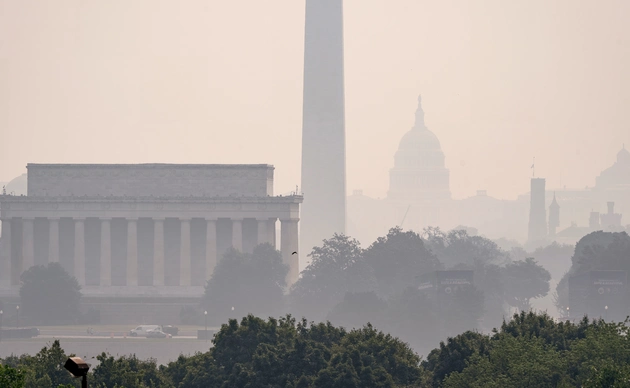
Smoke from hundreds of Canadian wildfires blanketed much of the eastern United States this week, pushing air quality in Detroit, Chicago, and Washington to among the worst readings of any major cities in the world and prompting warnings for millions of Americans to stay indoors. The haze also brought a political response. An Ohio senator said he would introduce legislation to sanction Canada, and President Trump threatened to fold the cost of the pollution into the tariffs Ottawa already pays.
By Friday, more than a dozen states sat under air quality alerts, the Canadian Interagency Forest Fire Centre counted roughly 900 active fires with about 750 out of control, and the two governments were trading blame over who was responsible and what should be done.
The Sanctions Bill
Senator Bernie Moreno, a Republican from Ohio and a close Trump ally, announced Thursday that he would introduce a bill next week to sanction Canada and the Canadian officials he holds responsible. "I'll be introducing a bill next week to sanction Canada and the responsible Canadian government officials for this atrocity," he wrote on X.
His office argued that Canada's government had failed to invest in wildfire prevention, citing forest thinning, fuel reduction, prescribed burns, and stronger enforcement against arson. An early version of the measure, called the CANADA FIRE Act, would declare a national emergency over the smoke and direct the president to determine whether Canadian wildfires had harmed U.S. air quality, then sanction those found responsible by freezing assets and imposing financial restrictions.
The bill would also revoke visas for anyone sanctioned under it and express the sense of Congress that Secretary of State Marco Rubio should declare certain Canadian officials "persona non grata," a status that would strip them of diplomatic welcome, until the president certifies that air quality in affected U.S. communities has stayed below an unhealthy threshold for 90 consecutive days after the smoke clears. The measure includes waivers and exceptions for diplomacy, safety, and national security.
Its prospects are uncertain. Democrats hold enough seats in the Senate to block the bill through a filibuster, and the causes of the fires are not as simple as the legislation's framing suggests.
Trump's Tariff Threat
Trump escalated the pressure Friday, threatening new tariffs on Canada and accusing its government of "willful negligence." Writing on Truth Social, he said the United States was "holding Canada responsible for the fact that they are not properly maintaining their Forests, and Brush therein," and that the country was "being unnecessarily invaded by filthy, polluted, and unhealthy air."
He said he would call Prime Minister Mark Carney to ask what Canada intended to do, called the cost to the United States "incalculable," and argued that the price of the pollution "must of necessity be added to the TARIFFS Canada is currently paying." Trump did not specify a rate, though Representative John James of Michigan and Moreno have pushed a 25 percent fee on imports, with James suggesting the revenue could seed a victim compensation fund and pay for cleanup. "Michigan is not Canada's ashtray," James wrote.
Four Michigan Republicans, James, Jack Bergman, John Moolenaar, and Lisa McClain, had earlier sent Carney a pointed letter, their third such appeal in three years. "This is the third consecutive year we have had to write to Canadian officials about a crisis that Canada has the tools to prevent and has chosen not to," they wrote, warning that if Canada would not manage its forests, the United States would "look elsewhere, and act on our own," including exploring "direct involvement in cross-border fuel reduction and firefighting capacity." Other Michigan Republicans floated their own measures, from delaying the opening of the new Gordie Howe Bridge to demanding regular briefings for U.S. agencies.
Canada Pushes Back
Canadian officials rejected the accusation of neglect and pointed to a long record of cross-border cooperation. Emergency Management Minister Eleanor Olszewski noted that Canada and the United States have a long history of fighting wildfires together, and said Canada had invested $12 billion in forest sustainability and fire prevention since 2020.
Ontario Premier Doug Ford was sharper. He announced the province would spend 650 million Canadian dollars, about 465 million U.S. dollars, on five helicopters and six water bombers, the largest such purchase in its history, and told U.S. critics to send help rather than complaints. "We have done the exact same thing for our American friends, and that's what you're supposed to do," he said, citing Canadian aid during California's 2025 wildfires and Hurricane Helene in the Carolinas and Georgia. Ontario has deployed 150 fire crews and more than 80 aircraft, with most of its fires concentrated in the remote, sparsely populated northwest, reachable only by air.
Carney, for his part, largely brushed off the criticism, framing wildfires as a shared problem tied to a warming planet. "Fighting climate change is the responsibility of all countries, including the United States," he told reporters in London, Ontario, a pointed reference to Washington's rollback of climate and clean energy policies. Notably, the U.S. ambassador to Canada, Pete Hoekstra, struck a cooperative tone at odds with the lawmakers, praising "outstanding cooperation" between the two governments monitoring the fires in real time.
What's Driving the Fires
The dispute reflects a genuine divide over cause. Republican critics attribute the fires primarily to inadequate forest management, arguing that thinning, controlled burns, and debris clearing could prevent much of the damage. Climate and public health experts point instead to conditions they link to a warming climate, chiefly a record-breaking North American heat wave that dried out forests and set the stage for lightning-sparked blazes.
An analysis by Climate Central found that on July 13, when the cluster of Ontario and Minnesota fires responsible for most of the haze began, temperatures in the province ran more than 25 degrees Fahrenheit above average, conditions its chief meteorologist said would have been virtually impossible without climate change. Researchers note the pattern is shifting eastward, putting eastern Canada at greater risk than its historical norm. Most experts describe forest management and climate as compounding factors rather than competing explanations: better management can reduce risk, but hotter, drier weather makes explosive fire growth more likely regardless.
The United States is having its own heavy fire year, with about 1.5 million hectares burned so far in 2026, well above recent averages. Canada's season, by contrast, has been less severe than the catastrophic 2023 year, when 17.6 million hectares burned, though this year's roughly 4.6 million hectares have still driven smoke across the border.
The health stakes are real. Fine particulate matter in wildfire smoke can trigger asthma, heart attacks, and breathing problems, poses heightened risks to children, older adults, and people with existing conditions, and has been linked in studies to tens of thousands of premature deaths each year in the United States. Hospitals in Michigan reported treating children, dialysis patients, and older residents for the effects of smoke that, as the Michigan lawmakers put it, "did not originate anywhere near them." As of Friday, winds were expected to begin clearing skies over the weekend, though forecasters cautioned the smoke could keep returning until the fires themselves are out.
Author

We cover the world’s chaos so you don’t have to scroll twelve feeds to understand it.
Sign up for Atlas newsletters.
Stay up to date with curated collection of our top stories.