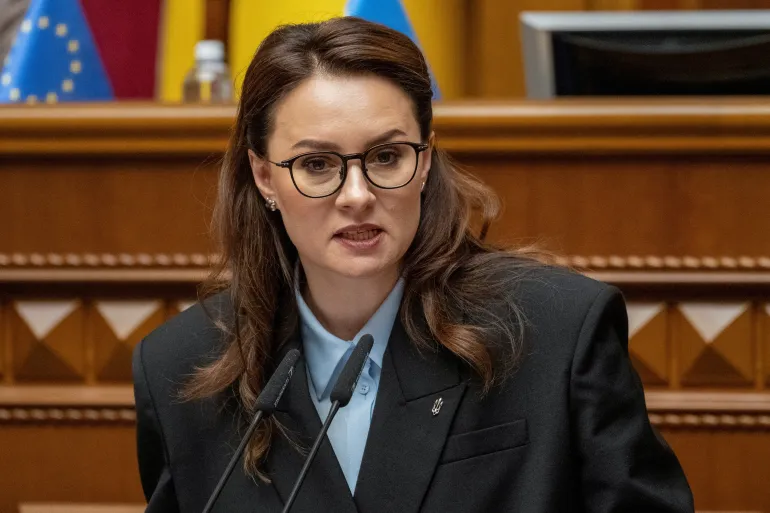
Yulia Svyrydenko lasted a year as Ukraine's prime minister. On Sunday, President Volodymyr Zelenskyy announced she was leaving the job, part of a shakeup he explained in a lengthy social media post that said almost nothing about why it was happening now.
"Ukraine is changing its political strategy," Zelenskyy wrote, adding that he and Svyrydenko had agreed the shift required "a renewal of the Cabinet of Ministers." He said he had offered her the chance to lead "a new and important area of relations with a key partner," and did not name the partner, the position, or her successor. He also said the heads of some law enforcement agencies would be replaced, without saying which ones.
Under Ukrainian law, the prime minister's resignation must be approved by parliament and brings down the entire government with it. It would be Zelenskyy's fourth major reorganization since Russia's full-scale invasion began in 2022.
A Short Tenure
Svyrydenko, an economist, is 39. She was named prime minister in July 2025, succeeding Denys Shmyhal, after a year as deputy head of Zelenskyy's office and four years as deputy prime minister for economic development and trade.
Her signature achievement came before she took the job: she led the negotiation of the critical minerals agreement with Washington, a deal widely credited with thawing an initially frosty relationship between Zelenskyy and President Trump and with tying American economic interests to Ukraine's security.
She did not say she had been pushed out. "I am proud to have had the honor of leading the Government during one of the most difficult periods in Ukraine's modern history," she wrote on X, thanking Zelenskyy for his trust and saying she had discussed "next steps" with him. "I remain ready to serve the Ukrainian state and carry out every task aimed at strengthening Ukraine's position, defending our national interests and bringing a just peace closer."
Lawmakers Caught Off Guard
Inside Zelenskyy's own Servant of the People party, the announcement landed as a surprise, and the absence of a stated reason has fed speculation.
"It's a strange situation," one party lawmaker told the Kyiv Independent, speaking anonymously. "Cabinet resignations are generally a last resort. They're usually something you would expect in the fall, when the political season begins." The lawmaker said there was no obvious cause for Svyrydenko's removal and called it "a preemptive move."
The party is scheduled to meet Tuesday to work through the personnel changes.
The timing sits against a bruising year. Ukraine has been shaken by the largest corruption case in its history, the so-called Midas investigation, which authorities say involved a $100 million kickback scheme at the state nuclear company Energoatom, with contractors allegedly forced to pay bribes of 10 to 15 percent on procurement deals. The scandal reached Zelenskyy's inner circle: prosecutors named his former business partner Timur Mindich as the alleged ringleader and identified his former chief of staff, Andriy Yermak, as a suspect. Both deny wrongdoing. Two ministers resigned. Svyrydenko had helped manage the fallout. Zelenskyy's last major reshuffle came in January, in the wake of it.
Who Might Replace Her
Zelenskyy gave no name, but he met individually with a series of senior officials the same day and posted photographs of the meetings, a fairly transparent shortlist.
Lawmakers point to four: Serhiy Koretskyi, who runs the state energy company Naftogaz; Energy Minister Denys Shmyhal, who held the premiership from 2020 to 2025 and could now return to it after a year away; Defense Minister Mykhailo Fedorov; and Kharkiv Mayor Ihor Terekhov. Koretskyi is described as the front-runner, though he is not a household name even within the party. "I don't know him at all," one lawmaker said. "I haven't heard of him before." Another was blunter about the whole exercise: "It's all just talk at this point."
Opposition lawmaker Yaroslav Zhelezniak, who is well sourced on such matters, said Svyrydenko is likely headed to Washington as ambassador. That post is currently held by Olha Stefanishyna, appointed last August.
The Strategy Behind It
Zelenskyy did lay out what he means by a new political strategy, even if he did not explain the personnel logic. Each foreign policy priority, he said, will be assigned to a specific person with the experience to deliver what leaders agree to.
At the top of the list is the licensed production of Patriot air-defense missiles in Ukraine, something Zelenskyy has pressed for and that Trump agreed to at the NATO summit in Ankara last week. Others include the European anti-missile project, Ukraine's EU accession bid, a reset with Hungary and Poland, security and economic cooperation with Gulf states, and pushing China to do more to help end the war.
Domestically, he named drone production, work in frontline and border regions, the overhaul of state-owned companies, and, repeatedly, preparation for winter. "Ukraine must be ready for every threat that may arise," he said.
The reshuffle comes as the war grinds through one of its deadliest stretches. Russia hit Kyiv overnight Friday into Saturday with more than 120 drones and 12 missiles, half of them ballistic, killing six people including a child and wounding 29. Ukrainian defenses stopped most of the drones but not the ballistic missiles. Moscow's Defense Ministry said Sunday it had struck the ports of Odesa and Chornomorsk.
Ukraine, for its part, kept up its campaign against Russian energy infrastructure, what Zelenskyy calls "long-range sanctions." A strike Sunday in Russia's Samara region killed one person and wounded three, including a child, with Russian outlets reporting the target was the Rosneft-owned Syzran refinery, roughly 500 miles from the border. Another drone attack damaged an empty tanker in the Azov-Black Sea canal. Those strikes have produced gasoline shortages and rationing across Russia, and Moscow has answered by intensifying its bombardment of Ukrainian cities, a cycle that shows no sign of breaking as the government in Kyiv changes hands.
Author

We cover the world’s chaos so you don’t have to scroll twelve feeds to understand it.
Sign up for Atlas newsletters.
Stay up to date with curated collection of our top stories.