The United Nations' human rights chief said Monday that Israel must end its occupation of large areas of southern Lebanon and halt the demolition of homes, warning that his office has documented large-scale violations of international humanitarian law, some of which may amount to war crimes.
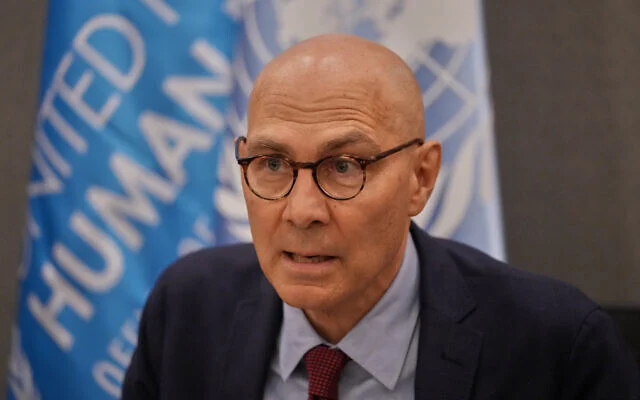
"My office has recorded large-scale violations of international humanitarian law, some possibly amounting to war crimes, and under certain circumstances they may also constitute crimes under international law," Volker Turk told a news conference in Beirut as he wrapped up a two-day visit to Lebanon, his second in just over a year.
Since March 2, more than 4,300 people have been killed and 12,200 injured in Lebanon, according to figures from Lebanese authorities. Turk said more than 135 healthcare workers, as well as many journalists and media workers, were among the dead.
The latest conflict began when Hezbollah fired rockets toward Israel after the US-Israeli attacks in February that set off the Iran war. Israel responded with an aerial campaign and ground invasion that has displaced 1.2 million people, and its military still occupies dozens of towns and villages in southern Lebanon. Despite a conditional cessation of hostilities announced April 17 and several rounds of negotiations aimed at de-escalation, "the Israeli military continues to kill and injure people in Lebanon amid continued airstrikes and ground operations," Turk said.
Villages Razed South of the Litani
Turk said entire villages south of the Litani River had been razed or rendered uninhabitable, as Israeli strikes and continuing demolitions flattened homes, schools, healthcare facilities, water distribution networks, electricity infrastructure, places of worship, and agricultural land.
"Demolition of this type raises huge flags about compliance with international humanitarian law," he said, describing what has happened as a "wholesale destruction" of civilian homes. He expressed particular concern that the overall conduct of Israeli forces, including large-scale displacement and the denial of residents' return, "could amount to international crimes."
At a school repurposed as a shelter housing around 1,000 displaced people, which Turk visited alongside Lebanon's social affairs minister, residents described repeated flight from their homes. "This is the second or third cycle of displacement for many," he said. "Some told me they attempted to return home last week, only to discover that their villages had been destroyed."
He recounted meeting a man who had returned to his village south of the so-called yellow line. "The Israelis were there, they prevented him from going anywhere close to it, and he saw how the village was demolished," Turk said. He added that he had contacted Israeli authorities in hopes of conducting a similar visit on the other side but received no reply.
"I am struck by the widespread damage and compounded suffering that I have seen," he said. "The trauma, frustration and despair are palpable — but so too is the demand for justice which I heard resoundingly."
Turk also criticized Hezbollah, noting that rockets fired by the group into populated areas of northern Israel had killed civilians and damaged civilian infrastructure. "Nobody is above international law and there are no exceptions to it," he said.
Lebanese Leaders Back Evidence Collection
Lebanese President Joseph Aoun, who met with Turk on Monday, condemned the demolitions and said Lebanon remains committed to the US-mediated framework agreement with Israel, but warned that Israel's continued military presence and destruction could "undermine its effectiveness." Lebanon "will not accept ongoing violations of its provisions," he said.
"Israel's continued destruction of homes and bulldozing of villages in the south constitutes a direct violation of human rights and a clear breach of international laws and norms, which necessitates international action to end it," Aoun said, adding that Israel had also targeted religious and heritage sites that "are not military sites and do not witness an armed presence in them."
Prime Minister Nawaf Salam reaffirmed his government's support for the continued collection and documentation of evidence related to war crimes and violations of international humanitarian law, commending the work of a UN team of experts and stressing the importance of preserving evidence through an impartial international body.
An assessment mission deployed by the UN human rights office, announced in June in agreement with the Lebanese government, is already on the ground collecting information on alleged violations committed by all parties to the conflict since March 2.
Framework Deal Faces Tests on the Ground
Turk's visit came about a week before Lebanese and Israeli officials are set to meet in Rome for talks on implementing the framework agreement reached June 26. The deal lays out a plan for the deployment of Lebanese military forces in southern Lebanon and a phased Israeli withdrawal, alongside the disarmament of Hezbollah, though it contains no timetable for the pullout. Hezbollah has rejected the direct talks and says it will not disarm.
The agreement also controversially includes both sides refraining from pursuing any form of legal accountability, a provision widely criticized in Lebanon.
Implementation has already run into difficulty. The Lebanese Armed Forces on Sunday accused Israel of obstructing its deployment in designated "pilot zones" established last week, saying Israeli gunfire near army positions in Kfar Tebnit, Upper Nabatieh, and Zawtar al-Gharbiyeh was hampering its missions. The military accused Israeli forces of continued violations through daily home demolitions, the burning of agricultural land, shelling, and gunfire.
The Lebanese army entered Zawtar al-Gharbiyeh last week after Israeli troops withdrew, but civilians eager to return were barred from entering until Friday. More than half the town has been destroyed, according to its mayor, and the initial zones drew criticism because no Israeli forces were present in two of them, Srifa and Froun.
Israel has said its attacks target Hezbollah personnel and infrastructure, accusing the group of hiding among civilians, and says its troops in occupied areas have uncovered weapons warehouses and tunnel networks. Israeli Prime Minister Benjamin Netanyahu, who departed Monday for Washington to meet President Donald Trump, reportedly told his cabinet that Israel would resist US pressure to withdraw its forces from southern Lebanon.
Peacekeeping Mandate and the Path Ahead
Turk voiced concern about the protection of civilians after the mandate of the UN Interim Force in Lebanon expires at the end of this year. "I hope that this dimension — the protection of civilians — will be taken into account in any future configuration," he said.
He also called for justice for victims of the 2020 Beirut port explosion as Lebanon prepares to mark the disaster's sixth anniversary, saying judicial reforms would be critical to restoring trust in state institutions. "Recovery and reconstruction are not simply a logistics exercise," he said, stressing the need for the "full empowerment of the Lebanese state" with full respect for the country's sovereignty and territorial integrity.
Turk acknowledged Lebanon's progress on several fronts, including ratifying the Convention on the Rights of Persons with Disabilities and proposing measures to abolish the death penalty and strengthen judicial independence. His office, he said, remains ready to support Lebanon "in the promotion and protection of human rights for all."
Author

We cover the world’s chaos so you don’t have to scroll twelve feeds to understand it.
Sign up for Atlas newsletters.
Stay up to date with curated collection of our top stories.