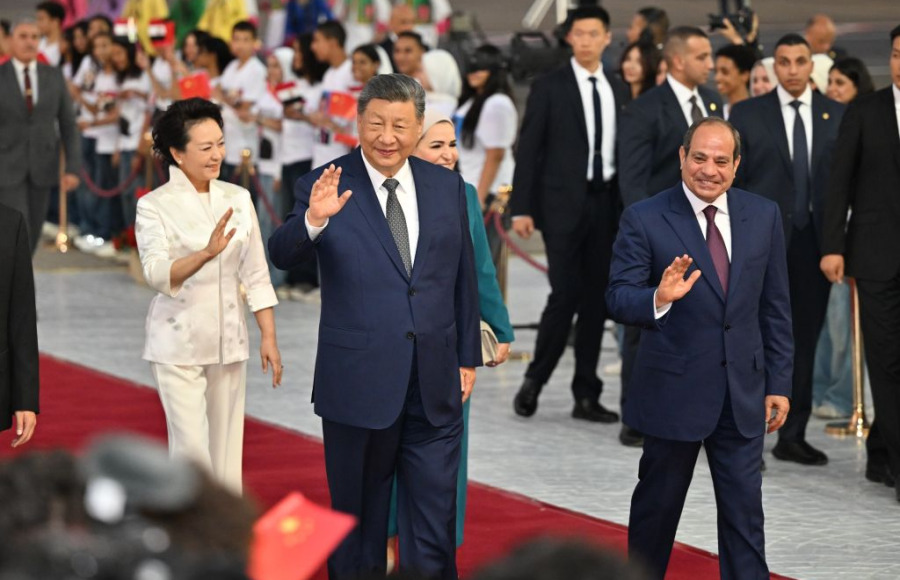
Chinese President Xi Jinping arrived in Cairo on the evening of Sept. 1 for his first state visit to Egypt in ten years, and his first trip to the wider region since a 2022 visit to Saudi Arabia. Talks with President Abdel Fattah el-Sisi were set for Wednesday at Al-Ittihadiya Palace.
Xi flew in from the Shanghai Cooperation Organization summit in Bishkek as the war between the United States and Iran continues to disrupt Middle East diplomacy and shipping. Egypt sits on the Suez Canal. China is one of Egypt’s largest trade partners. Both governments cast the visit as a renewal of a comprehensive strategic partnership, not as a security realignment.
Egypt’s president has traveled to China repeatedly since taking office. One count puts the number at eight visits since 2014. Xi’s return after a decade closes that imbalance and puts the relationship back on Egyptian soil.
Arrival In Cairo And The Wednesday Summit
Sisi and first lady Entissar Amer greeted Xi and Peng Liyuan at Cairo International Airport. The arrival featured a red carpet, an honor guard, and Chinese and Egyptian flags. China’s Foreign Ministry released a written statement on arrival marking 70 years of diplomatic ties and the comprehensive strategic partnership.
Wednesday’s program was to open with an official reception at the palace, including anthems and an artillery salute, before the leaders’ talks. The visit is expected to last two to three days. Xi also plans to tour the Grand Egyptian Museum near the Giza pyramids.
The program follows a standard state-visit format: ceremony first, substance in the closed sessions, and a museum stop tied to Egypt’s cultural diplomacy. What the two presidents sign, if they sign at all on day one, will matter more than the salute.
Trade, Suez, And The Deals On The Table
Officials and advance coverage pointed to expected agreements in artificial intelligence, transport, energy, and investment in the Suez Canal Economic Zone. Those deals had not been signed as of arrival night. Chinese companies already have money in Egyptian ports, factories, and clean energy. Some secondary reporting cited a currency-swap or broader financial package, including a figure of 30 billion yuan. That swap claim remains soft; it has not been confirmed here as a signed deal.
Trade flows favor Beijing. Chinese customs data, reported via Japanese coverage, showed a surplus of about $12 billion for China in the first seven months of 2026. Egypt buys Chinese goods at scale. Cairo wants more investment that creates jobs and builds capacity in the canal zone, not only imports.
Military ties have also thickened. In August the two countries held a joint air exercise, Eagles of Civilization, the first combat exercise pairing China’s J-16 with Egypt’s Rafale. That drill sits beside the commercial agenda. It does not mean China is replacing the United States as Egypt’s security patron, a claim neither capital made in the arrival statements.
Iran War, Hormuz, And Middle East Diplomacy
The strategic backdrop is harder than the trade brief. The U.S.-Iran conflict has raised the cost of Middle East energy and shipping. Washington has warned that it could expand sanctions on Iran’s backers and partners in ways that might touch Egyptian and Chinese banks. That warning is a U.S. policy signal. It is not, on the public record of this visit, a finding that those banks have already been hit.
Egyptian media expected Gaza, Iran, and Red Sea and Hormuz shipping to feature in the talks. Xi arrived with SCO language still fresh from Bishkek, where the organization condemned strikes on Iran. Sisi governs a country that lives off canal tolls and needs calm in nearby waters. Both leaders have incentives to talk about de-escalation and commerce. Neither arrival text announced a mediation mandate.
Op-eds framed the visit in partnership language. Xi appeared in Egyptian media. Sisi, writing in Al-Ahram, stressed the comprehensive strategic partnership and Chinese investment in the Suez Canal Economic Zone. The public line is economic depth and political consultation. The private line will have to handle sanctions risk and wartime shipping.
What Both Capitals Want From The Trip
Beijing wants a visible Middle East partner after Bishkek, continuity on the Belt and Road footprint in the canal zone, and a hearing for its call to protect regional stability without being drafted into Egypt’s security burdens. Cairo wants capital, technology, and political cover from a major power that is not asking it to choose sides in the same way Western partners sometimes do.
Sisi has called the partnership a breakthrough in earlier remarks on the relationship. China’s earlier diplomatic line, including comments from Foreign Ministry spokespeople on safeguarding peace and stability, fits the tone Xi’s written arrival statement struck on friendship and partnership. Concrete deliverables still depend on what is signed Wednesday and after.
As of arrival night, expected agreements in AI, transport, energy, and the canal zone had not been published as signed deals. Neither side had announced operational language on Hormuz, the Red Sea, or Gaza, or a joint response to the U.S. sanctions warning. What was clear is simpler. After ten years, Xi is back in Cairo, Sisi is hosting, and both governments are treating the comprehensive strategic partnership as unfinished business rather than a slogan.
Author

We cover the world’s chaos so you don’t have to scroll twelve feeds to understand it.
Sign up for Atlas newsletters.
Stay up to date with curated collection of our top stories.



