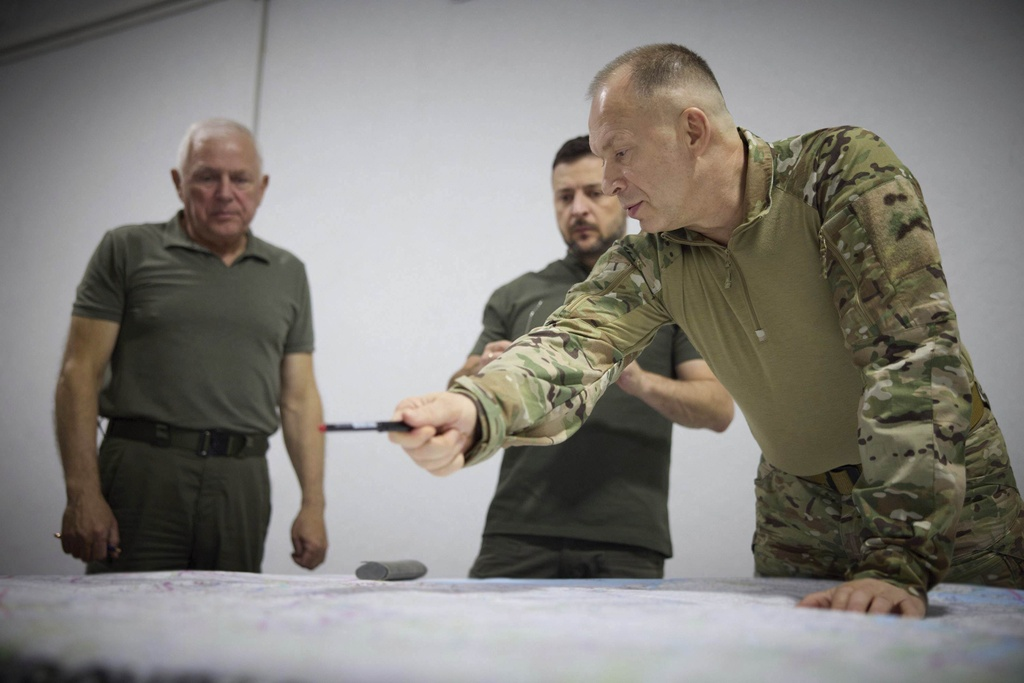
Volodymyr Zelenskyy dismissed the commander of Ukraine's armed forces on Tuesday, bowing to nearly a week of street protests that had turned into the sharpest political crisis of his wartime presidency. He replaced General Oleksandr Syrskyi with Major General Mykhailo Drapatyi, a younger officer aligned with the reformers whose cause the demonstrators had taken up.
The move followed the ouster last week of Defense Minister Mykhailo Fedorov, a popular modernizer whose removal sent thousands into the streets of Kyiv and other cities. It was the second time in roughly a year that Zelenskyy has reversed course under public pressure, after protests last summer forced him to abandon a law weakening Ukraine's anti-corruption agencies.
The Decision
Zelenskyy announced the change in a late-night message, framing it as a reset rather than a rebuke. "I am grateful to Oleksandr Syrskyi and to every one of our warriors for Ukraine's strong front-line positions," he said, crediting the general with defending Kyiv in the first days of Russia's 2022 invasion and with operations in Kharkiv and Kursk. "Our shared wish is one — victory over the enemy and conditions at the front and in pressure on Russia that would force Russia toward peace."
He said the decision came after a weekend of meetings with military commanders, effectively an interview process for Syrskyi's replacement. Zelenskyy directed Drapatyi and other commanders to present an updated defense strategy covering reform of the corps system, faster weapons and drone deliveries, stronger air defense, and a clearer mobilization plan, the last a pressing problem after nearly five years of war have left few Ukrainians willing to volunteer.
Drapatyi accepted in measured terms. "I will work responsibly, with full focus, and with respect for the people who are defending our country today," he wrote on Facebook, thanking Syrskyi for his work strengthening the army. "I grew up in it," he added.
The General They Wanted Gone
Syrskyi, 60, had led the military since February 2024 and was among Ukraine's most experienced commanders, but he had become a lightning rod. Associated with a Soviet-style, top-down command culture, he was seen by many younger Ukrainians as an emblem of the old way of fighting, and within the ranks he had earned the grim nickname "the Butcher."
That reputation was forged in some of the war's costliest battles. Critics pointed to the drawn-out defense and late withdrawal from Bakhmut, and to the chaotic retreat from Russia's Kursk region last year that left soldiers stranded and walking back under fire. His standing eroded further in June, when the Ukrainian outlet Babel published an investigation into alleged abuses within an assault regiment closely tied to him, documenting dozens of deaths among recruits.
Syrskyi did not immediately comment on his dismissal. A day earlier, in an op-ed, he had described his relationship with Fedorov as a working one and offered a qualified apology, writing, "If I offended anyone, Mykhailo Albertovych, I'm sorry." He pushed back on the protests, arguing that questions of contracts, procurement, and mobilization were more complicated than slogans allowed. "Decisions on which people's lives depend are not made with slogans," he wrote. "Real work, not the public drama surrounding it, wins the war."
How the Crisis Began
The turmoil started last Thursday, when Zelenskyy overhauled his wartime government, replacing Prime Minister Yulia Svyrydenko and firing Fedorov after just six months as defense minister. Zelenskyy cited an unworkable rift between Fedorov and Syrskyi, telling reporters that because the two could not resolve their dispute, he would "have to resolve it."
Fedorov, 35, a former digital transformation minister, had won broad praise for modernizing the armed forces, using data to analyze front-line performance and championing the drone warfare behind Ukraine's recent successes against Russian targets. After his dismissal, he accused Syrskyi of blocking his reforms and pressuring Zelenskyy to remove him, a charge the general denied.
The reaction was immediate. Protesters framed Fedorov's removal as Zelenskyy siding with an entrenched military old guard over a reformer, and gave a Friday deadline for his reinstatement, threatening indefinite demonstrations. The backlash spread into the military itself: the air force's deputy commander, Pavlo Yelizarov, resigned in protest, warning the move would weaken air defenses, while soldiers and veterans joined the crowds.
Drapatyi and What Comes Next
Drapatyi, 43, is a battle-hardened general widely regarded within the army and viewed as an ally of Fedorov. He has fought Russia since its covert 2014 push into the Donbas, becoming known nationally after driving an infantry fighting vehicle over a barricade set up by pro-Russian militants in Mariupol. In 2024 he commanded forces that halted Russia's advance on Kryvyi Rih, Zelenskyy's hometown, and helped blunt a renewed offensive in Kharkiv. He was named ground forces commander that year but resigned in 2025 after a Russian strike on a training center killed several troops.
Fedorov endorsed the appointment, calling it "a breath of fresh air" and "new hope in the fight of free people for freedom and justice," language that is likely to help defuse the crisis. He said he had called Syrskyi to thank him for the defense of Kyiv and other battles, while adding that Ukraine must "move even faster and write new chapters, correcting all previous mistakes."
Fedorov's own future remained unsettled. Zelenskyy said he met him Tuesday and offered a "respected position" overseeing the country's technology sector, though it was unclear whether Fedorov, who had reportedly wanted his old job back, accepted. The defense minister post has for now been filled by Yevhen Khmara, a former security service official. Protesters will likely want to see Fedorov returned to real authority before the streets fully quiet.
The shake-up unfolds against a grinding war. The UN human rights mission reported Tuesday that 1,396 civilians were killed and 7,978 wounded in Ukraine in the first six months of 2026, a 37 percent rise from a year earlier. Russia has intensified ballistic missile and drone strikes on Ukrainian cities while Kyiv, short of Patriot interceptors, has pressed its own long-range campaign against Russian oil and logistics targets, launching some 400 drones toward the Moscow region this week. Zelenskyy said those strikes would continue. "Ukraine's plan for long-range sanctions and our program of middle-range strikes will be carried out with absolute precision," he said.
Author

We cover the world’s chaos so you don’t have to scroll twelve feeds to understand it.
Sign up for Atlas newsletters.
Stay up to date with curated collection of our top stories.