Pakistani jets bombed villages across three Afghan border provinces overnight into Monday, and by the Taliban government's count, 36 civilians were dead and more than 160 hurt. Islamabad told a different story: it had hit militant hideouts and killed 29 fighters, payback for a wave of attacks at home. Both versions cannot be true, and the gap between them is now its own diplomatic problem.
Two Accounts
Pakistan's information minister, Attaullah Tarar, laid out his government's version on X. Security forces ran an intelligence-based ground operation near the border late Sunday, then followed with what he called calibrated strikes on terrorist camps in Paktia, Paktika, and Kunar provinces. Twenty-nine fighters dead, he said, four of them tied to Jamaat-ul-Ahrar, a Pakistani Taliban splinter group, plus weapons and ammunition destroyed. He posted three videos he said showed the strikes landing on militant safe havens.
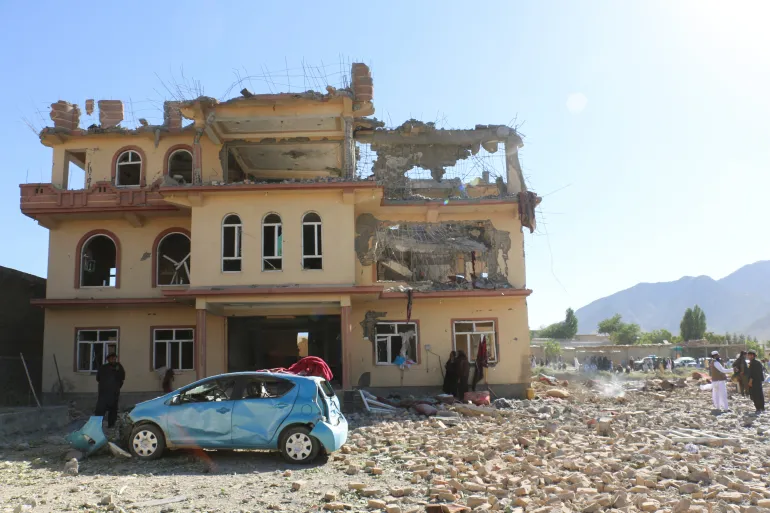
Kabul called that a fiction. Hamdullah Fitrat, deputy spokesman for the Taliban government, said the targets were homes, not hideouts, and that the dead included women and children. Afghanistan condemned the operation as a cowardly act of aggression. A deputy minister, Hayatullah Mohajer Farahi, said the response would come "at the right time," and made a point of saying it would not be driven by emotion.
The United Nations mission in Afghanistan put the confirmed toll lower than the Taliban did, at 28 civilians killed and 49 injured. None of the figures could be independently verified, and the BBC and others noted as much.
What Happened in Mandokhail
The worst of it was in Paktia. By Fitrat's account, a strike first hit a house in the Chamkani district, killing an elderly man and a child. Then, as villagers ran in to dig out the wounded, a second strike hit the same spot. That one killed 28 people and wounded 158.
The double-strike detail did not come only from the Taliban. Khalid Ahmad Sajad, deputy head of the district, told reporters the same thing: rescuers were at work when the second airstrike came down on them. Most of the casualties were in one village, Mandokhail.
Six more people, most of them women and children, died in the Giyan district of neighboring Paktika when another house was struck, Fitrat said. A home in Kunar was hit too, killing no one but about 30 head of livestock.
Adam Khan, 63, described the hospital to the AFP news agency. He said he could not find words for the state of the children he saw there, or for the sound of their families.
The Trigger
The strikes followed a militant attack a day earlier in Karachi. Pakistan's military said three soldiers of the paramilitary Sindh Rangers were killed when attackers set off an explosive at the entrance of their headquarters and then opened fire. Troops killed three of the attackers and captured a fourth, identified by the military as a wounded Afghan national. Jamaat-ul-Ahrar claimed that attack.
Pakistan has accused the Taliban for years of giving shelter to the Tehrik-e-Taliban Pakistan and groups like it, blaming them for a steady rise in attacks on Pakistani police and soldiers. Kabul rejects the charge and says the militants are Pakistan's own problem. The Pakistani Taliban and the Afghan Taliban are separate movements, though allied; the latter has run Afghanistan since 2021.
Tarar also pointed a finger at India, using Islamabad's term for the TTP and tying the group to Indian backing. New Delhi shot that down. A Foreign Ministry spokesman, Randhir Jaiswal, called the claim baseless and said Pakistan should "look inwards" at the militant networks on its own soil.
A Fight That Keeps Reigniting
This was not a one-off. Pakistan had bombed what it called militant hideouts in Afghanistan less than three weeks earlier, on June 10, breaking roughly a month of quiet. That round, too, drew Afghan claims of civilian deaths.
The pattern runs back to February, when Afghanistan struck back after Pakistani airstrikes inside its territory. Hundreds have been killed in cross-border fighting since. Talks have repeatedly failed to hold. China brought the two sides together in April and said afterward they had agreed not to escalate, an agreement that plainly has not stuck.
On Monday both governments summoned each other's chargé d'affaires to file protests. India went further, with its Ministry of External Affairs branding the strikes a blatant act of aggression and a direct threat to regional peace, and accusing Pakistan of trying to externalize its internal failures through violence across the border. It offered condolences to Afghan families and restated its support for Afghanistan's sovereignty.
Pakistani officials said an uneasy calm had returned to the frontier by Monday, with forces on alert. Kabul, having promised retaliation in its own time, left little doubt the matter was not finished.
Author

We cover the world’s chaos so you don’t have to scroll twelve feeds to understand it.
Sign up for Atlas newsletters.
Stay up to date with curated collection of our top stories.