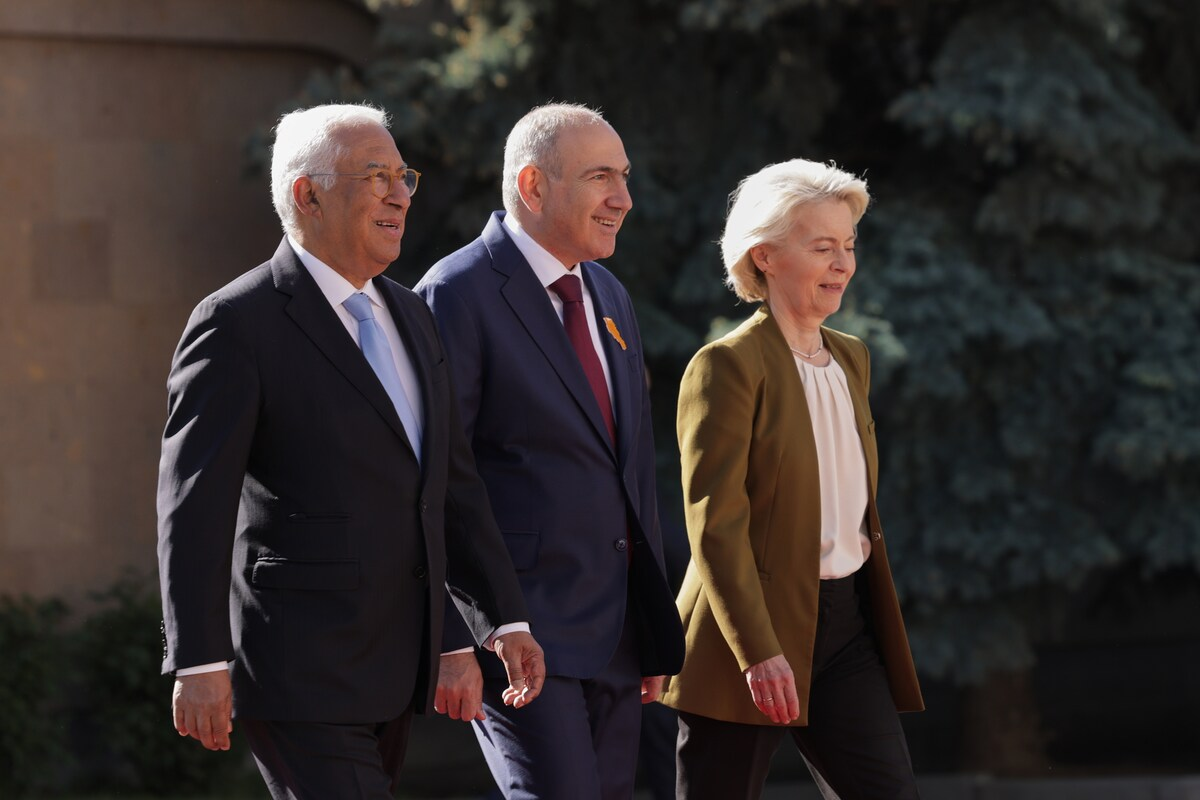
Armenia hosted its first bilateral summit with the European Union in Yerevan on May 5, giving formal shape to a relationship that has been moving quickly since the collapse of Armenia’s security assumptions after the loss of Nagorno-Karabakh. Prime Minister Nikol Pashinyan received European Commission President Ursula von der Leyen and European Council President António Costa one day after Armenia hosted the European Political Community summit, bringing a large group of European leaders to the South Caucasus.
The meeting produced a joint declaration, a new connectivity partnership, and commitments on energy, transport, digital development, border management, and security cooperation. It did not produce EU candidate status, a defense guarantee, or a timetable for membership. That distinction matters. The summit was a diplomatic milestone, but it was not a formal accession step.
For Armenia, the event was still significant. It placed the country in front of Europe at a moment when Yerevan is trying to reduce dependence on Moscow without provoking a complete break. Armenia remains tied to Russia through energy, trade, and security structures. It is still a member of the Eurasian Economic Union. Russia still has a military base in Gyumri. But the direction of travel is now visibly different.
What was signed in Yerevan
The main agreement was a connectivity partnership designed to strengthen Armenia’s transport, energy, and digital links with Europe. The EU framed the deal as part of its wider cross-regional connectivity agenda. Armenia presented it as consistent with its “Crossroad of Peace” initiative, a plan meant to turn the country into a transit and trade link between neighboring regions.
The partnership is expected to be followed by regular high-level talks on connectivity and transport. In practical terms, the EU wants to support infrastructure that could help Armenia plug into wider trade routes, improve its energy resilience, and develop digital links with European markets.
The summit also moved forward cooperation on border and migration management. A working arrangement was initialed between Frontex and Armenia’s Ministry of Internal Affairs. The EU also handed Armenia the first progress report tied to its visa liberalization action plan. That report did not grant visa-free travel, but it recognized progress and outlined further steps.
Economic investment was another part of the summit package. EU-linked support for Armenia is expected to reach 2.5 billion euros through the bloc’s Global Gateway infrastructure program. Brussels also opened a call for strategic investment projects involving companies from Armenia, the EU, and the European Economic Area. The stated priority areas include digital infrastructure, semiconductor skills, innovation, and private investment.
Security cooperation was addressed more carefully. EU leaders welcomed the creation of an EU partnership mission in Armenia and noted the first deliveries of support to the Armenian armed forces through the European Peace Facility, worth 30 million euros. That is not a mutual defense commitment. It is a resilience package, designed to help Armenia strengthen its own institutions and security capacity.
The Russian question behind the summit
Russia was not the headline topic in Yerevan, but it shaped nearly every part of the summit. Armenia was once considered Moscow’s closest ally in the South Caucasus. That relationship changed after Azerbaijan’s military victories in and around Nagorno-Karabakh, especially in 2023, when Azerbaijan completed its takeover of the region and more than 100,000 ethnic Armenians left.
Armenian officials have said Russian peacekeepers failed to prevent Azerbaijan’s operation. Moscow has rejected that argument, saying its forces did not have a mandate to intervene. Either way, the political result in Armenia was clear. Confidence in Russia as a security guarantor sharply declined.
Since then, Pashinyan’s government has frozen Armenia’s participation in the Russian-led Collective Security Treaty Organization and moved closer to the EU. In 2025, Armenia’s parliament passed a law declaring the country’s intention to pursue EU membership. Pashinyan has also spoken publicly about aligning Armenia more closely with European standards, while acknowledging that the process would be long and uncertain.
Russia has warned Armenia about the limits of that approach. Vladimir Putin told Pashinyan earlier this year that Armenia cannot belong fully to both the Eurasian Economic Union and the European Union. He also pointed to Armenia’s dependence on Russian gas, which Moscow supplies at rates far below typical European prices.
That is the constraint under the summit. Armenia wants European options, but it does not yet have replacements for every Russian link. The EU can offer investment, technical assistance, political support, and help against foreign interference. It cannot quickly replace Armenia’s energy dependence on Russia or provide the kind of hard security architecture that would make Moscow irrelevant.
A summit before an election
The timing of the summit was politically important. Armenia is scheduled to hold parliamentary elections in June. Pashinyan will enter that vote with a visible endorsement from Europe’s top institutions and the prestige of having hosted two major European gatherings in two days.
European leaders praised Armenia’s reform course and spoke of democracy, rule of law, peace, and resilience. That gives Pashinyan a foreign policy achievement he can point to at home. It also gives his critics an opening to argue that European support is aimed as much at him personally as at Armenia as a state.
The election will test how much public support there is for his course. Many Armenians want closer ties with Europe, especially after the failure of Russian-backed security structures. But the country is divided over the cost of that shift, the handling of relations with Azerbaijan, and the fate of Armenian prisoners still held by Baku.
Those tensions were visible around the summit. Demonstrators in Yerevan held photos of Armenian prisoners in Azerbaijan. Their message was that European leaders should not treat normalization or regional cooperation as complete while those cases remain unresolved.
Azerbaijan, meanwhile, has grown increasingly irritated with European institutions. Baku recently protested a European Parliament resolution calling for the release of Armenian prisoners and criticizing the treatment of Armenians from Karabakh. Azerbaijani lawmakers then voted to suspend cooperation with the European Parliament. That dispute formed part of the regional backdrop to the Yerevan meetings.
What the summit changes
The summit does not move Armenia into the EU accession queue. It does not end Armenia’s economic dependence on Russia. It does not settle the conflict with Azerbaijan. It does not give Yerevan a western security umbrella.
What it does is more limited, but still important. It institutionalizes Armenia’s turn toward Europe. It puts transport, energy, digital cooperation, border management, visa liberalization, and security resilience into a more formal framework. It also shows that Brussels is prepared to invest political capital in Armenia at a time when Moscow’s standing there has weakened.
For Europe, Armenia is now a more active partner in the South Caucasus. For Armenia, the EU is no longer only a distant political model or aid provider. It is becoming a practical counterweight, though still an incomplete one.
The result is a careful recalibration, not a clean realignment. Armenia is moving west, but it is doing so while still tied to Russian markets, Russian energy, and unresolved regional threats. The Yerevan summit made that shift more visible. The June election, the future of talks with Azerbaijan, and Moscow’s response will determine how far it can go.
Author

We cover the world’s chaos so you don’t have to scroll twelve feeds to understand it.
Sign up for Atlas newsletters.
Stay up to date with curated collection of our top stories.