Australia and Fiji signed their first mutual defense treaty in Suva on Monday, binding each country to come to the other's aid if attacked. Within hours, a Chinese submarine launched a nuclear-capable ballistic missile into the South Pacific. Beijing called the timing coincidental and the test routine. Almost no one in the region read it that way.
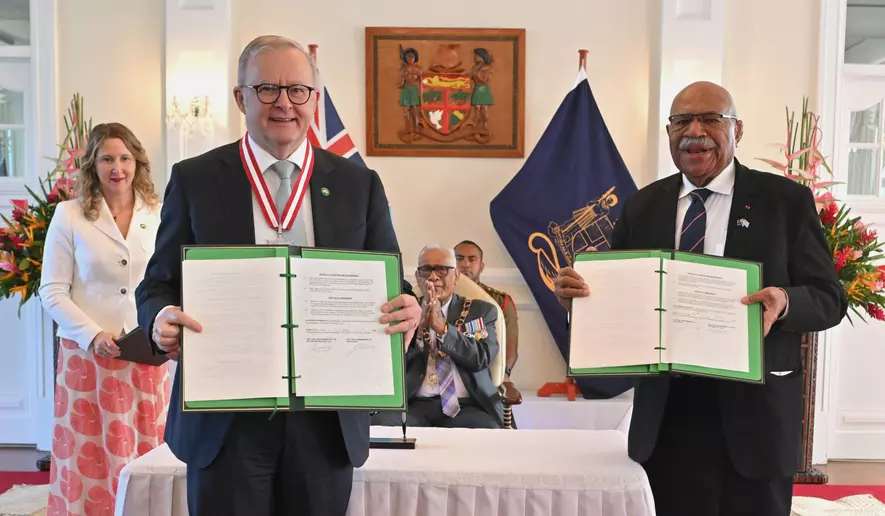
The pact, named the Ocean of Peace Alliance, makes Fiji Australia's fourth treaty ally, after the United States, New Zealand, and Papua New Guinea. It is the first alliance of any kind that Fiji has ever entered. Prime Minister Anthony Albanese, midway through a three-day swing through the Pacific, called the twin agreements signed Monday "one of the most significant endeavors Australia has ever undertaken" with any country.
What the Treaty Commits Them To
The core of the alliance is a promise to stand together under threat. Article 6 of the text holds that an armed attack on either party within the Pacific "would be dangerous to each other's peace and security," and that each would "act to meet the common danger, in accordance with its domestic processes." Article 5 requires the two governments to consult whenever a security development threatens the sovereignty, peace, or stability of either.
Albanese put it plainly at a joint news conference with Fijian Prime Minister Sitiveni Rabuka. "An attack on Fiji from an outside force would trigger Australia's full support for Fiji and for its sovereignty," he said. He described the mutual defense obligation as carrying no higher duty than coming to a partner's aid in a moment of need.
The language closely tracks the Pukpuk treaty Australia signed with Papua New Guinea last year, and the alliance is built to grow. By unanimous agreement, Australia and Fiji can invite other Pacific states to join, though Canberra has signaled it is focused for now on countries with standing militaries, meaning Tonga, Papua New Guinea, and New Zealand. New Zealand's government welcomed the pact, and Prime Minister Christopher Luxon said his country would be interested in signing on.
Alongside the defense treaty, the two signed the Vuvale Union, an economic and security agreement backed by more than 1 billion Australian dollars, roughly 690 million US dollars, in Australian investment over the next decade. Vuvale means "family" in Fijian. Rabuka called the day "a very defining moment," marking what he described as a significant elevation of the relationship. He framed his ambitions more broadly still, casting the Pacific not as the periphery of global affairs but as a region that should shape the norms of cooperation and collective security.
A Missile in the Water
The launch came just hours after the signing. China's People's Liberation Army Navy fired a long-range ballistic missile carrying a dummy warhead from a submarine into what a navy spokesman called "relevant high seas areas of the Pacific Ocean." Senior Captain Wang Xuemeng said the missile landed accurately within a predetermined zone and that the test was part of routine annual training, in line with international law and aimed at no particular country. Chinese state media identified it as likely a JuLang-3 submarine-launched missile. It was China's first such Pacific test in two years; the last, in September 2024, sent a missile some 11,500 kilometers into waters near French Polynesia.
The notification arrived with little warning. Chinese officials briefed regional governments, including Australia, New Zealand, and Japan, only hours ahead, and Japan said it received word 90 minutes before the launch. Foreign Minister Penny Wong, in Suva for the signing, said Australia had told Beijing it viewed the test as destabilizing, and that it fit a pattern of rapid Chinese military buildup lacking transparency about intent. Asked whether China had timed the launch to send a message, she declined to speculate. "I'll leave China to speak to its intent," she said.
New Zealand's foreign minister, Winston Peters, called the test unwelcome and concerning, noting it landed inside the South Pacific Nuclear Free Zone established under the Treaty of Rarotonga. Japan said it had urged Beijing to reconsider. China's foreign ministry spokeswoman, Mao Ning, asked that countries not overinterpret the launch.
Whether the two events were linked remains contested. Australian Defense Minister Richard Marles said he did not believe the test was retaliation for the treaty, but the circumstantial signals were hard to miss. The maritime intelligence firm Starboard tracked three Chinese satellite-tracking vessels across the Pacific, one of them, the Yuan Wang 5, berthed in Suva itself at the time of the launch. A Starboard analyst said the ship's presence in Fiji's capital during the very week of the signing "won't be lost on anyone." Marles said Australia had lodged formal protests in both Canberra and Beijing.
Why Fiji, Why Now
Fiji's turn toward Canberra marks a reversal. Under former Prime Minister Frank Bainimarama, the country drifted closer to Beijing, and analysts once worried it might host a permanent Chinese military presence. Rabuka, who took power in 2022, shut that door. "If they want to come, who would welcome them? Not Fiji," he said in 2025, adding that China understood as much.
For Fiji, the pact is not only about great-power rivalry. Rabuka pointed to a wave of transnational crime washing through the islands, drug trafficking that has fed an addiction crisis and a rising HIV epidemic, along with cyber threats. Graeme Smith, a China-in-the-Pacific expert at the Australian National University, said Fiji's most urgent worries are policing and health, not warships. "It's a whole transnational crime issue," he said. "People are dying."
Rabuka, for his part, played down any rupture with Beijing. He said he did not expect severe pushback and believed China would welcome the understanding. "It does not threaten Fiji's relationship with China nor Australia's relationship with China," he said. "Your enemies are not necessarily my enemies." Beijing's response was cooler. Mao warned Australia to respect the independence of island nations and to avoid harming the interests of any third party.
Part of a Wider Push
The Fiji treaty is the latest piece in a web of agreements Australia has assembled since 2022, when the Solomon Islands signed a secretive security pact with China that raised the specter of a Chinese naval base in the region. Since then Canberra has struck deals with Tuvalu, Nauru, Papua New Guinea, and, just last week, Vanuatu, whose Nakamal Agreement bars foreign military bases on its soil. Australia has described itself as locked in a "permanent state of contest" with China across the Pacific.
The diplomacy did not pause with Fiji. Albanese was set to fly Tuesday to the Solomon Islands to meet Prime Minister Matthew Wale, a longtime skeptic of the 2022 China deal who has floated the idea of a region-wide security pact and pledged to review the Beijing agreement. On Wednesday, Albanese was to host the leaders of Papua New Guinea and Tonga in Brisbane, the same day Australia's defense treaty with Papua New Guinea takes effect. One analyst noted a persistent gap in the strategy: under President Trump, Washington has paid little attention to the Pacific, leaving Australia to carry much of the weight. For now, Canberra has another ally and another treaty. Beijing has answered with a missile.
Author

We cover the world’s chaos so you don’t have to scroll twelve feeds to understand it.
Sign up for Atlas newsletters.
Stay up to date with curated collection of our top stories.