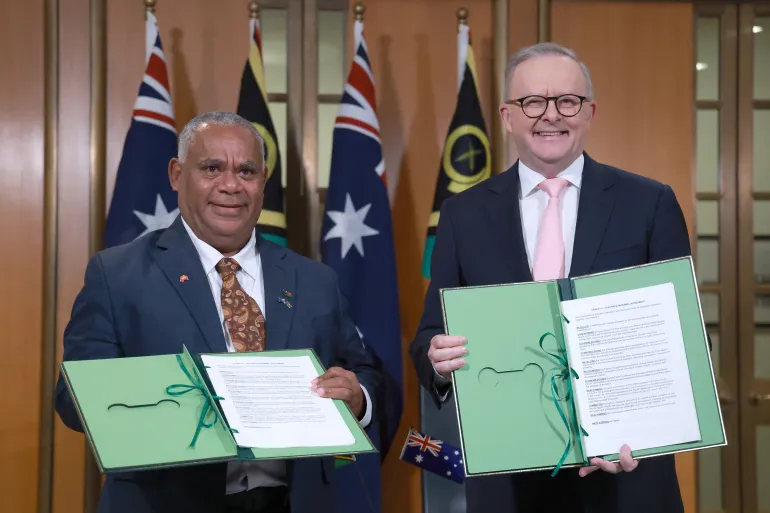
Australia and Vanuatu signed a long-delayed security and economic treaty in Canberra on Monday that bars any foreign military base on Vanuatu's soil, a deal Canberra has pursued for the better part of a year as it works to blunt China's growing reach into the South Pacific.
The Nakamal Agreement, signed by Prime Minister Anthony Albanese and his Vanuatu counterpart, Jotham Napat, lands nine months after Vanuatu walked away from an earlier draft. It locks in Australia as Vanuatu's preferred partner on policing and security, and it commits the island nation to keep its critical infrastructure free of militarization. Beijing, the unnamed subject of much of the deal, made plain it was watching.
What the Deal Does
The core of the agreement is a single line with large implications: Vanuatu will not allow its territory to be used for any foreign military base or infrastructure. Albanese framed it bluntly, telling reporters the pact provides certainty for Australia that there will be no foreign military base, and that the two countries had reached a balanced agreement protecting their security and sovereignty.
Napat, for his part, said Vanuatu had already passed legislation barring militarization of its critical infrastructure, and described the treaty as a reaffirmation of a partnership built on mutual respect and a shared vision for a stable Pacific. The text commits both governments to keep Vanuatu's infrastructure free from militarization, foreign interference, or unauthorized access.
The agreement also names Australia as Vanuatu's longstanding primary policing partner and commits Vanuatu to prioritize policing requests from members of the Pacific Islands Forum, the 18-member regional bloc that does not include China. The two sides agreed to expand cooperation on police training, maritime security, cybersecurity, intelligence sharing, and infrastructure. Vanuatu also agreed to turn first to Australia, New Zealand, or France in the event of a major natural disaster.
Why It Stalled, and What Changed
The deal nearly happened last September, then collapsed. Albanese was hours from flying to Port Vila for a signing ceremony when word came that Vanuatu had rejected the draft. Members of Napat's coalition feared the original terms, which restricted foreign investment in critical infrastructure, would choke off funding from other sources, China chief among them.
The version signed Monday softened that language. Rather than handing Australia veto power over outside investment, as the earlier draft had floated, the new text requires only that Vanuatu consult Canberra on any third-party engagement in its critical infrastructure. That distinction matters in a country where China is the largest external creditor.
Australia had pledged 500 million Australian dollars, about 345 million US dollars, over ten years under the original draft. Albanese said the cost of the final version would be disclosed in the government's budget update by December.
The China Factor
Vanuatu sits at the center of a contest between China and US-aligned powers for influence across the South Pacific, and the fingerprints of that rivalry are all over the agreement, even where China goes unnamed.
China's loans, routed through Chinese banks to Chinese contractors, financed much of Vanuatu's recent construction, including the presidential office complex, the parliament building, and stretches of the road network. Beijing also funded the expansion of a wharf in Luganville, the site of what was once the largest US military base in the South Pacific, fueling concern in Canberra and Washington that China was angling for a naval foothold. China and Vanuatu have said the wharf is for cruise ships. The Chinese navy has made repeated port calls, and since 2023 China has built policing ties with Vanuatu, donating drones, patrol boats, and vehicles.
Beijing responded to Monday's signing without naming a grievance but leaving little doubt about its view. Foreign Ministry spokesperson Guo Jiakun said cooperation between relevant countries and Pacific nations should contribute to regional stability rather than target any third party or serve as a tool for geopolitical rivalry. He added that China would continue to expand cooperation with Vanuatu according to the island nation's own wishes and needs.
Chinese state media went further, casting Western coverage of the deal as Cold War thinking. An analyst quoted by the Global Times argued that Pacific nations face existential threats from natural disasters and energy shortages, not from competition over military outposts, and that such assets are not areas where outside parties should impose investment limits under the banner of security.
A Pattern of Pacific Deals
The Vanuatu treaty is one of several Australia has signed or is negotiating with Pacific neighbors as it tries to box out Chinese security influence. The push follows the 2022 security pact between China and the Solomon Islands, which gave Chinese police a foothold there and rattled both Canberra and Washington. The new prime minister of the Solomon Islands has since said his government would review that secretive treaty.
Vanuatu, meanwhile, is not abandoning Beijing. Napat confirmed his government is pursuing a separate economic agreement with China, which he has described as a development cooperation deal rather than a security pact. He said that agreement, sometimes called the Namele Agreement, was awaiting clearance from Beijing and had not yet been signed, and he pledged transparency, saying there was nothing to hide and that Australia had cleared him to share the Nakamal text with China.
Analysts expect the tug-of-war to continue. James Batley, a former Australian diplomat in the region, noted that Vanuatu's long tradition of non-alignment means it will not simply cut ties with China, nor will China stop trying to chip away at Australian influence. For Napat's government, the balancing act is the point: securing Australian backing on security while keeping the door open to Chinese money for the ports, airports, and power lines its economy depends on. Whether that balance holds will depend on how the consultation provisions work in practice, and on how much friction emerges the next time Chinese investment meets Australia's strategic interests.
Author

We cover the world’s chaos so you don’t have to scroll twelve feeds to understand it.
Sign up for Atlas newsletters.
Stay up to date with curated collection of our top stories.