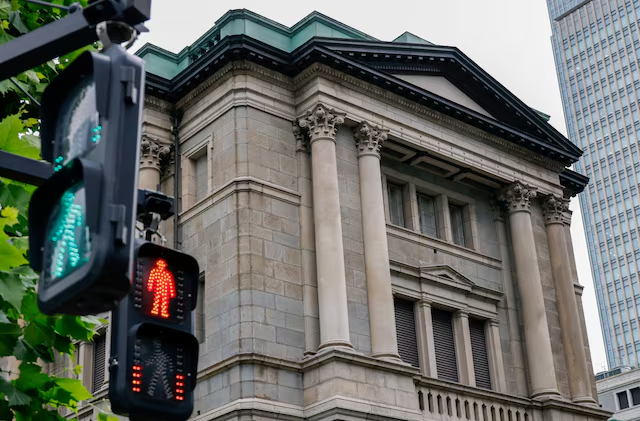
The Bank of Japan raised its benchmark interest rate to 1 percent on Tuesday, the highest level in more than three decades, pressing ahead with a campaign to tame inflation driven by the energy shock of the recent Middle East war.
The quarter-point increase, from 0.75 percent, lifts the short-term policy rate to a level last seen in 1995. It is the bank's first move since December and the fifth hike since it abandoned its negative interest rate policy in March 2024, a slow normalization after two decades in which borrowing costs sat near zero and prices barely moved.
The decision was widely anticipated. Money-market pricing had put the odds of a June increase at roughly 99 percent, and economists polled before the meeting had nearly all penciled it in. The board approved the hike by a 7-1 vote. Governor Kazuo Ueda missed the meeting and did not cast a ballot, undergoing a two-week course of treatment in the hospital for an infected liver cyst, with Deputy Governor Shinichi Uchida set to address reporters in his place.
An energy shock and a weak yen
The hike comes days after the United States and Iran reached an interim agreement to end their roughly three-month war and reopen the Strait of Hormuz, the passage that carries close to a fifth of the world's oil. The deal is due to be signed Friday in Switzerland, though officials and shippers have cautioned that traffic through the strait will take weeks to return to normal.
The war, which began February 28, and the closure of Hormuz sent energy prices sharply higher and rattled an economy that imported about 90 percent of its crude from the Middle East before the conflict. In its statement, the central bank said the risk of a sharp downturn from the conflict had eased, helped by government steps to cushion households from high fuel costs and by progress in lining up alternative energy supplies. The greater concern, it signaled, was prices: companies have been passing along higher oil costs to one another at what the bank called a relatively fast pace, a pattern that could push up the cost of a wide range of consumer goods.
That pressure is already visible upstream. Wholesale prices climbed 6.3 percent in May from a year earlier, the fastest in over three years. Consumer inflation has run cooler, at 1.4 percent in April, a fourth straight month below the bank's 2 percent target, though analysts note the soft readings owe much to government measures, including the removal of a gasoline tax and free high school tuition, that have artificially held the figure down.
Weighing heavily on the calculus was the yen. The currency has hovered around 160 to the dollar, a level markets treat as an intervention threshold, and Tokyo spent roughly 11.7 trillion yen, about $73 billion, last month trying to slow its slide. A weak yen raises the price of imports and broad inflation, and analysts argued that standing pat would have invited further depreciation. Intervening without raising rates, one Tokyo-based strategist said, is like tapping the brake while keeping a foot on the accelerator.
Dissent on the board and a cautious government
The lone dissent came from Toichiro Asada, who pushed to hold the rate at 0.75 percent, arguing that the threat to growth from the Middle East conflict outweighed the inflation risk. Asada joined the board in April as the first member selected under Prime Minister Sanae Takaichi, who has favored higher public spending and once played down the case for tighter policy.
Takaichi has not publicly criticized the bank's rate increases since taking office last year, even as her administration passed a supplementary budget of 3 trillion yen to shield households from rising energy bills. The tension between fiscal support and monetary tightening has surfaced inside the bank as well: three of its nine members had voted against holding rates steady at the prior meeting in April, a sign of the building case for action.
Bonds, markets, and the path ahead
Alongside the rate move, the bank set a timetable for its bond holdings. It will keep trimming purchases of Japanese government bonds by 200 billion yen each quarter through the first quarter of next year, then halt the taper from April 2027 and hold monthly purchases steady at 2 trillion yen. It also dropped its practice of conducting an annual review of the taper plan, while reserving the right to adjust the pace as needed.
Markets took the decision in stride. The Nikkei 225 rose as much as 1 percent to a record high above 70,000, the yen firmed slightly to about 160.2 per dollar, and the yield on the 10-year government bond ticked up to around 2.61 percent. With no proposal for a larger half-point move on the table, several analysts read the outcome as a signal that the bank intends to tighten gradually, roughly once every six months to a year. A Reuters survey of economists projected another increase, to 1.25 percent, in the fourth quarter, and some said the 1 percent mark itself, a psychologically important threshold, could prompt the bank to flag a second hike before year's end.
Part of a wider tightening
Japan's move landed in a crowded week for central banks. The European Central Bank and Bank Indonesia both raised rates last week, and attention now turns to the Federal Reserve, which is widely expected to hold steady on Wednesday at the first meeting chaired by Kevin Warsh, even as U.S. inflation has climbed to a three-year high and more investors anticipate that the Fed's next move could be a hike rather than a cut. The Reserve Bank of Australia held at 4.35 percent, and the Bank of England is also expected to stay put.
Even after Tuesday's increase, Japan's policy rate remains well below those of its peers, with the United States and Britain above 3 percent. One economist described the shift less as a one-off than as the early stage of a slow global realignment, with a long-deflationary economy finally moving back toward conventional policy. For now, the bank has made clear that, with the energy shock feeding through to prices and the yen still under strain, it sees more reason to keep moving than to wait.
Author

We cover the world’s chaos so you don’t have to scroll twelve feeds to understand it.
Sign up for Atlas newsletters.
Stay up to date with curated collection of our top stories.