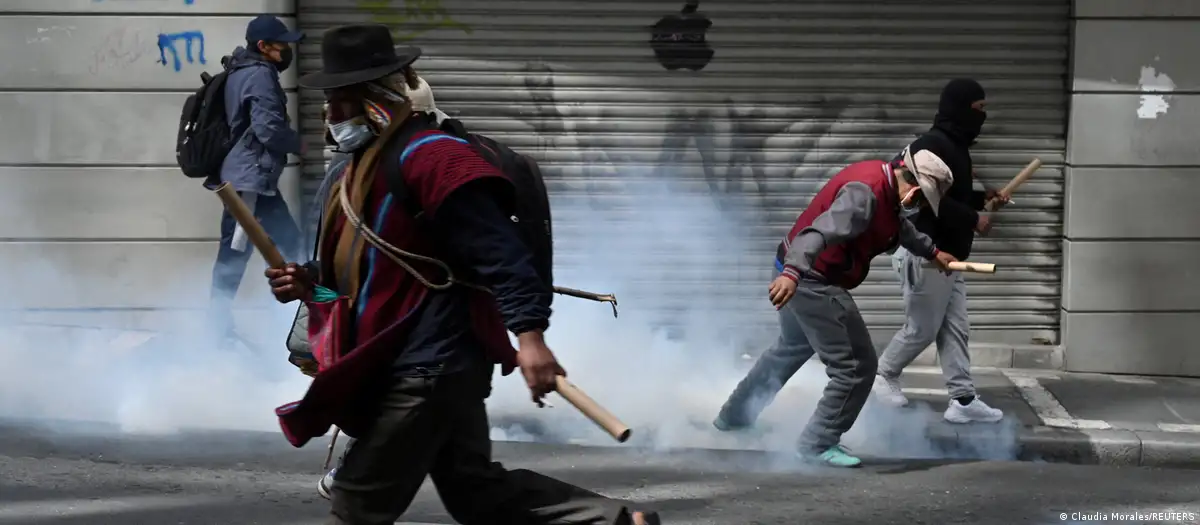
Thousands of Bolivians converged on La Paz on Monday in the most violent day yet of a nationwide protest movement demanding the resignation of center-right President Rodrigo Paz, who took office less than six months ago.
Farmers, miners, teachers, public sector workers, and Indigenous communities converged on the city after weeks of mobilizations over wage increases, economic instability, and moves to privatize state-owned companies. Riot police met them with tear gas at the edges of Plaza Murillo, the square that houses the presidential palace and Bolivia's parliament. Protesters hurled stones and small explosives in response.
Government spokesman José Luis Gálvez confirmed Paz remained inside the palace throughout the day under heavy police-military protection. A National Property Registry office was entered and stripped of computers, screens and furniture, with images released by the Interior Ministry. Local TV station Unitel reported more than 100 detentions nationwide. Authorities have not reported any injuries, but AFP observed at least two wounded protesters. TeleSUR said that at least four demonstrators were reportedly killed over the course of the unrest.
The Worst Economic Crisis in Forty Years
The protests are unfolding against the backdrop of what officials and economists describe as Bolivia's deepest economic crisis in four decades. Year-on-year inflation reached 14 percent in April, eroding purchasing power and deepening anger over rising living costs.
The government's foreign currency reserves have cratered, as exports from Bolivia have slowed down. Once a net energy exporter, in 2022, the dynamic switched, amid mismanagement and dwindling supplies. Since then, Bolivia has had to import fuel from abroad, exacerbating its economic crisis. Currently, many parts of the country have experienced long lines for fuel and shortages of basic supplies like food. Two weeks of road closures — spearheaded by the Bolivian Workers' Central, COB, peasant unions and miners — have emptied markets in La Paz and depleted vital hospital oxygen reserves.
Paz, who was elected in October, had campaigned on alleviating the economic stress. But since taking office, he has spurred outrage by ending a two-decade-old fuel subsidy and pushing to privatise state-owned companies. His election ended nearly two decades of governance by the Movement Toward Socialism (MAS), the party of former president Evo Morales.
The Land Law and the Fuel Decree
Two specific government actions lit the fuse. Fuel cuts were enacted directly by the president as an executive decree in December 2025, and then a land measure was passed by congress as a formal law in April 2026 which triggered the protests we are witnessing.
Law 1720 was a law that was put into effect on 10 April, which allowed titled small agricultural property to be voluntarily converted into medium property upon written request and a sworn declaration, making the land to be used as collateral for bank loans. Critics argued that the law perceived as a threat for farmers as Law 1720 also stripped its immunity from seizure and commodification of the farmers' land.
Protests has been occurring sporadically since January, but only flared up at the beginning of May. Initially triggered by farmers protesting against a law allowing land mortgage, the unrest began with roadblocks and marches across the country. 67 highways were blockaded around Bolivia leading to restricted domestic trade. Bolivia's Highway Administration, known as ABC, reported seeing more than 40 blockade points across six of the country's departments, or administrative regions, leaving Bolivia nearly cut off internally. More than 130 fuel tanker trucks remain stranded on highways, creating additional shortages of diesel and gasoline.
Following intense nationwide protests, President Rodrigo Paz signed a decree fully annulling the controversial land mortgaging law to protect rural and Indigenous territories. However, while the administration agreed to suspend and rewrite the broader austerity measures within the fuel decree, it refused to back down on the most contentious point: the elimination of fuel subsidies remains in place to combat the country's fiscal deficit.
Arrest Warrants and a Hard Line
Bolivia's government has ruled out declaring a state of emergency, despite escalating violence linked to nationwide protests that have left dozens injured and detained while causing multimillion-dollar losses through road blockades across the country. Presidential spokesman José Luis Gálvez and Government Minister Marco Antonio Oviedo said Tuesday imposing the constitutional measure would deepen social polarization.
The administration has instead leaned on the courts. The public prosecutor said Monday it was issuing an arrest warrant for the leader of the country's largest union COB, accusing him of terrorism and inciting crime. The warrant for COB secretary-general Mario Argollo is "in the hands of the general command of the Bolivian Police," Attorney General Roger Mariaca told a press conference.
This action is part of a larger crackdown: simultaneously, the Public Prosecutor's Office ordered the capture of farmer leader David Quispe Machaca, executive secretary of the Single Confederation of Peasant Workers of Bolivia (CSUTCB), along with leaders Juan Héctor Huacani Guachalla, Justino Apaza Callisaya, Winston Jemio Quispe Gutiérrez, and alternate senator Nilton Condori Alanoca.
"They will not subdue us in the struggle we have undertaken," Argollo said in a public statement. "They are trying to silence us as leaders with popular actions and criminal charges."
Over the weekend, as many as 3,500 soldiers and police were deployed as part of the operation that began in the early hours of Saturday. Around 57 people were arrested, according to the citizens' rights ombudsman's office. The US State Department said Sunday that it supported Paz's efforts to "restore order."
The Morales Factor
The movement has drawn in supporters of Evo Morales, the leftist former president who governed Bolivia from 2006 to 2019. Supporters of former socialist president Evo Morales, who was in power from 2006 to 2019, arrived in La Paz on Monday after marching for seven days from Oruro, about 180 kilometers south of the capital.
Former president Evo Morales, who ruled Bolivia from 2006 to 2019, was accused by some allies of Paz of encouraging the protests. Economy Minister José Gabriel Espinoza has said the government remains "open to dialogue" with the protesters but has cast some demonstrators as political operatives seeking to clear a return path for Morales, who is wanted on a separate arrest order tied to a long-running human trafficking case.
How long Paz can ride out the standoff is unclear. The COB has called an indefinite strike, road closures remain in place across much of the country, and the underlying conditions that drove people into the streets — the dollar shortage, the fuel shortage, and inflation running in the double digits — are not going away in the near term. Paz convened an emergency cabinet meeting last week but has not signaled any retreat on the fuel decree or his broader austerity agenda.
Author

We cover the world’s chaos so you don’t have to scroll twelve feeds to understand it.
Sign up for Atlas newsletters.
Stay up to date with curated collection of our top stories.